
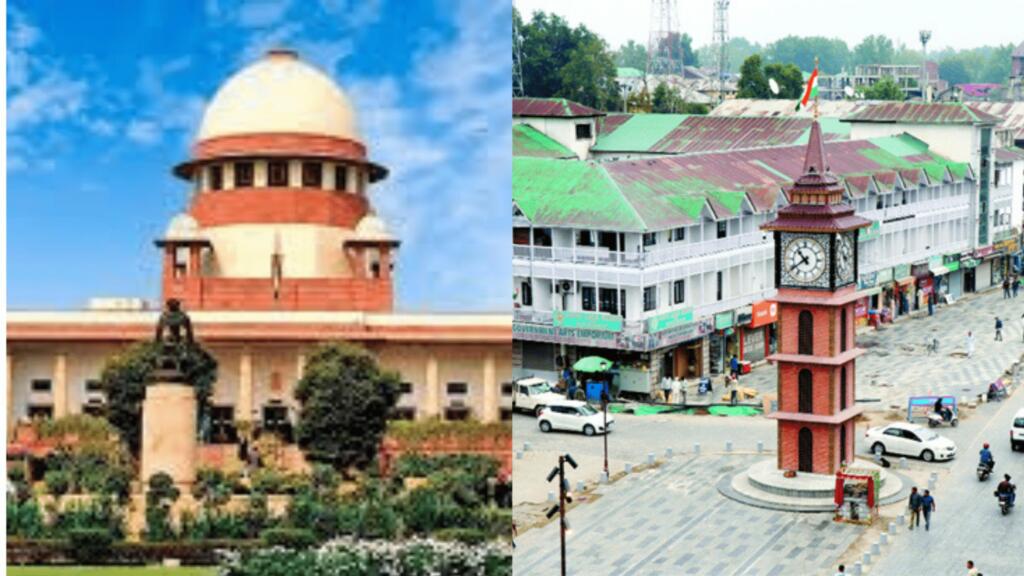
The Supreme Court on Thursday sent a clear message while hearing a plea on the restoration of statehood to Jammu and Kashmir the ground situation cannot be ignored, especially incidents like the recent Pahalgam attack. Chief Justice of India (CJI) BR Gavai said, “You also have to take into consideration the ground realities; you cannot ignore what has happened in Pahalgam.” The matter has now been adjourned for eight weeks.
Hearing on Statehood Restoration
A bench comprising CJI BR Gavai and Justice K Vinod Chandran was hearing a plea filed by college teacher Zahoor Ahmed Bhat and activist Khurshid Ahmad Malik. The petitioners argued that the continued denial of statehood was harming citizens’ rights and undermining federalism, a key feature of the Constitution’s basic structure. They stressed that conducting Assembly elections before restoring statehood would be a violation of constitutional principles.
Solicitor General Mehta, representing the Centre, urged the court to allow eight weeks to seek instructions, reiterating that statehood would be restored after elections. He described Jammu and Kashmir as a unique case that required careful handling.
Background of Article 370 Abrogation
On August 5, 2019, the Union government revoked Article 370, which had granted special status to Jammu and Kashmir, and bifurcated the state into two Union Territories Jammu & Kashmir with a legislative assembly, and Ladakh without one. The Supreme Court has previously upheld this decision but also asked the Centre to restore J&K’s statehood at the earliest possible time.
The move had been a watershed moment in Indian politics, drawing international attention and triggering protests in the Valley. Several political parties, including the National Conference, have consistently demanded the restoration of both statehood and special status.
Political Reactions and Current Governance
In last year’s Assembly elections the first in over a decade the National Conference-Congress alliance came to power, with Omar Abdullah as Chief Minister. Abdullah has been vocal about restoring statehood, saying it is essential for ensuring the rights and dignity of the people of Jammu and Kashmir.
The Centre, however, maintains that the timing for such a move must depend on the security situation and broader regional stability. Top ministers have repeatedly said statehood will be restored “when the time is right.”
Pahalgam Attack and Security Concerns
The court’s remarks gain significance in the wake of the April 22 Pahalgam attack, where 25 tourists targeted for being Hindus were killed by terrorists from The Resistance Front (TRF), an offshoot of Lashkar-e-Taiba. A local pony operator who tried to intervene was also killed.
The attack reignited tensions between India and Pakistan. In retaliation, Indian forces carried out air strikes on terror camps in Pakistan-occupied Kashmir and Pakistan’s Punjab, shot down drones and missiles, and destroyed Pakistani airbases. The perpetrators were later tracked down and killed near Srinagar.
Waiting for the Right Time or Justice Delayed?
The Supreme Court’s insistence on considering “ground realities” reflects the tightrope between security concerns and democratic rights in Jammu and Kashmir. The government argues that the timing of statehood restoration must align with stability in the region. With the matter now adjourned for eight weeks, the debate over J&K’s political future remains unresolved but the court’s sharp words have made one thing clear: security incidents like Pahalgam cannot be brushed aside in shaping the region’s destiny.