
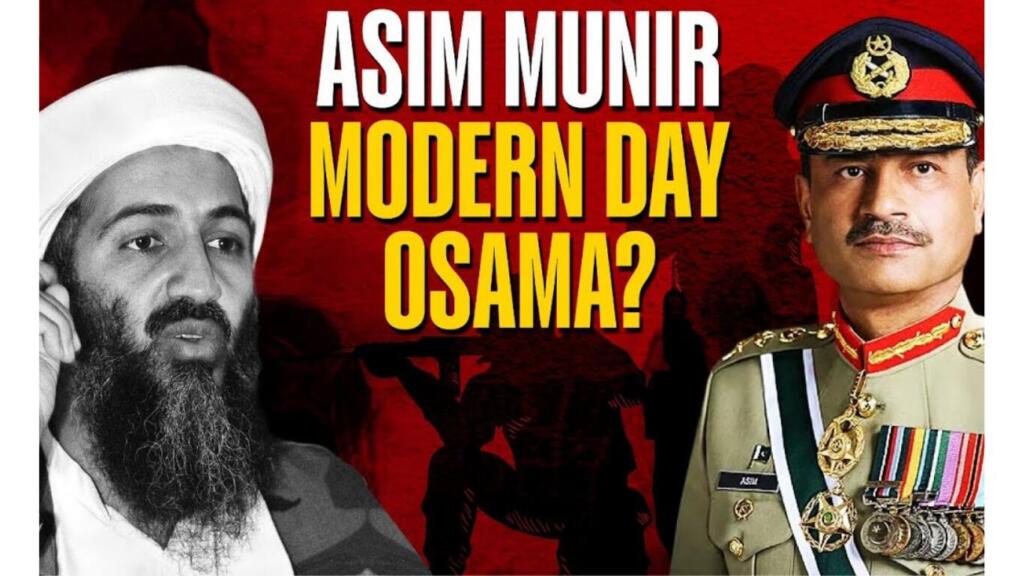
Pakistan’s military establishment has long been accused of harbouring terrorists, destabilising its neighbours, and holding the world hostage with its nuclear arsenal. But the latest comments from its army chief, Asim Munir, have ignited global outrage and confirmed to many why Islamabad is often called the “capital of terrorism.” Speaking from American soil, Munir issued a chilling threat: if Pakistan were to “go down,” it would “take half the world down” with it.
Former Pentagon official Michael Rubin wasted no time in denouncing Munir’s nuclear sabre-rattling, calling Pakistan a “rogue state” and labelling its army chief nothing less than “Osama bin Laden in a suit.” His words have struck a chord internationally, as world leaders grapple with a nuclear-armed nation openly threatening mass destruction.
Nuclear Threats on US Soil
The remarks, reportedly made during a dinner in Tampa, Florida, in the presence of US military officials, mark the first known instance of a Pakistani leader issuing nuclear war threats against a third country from American territory. “We are a nuclear nation. If we think we are going down, we’ll take half the world down with us,” Munir allegedly declared. He further warned that any Indian infrastructure on the Indus River would be destroyed with “10 missiles.”
India’s Foreign Ministry condemned the comments, noting that “nuclear sabre-rattling is Pakistan’s stock-in-trade” and expressing regret that such rhetoric was delivered from the soil of a friendly nation.
Rubin, speaking to ANI, called the threats “completely unacceptable” and warned that Pakistan’s nuclear posturing could give cover to terrorist groups seeking to “go rogue” with nuclear weapons. He stressed that Pakistan was not a normal diplomatic challenge but a dangerous ideological one.
From Bin Laden to ISIS: A Pattern of Extremism
Rubin’s assessment went beyond Munir’s remarks, drawing parallels between the Pakistan Army’s mindset and that of global terror groups. “Asim Munir is Osama bin Laden in a suit,” Rubin said, adding that his rhetoric was “reminiscent of what we’ve heard from the Islamic State.”
He questioned Pakistan’s ability to behave as a responsible state and proposed that the international community consider a “managed decline” of the country. This could include recognising independence movements in regions like Balochistan and even a future military operation to secure Pakistan’s nuclear arsenal.
Rubin urged Washington to strip Pakistan of its status as a major non-NATO ally, designate it as a state sponsor of terrorism, and remove it from the US Central Command framework. “Asim Munir should be persona non grata in the USA and never get an American visa,” he insisted.
Why Start from India’s East?
Perhaps the most provocative part of Munir’s speech was his vow to “start from India’s East” in the event of war. He indirectly suggested that the resource-rich northeastern states of India would be the first target before moving westwards. The statement has raised serious questions about whether Munir’s rhetoric hints at coordination with China a close ally of Pakistan and a country with its own territorial disputes with India in the east.
Strategic analysts point out that Pakistan does not possess the logistical capability to launch and sustain a ground offensive across the breadth of India to reach its eastern frontier. This raises concerns that Munir’s threats are meant to psychologically unnerve India and signal a wider coalition strategy involving Beijing.
On the Indus Waters Treaty, Munir’s threats to obliterate Indian infrastructure further underscore Pakistan’s willingness to weaponise natural resources as a means of coercion.
A Dangerous Cocktail of Arrogance and Insecurity
In an ironic moment, Munir admitted Pakistan’s inferiority to India by comparing New Delhi to a “shiny Mercedes” and Islamabad to a “dump truck full of gravel.” His crude analogy attempted to portray Pakistan as a blunt-force equaliser, but instead highlighted a deep-seated insecurity masked by reckless nuclear bravado.
The Pakistan Army Chief’s posturing mixing religious overtones, terror references, and threats of annihilation mirrors the dangerous fusion of ideology and militarism that has kept South Asia on edge for decades.
The World Cannot Ignore Pakistan’s Nuclear Blackmail
Michael Rubin’s blistering comparison of Asim Munir to “Osama bin Laden in a suit” should be a wake-up call to the global community. A nuclear-armed nation that routinely harbours terrorists, threatens its neighbours, and undermines global security cannot be indulged as a normal state actor. Pakistan’s military leadership thrives on instability, and Munir’s rhetoric from US soil marks an escalation that cannot go unanswered. If the world continues to turn a blind eye, it risks allowing a “rogue state” armed with nuclear weapons and extremist ideology to dictate the terms of peace and war in one of the most volatile regions on earth.