
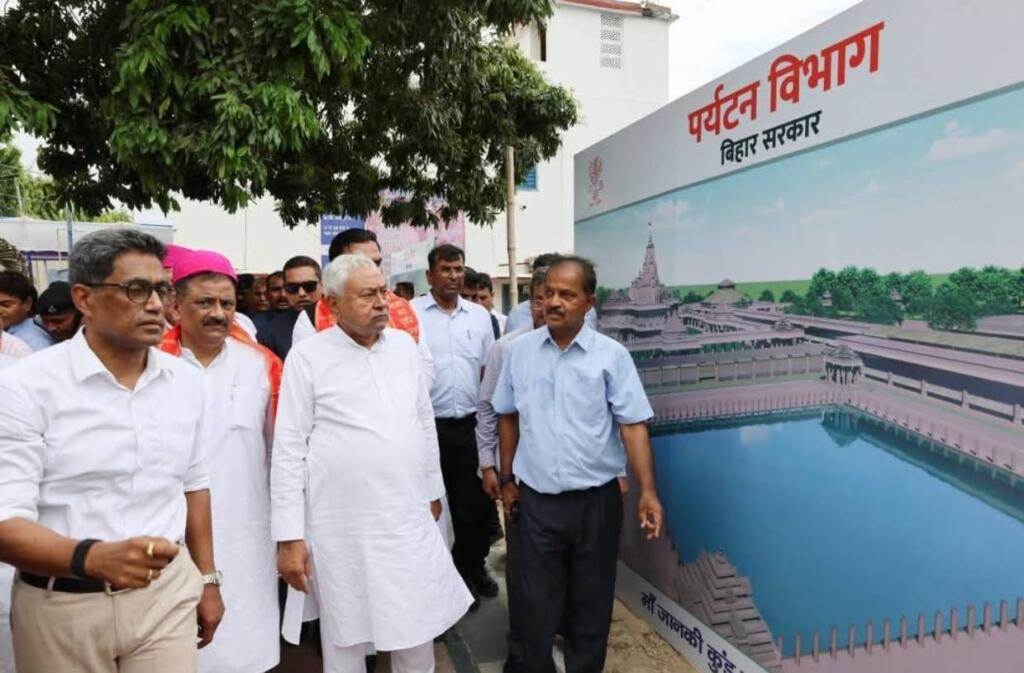
The land of Mithila, where Punaura Dham is located, is not just a geographical region but a cradle of ancient Indian civilization, spirituality, and culture. For centuries, however, while Ayodhya’s prominence remained in the public consciousness, Mithila’s spiritual heart- Punaura Dham did not receive the recognition it deserved. But now, as the foundation of a grand Janaki temple is about to be laid, Mithila’s cultural and spiritual identity is finally rising to its rightful glory.
A major religious and cultural milestone is set to unfold as Union Home Minister Amit Shah and Bihar Chief Minister Nitish Kumar will lay the foundation stone of the grand Janaki Temple at Punaura Dham in Sitamarhi on August 8. This historic event will mark the beginning of an ambitious project aimed at restoring and revitalizing the revered birthplace of Goddess Sita.
Three-Day Celebration Planned
The foundation stone laying ceremony will be celebrated as a three-day festival. The event is expected to witness the participation of lakhs of devotees, along with prominent saints and political leaders. The atmosphere in Sitamarhi is already charged with spiritual fervor as preparations are underway in full swing. Devotees are being invited through a traditional campaign involving sacred yellow rice grains (Akshat) and Tulsi leaves, both door-to-door and in public spaces across the city.


To add to the sanctity of the occasion, holy water from 11 sacred rivers including the Ganga, Yamuna, Bhagirathi, Alaknanda, Mandakini, Saraswati, and Saryu will be used during the foundation ceremony.
Deepotsav and Illumination of the Temple Complex
A grand festival of lights ‘Deepotsav’ has also been planned for the evening of the ceremony. The temple and the surrounding Sitakund complex will be illuminated with 51,000 oil lamps. Organizers are encouraging attendees to bring lamps to participate in the celebrations and collectively light up the sacred site.
The Bihar Cabinet approved a comprehensive development plan worth Rs 882.87 crore on July 1, 2025, for Punaura Dham. Of this, Rs 137 crore is allocated for the construction of the Janaki temple itself, and Rs 728 crore will be invested in developing tourism infrastructure. An additional Rs 16.62 crore has been set aside for the site’s maintenance over the next decade.
Under the plan, 50 acres of land will be acquired for the temple complex, which will feature a grand temple built in traditional architectural style, rest houses, an entrance gate, Yagyashala, Bhojanalaya (community kitchen), meditation centers, and discourse halls.
In addition to spiritual structures, the site will host museums, Smriti Dwar (memorial gateways), memorial buildings, landscaped gardens, fountains, and water reservoirs. Special attractions like Sita Vatika and Lav-Kush Vatika will also be developed to highlight the divine legacy of Mata Sita and her sons.
To enhance accessibility and convenience for pilgrims, a dedicated bus terminal will be constructed, along with wide roads, modern parking facilities, footpaths, and street lighting. Safety and information needs will be addressed through digital information centers and CCTV surveillance across the complex.
The development is expected to significantly boost tourism and generate employment in the region, transforming Sitamarhi into a major spiritual and cultural hub.
Architectural Grandeur Inspired by Ram Mandir
The Janaki temple at Punaura Dham will be constructed under the guidance of Ashish Sompura, the architect behind the Ram Mandir in Ayodhya. The same company responsible for Ayodhya’s temple design has been roped in for this project.
The new temple, standing at a height of 151 feet, will be built using red sandstone from Bansi Paharpur in Rajasthan, renowned for its durability and elegance. Sompura has emphasized that every effort is being made to ensure that the temple is as architecturally magnificent and spiritually enduring as the Ram Mandir.
Historical and Spiritual Significance
Punaura Dham is believed to be the birthplace of Goddess Sita, also known as Bhumiputri or Bhusuta, as she is said to have emerged from the Earth while King Janak was ploughing a field to invoke rain. The pond where she appeared, known as Janaki Kund, lies south of the current temple and holds deep mythological importance.
Despite its significance, the site remained neglected for decades. While Ayodhya saw years of legal battles before the construction of Ram Mandir, Punaura Dham, despite facing no disputes, suffered from governmental indifference. This is now changing under CM Nitish Kumar’s leadership, who has taken personal interest in the site’s development. Frequent visits, including a recent one on July 26 with Deputy CM Samrat Chaudhary, reflect his commitment to the project.
With the temple’s foundation now set to be laid, the long-overdue recognition of Mithila’s sacred heritage is finally materializing. The Janaki temple at Punaura Dham is poised to become not just a grand center of worship, but a proud symbol of Bihar’s rich spiritual and cultural legacy.