
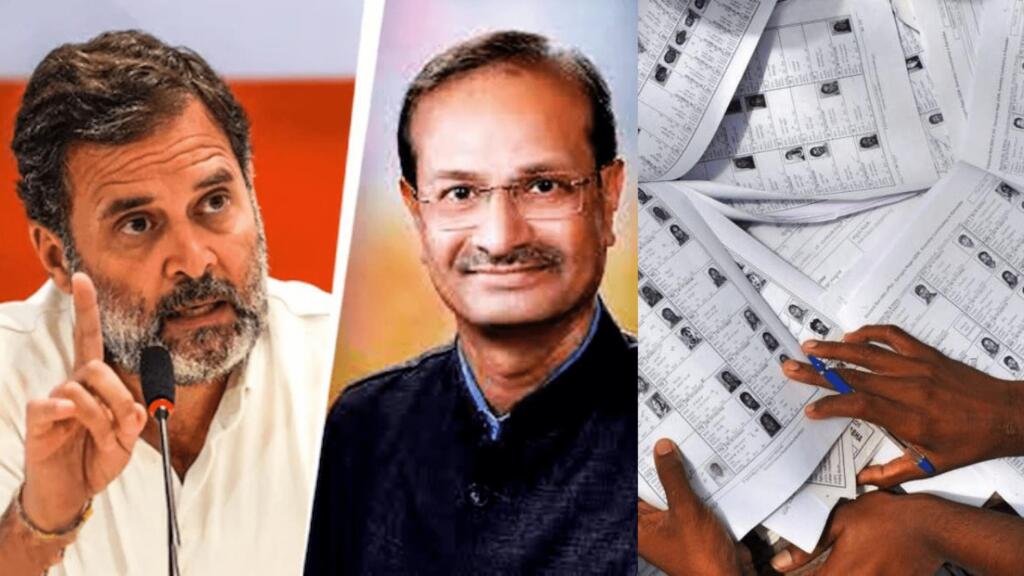
A major controversy has erupted after psephologist Sanjay Kumar of the Centre for the Study of Developing Societies (CSDS) admitted to errors in analyzing voter data for the recent Maharashtra elections. His initial claims of sharp voter additions and deletions across several constituencies fueled allegations of electoral fraud by the Congress, which latched on to his findings to attack the Election Commission of India (ECI) and the ruling BJP. However, Kumar later deleted his posts and issued an apology, admitting his team had misread the data.
The fallout has been swift. The Indian Council of Social Science Research (ICSSR), an autonomous body under the Union Ministry of Education, has announced it will issue a show-cause notice to CSDS over what it calls “data manipulation” and an “attempt to create a narrative” against the Election Commission.
ICSSR’s Hard-Hitting Response
In a strongly worded post on X, ICSSR said it had taken serious cognizance of the matter. The research body accused CSDS of violating Grant-in-Aid rules by publishing “biased interpretations” of the ECI’s Summary Revision (SIR) exercise and claimed the institute had undermined the sanctity of India’s electoral process.
“It has come to the notice of ICSSR that an individual holding a responsible position at CSDS has made media statements that had to be retracted subsequently citing glitches in data analysis regarding elections in Maharashtra. Further, the institute has published media stories based on biased interpretation of the SIR exercise by the Election Commission of India,” the statement said.
Emphasizing its faith in the electoral system, ICSSR reiterated that the Election Commission has conducted free and fair elections for decades, upholding India’s democratic credentials. The body warned that manipulation of data not only misleads the public but also damages trust in democratic institutions.
The Claims and the Retraction
Sanjay Kumar, a professor and co-director of the Lokniti programme at CSDS, had initially claimed massive swings in voter rolls in key Maharashtra constituencies. According to him, the Nashik West and Hingna Assembly seats saw a voter increase of 47% and 43% respectively, while Ramtek and Devlali recorded decreases of 38% and 36%.
These figures, if true, would have been extraordinary—and the Congress seized the opportunity to accuse the BJP and the Election Commission of manipulating electoral rolls. Top Congress leaders amplified Kumar’s findings across social media, using them to bolster their “vote fraud” campaign.
But the narrative collapsed when Kumar deleted his tweets and publicly apologized.
“I sincerely apologize for the tweets posted regarding Maharashtra elections. Error occurred while comparing data of 2024 LS and 2024 AS. The data in row was misread by our data team. The tweet has since been removed. I had no intention of dispersing any form of misinformation,” he said.
Political Reactions: BJP and Congress Trade Blows
The BJP quickly went on the offensive. Amit Malviya, the party’s IT cell head, said Rahul Gandhi and the Congress owed the nation an apology.
“The institution Rahul Gandhi relied on to make his allegations has now admitted that its figures were wrong. Where does this leave Rahul Gandhi and the Congress, which brazenly targeted the Election Commission and went so far as to brand genuine voters as fake? Shameful,” Malviya said.
The Congress, however, refused to backtrack. Party spokesperson Sujata Paul told NDTV that CSDS was just one of the many sources the party had relied upon.
“As far as we are concerned, we might have taken up this data, but we have also corroborated it with evidence that we have got from our sources, our workers, and the entire opposition that was fighting the elections together in Maharashtra. The CSDS data was just used as additional evidence. And why he (Sanjay Kumar) apologised, that is his problem, not ours,” she said.
This defiant stance suggests the Congress intends to continue its attack on the BJP and ECI, even as the credibility of its “vote fraud” narrative takes a hit.
A Battle of Narratives and Credibility
The episode has raised larger questions about the role of research institutions, media amplification, and political opportunism in shaping public perception. The ICSSR’s decision to issue a show-cause notice to CSDS underscores the seriousness with which the government views attempts to undermine trust in the Election Commission.
At the same time, the incident highlights the risks of political parties weaponizing unverified data to score points. While Congress insists its case rests on broader evidence, its heavy reliance on CSDS’s flawed analysis has weakened its credibility. For the BJP, the retraction has provided an opportunity to accuse its rivals of spreading “fake narratives.”
Protecting Democratic Trust
Ultimately, the controversy reflects the high stakes surrounding elections in India. With millions of voters and a robust democratic framework, the integrity of data and analysis is crucial. As the ICSSR takes action against CSDS, the episode serves as a reminder that facts must be verified before they become political ammunition—and that trust in institutions is too valuable to be undermined by haste or bias.