
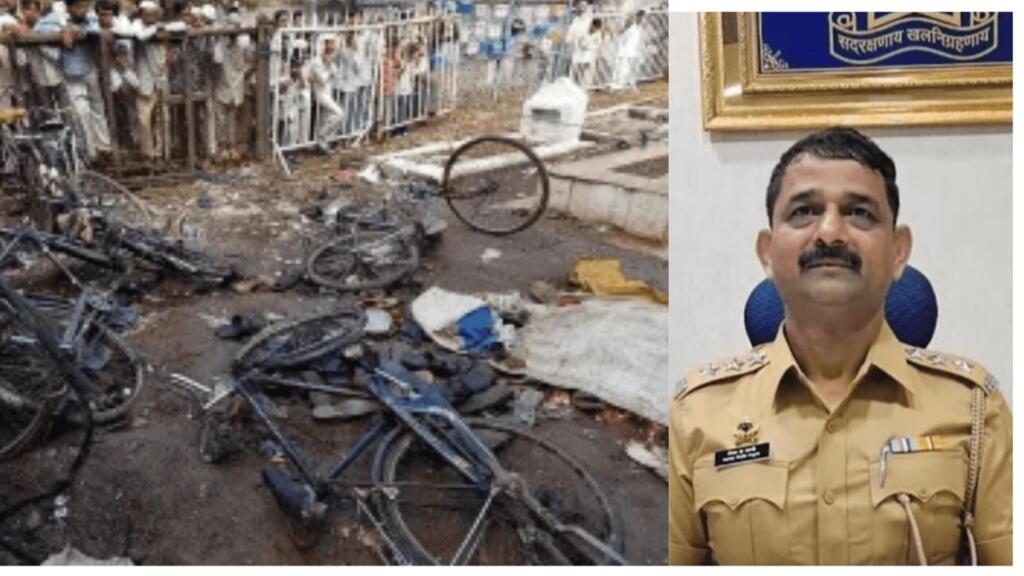
In a dramatic turn in the 2008 Malegaon blast case, a special NIA court in Mumbai delivered a damning verdict that not only acquitted all seven accused, including Sadhvi Pragya Singh Thakur and Lt. Colonel Shrikant Prasad Purohit, but also exposed serious irregularities in the original investigation by the Maharashtra Anti-Terrorism Squad (ATS). Most notably, the court ordered an inquiry against then-API and now ACP Shekhar Bagde for allegedly planting evidence to frame the accused. The ruling has severely dented the credibility of the “saffron terror” theory pushed for over a decade and raises grave questions about the motivations behind the original probe.
Special Judge A.K. Lahoti, who presided over the case, flagged the conduct of the ATS and specifically questioned Bagde’s suspicious visit to the residence of one of the accused, Sudhakar Chaturvedi, when he was not present. According to the court, the NIA’s own investigation revealed through testimonies of Army officers that Bagde had entered Chaturvedi’s residence without authorization and planted RDX to falsely implicate him. The entire prosecution case now stands exposed as a fabricated narrative, with the court ruling that there was no cogent evidence to sustain any of the charges against the accused.
ATS Officer Accused of Evidence Planting
The court’s ruling referenced specific depositions by two Army officers who were witnesses during the NIA’s re-examination. They testified that Bagde had secretly entered Chaturvedi’s house on November 3, 2008, and left behind traces of RDX. Furthermore, Bagde reportedly instructed the Army personnel not to disclose his visit to anyone. Days later, an ATS team conducted a so-called “raid” at the same location and conveniently discovered the RDX traces using cotton swabs — a sequence of events the court found deeply suspicious.
This discovery formed one of the key pieces of evidence used by the ATS to build its case against Chaturvedi and Col Purohit. However, the NIA’s inquiry contradicted the ATS version, suggesting that the evidence had been planted. The court stated that the ATS had failed to provide any plausible explanation for Bagde’s unauthorized entry or the subsequent discovery of RDX. As a result, it concluded that there is a high likelihood of deliberate evidence fabrication.
Forgery of Medical Records and Mishandling of Evidence
Beyond the alleged planting of explosives, the court also raised serious concerns about the authenticity of medical records used in the prosecution’s case. It found that several medical certificates claiming to document injuries sustained by bomb blast victims were issued by unlicensed medical practitioners. Some certificates were allegedly altered upon the request of ATS officials. The judge refused to accept these documents as valid evidence and directed authorities to launch an investigation into the suspected forgery and misuse of medical documentation.
Even more troubling was the court’s finding that basic investigative procedures were ignored. For instance, despite claims that explosives were stored at Col Purohit’s residence, there was no sketch prepared of the alleged storage room. Forensic samples, which should have served as key evidence, were found to be contaminated. The ATS failed to justify these lapses, further weakening their already crumbling case.
No Proof of Motorcycle Link, Abhinav Bharat Allegation Falls Flat
One of the original pillars of the prosecution’s case was that the motorcycle used in the Malegaon blast belonged to Sadhvi Pragya Singh Thakur. However, the court noted that she had renounced material life and taken diksha as a sadhvi two years prior to the blast. The prosecution failed to establish her ownership or usage of the motorcycle during the relevant period. Similarly, the alleged link between Lt Col Purohit and the supply of RDX remained unproven, with the court highlighting that no solid evidence tied him to manufacturing or transporting explosives.
Another major claim — that both Thakur and Purohit had founded a right-wing group called Abhinav Bharat and used its funds for terror activities — was rejected outright. The court found no financial records, witness testimonies, or other evidence to support this narrative. The “saffron terror” theory, it appears, was built more on political convenience than forensic fact.
Judiciary Exposes Fabrication; Saffron Terror Theory in Tatters
The special court’s judgment — extending over a thousand pages — has not only acquitted the accused but also exposed a chilling saga of misused power, planted evidence, and politically loaded narratives. With the Supreme Court having earlier flagged similar concerns in 2017 while granting bail to Lt Col Purohit, the current ruling further vindicates those who maintained that the Malegaon case was manipulated to push a fabricated “saffron terror” agenda.
A copy of the judgment has been sent to the DGP Maharashtra, DG ATS, and DG NIA, with strong recommendations for an internal probe. What began as an investigation into a tragic blast has now evolved into a trial of the investigators themselves. If the inquiry against ACP Shekhar Bagde proceeds in full seriousness, it could unearth one of the biggest instances of misuse of anti-terror laws in India’s history.