













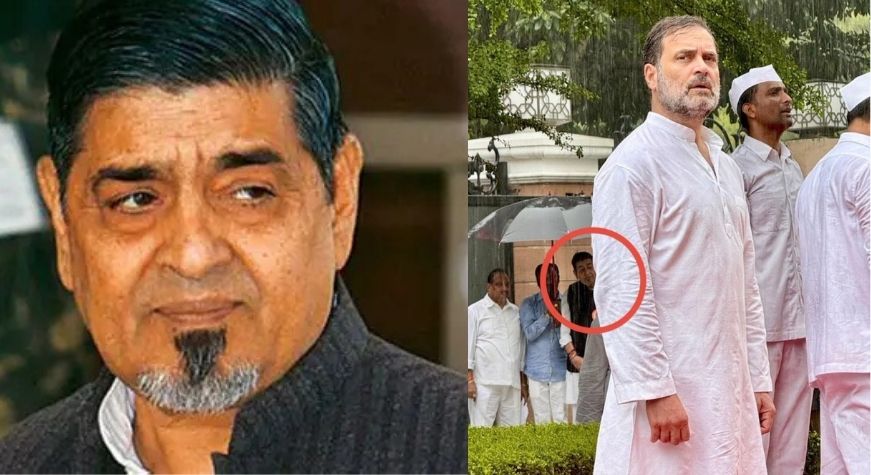
A major political storm broke out on Independence Day after senior Congress leader and 1984 anti-Sikh riots accused Jagdish Tytler was seen standing behind Rahul Gandhi at the Congress headquarters in Delhi during the national flag hoisting ceremony.
The optics of Tytler’s presence, almost four decades after one of India’s darkest chapters triggered a sharp attack from the Bharatiya Janata Party (BJP), which accused the Gandhi family of remaining “unapologetic” about the massacre of Sikhs.
BJP’s Scathing Criticism
Sharing a photograph of Rahul Gandhi at the Congress HQ with Tytler circled in red in the background, BJP IT cell head Amit Malviya posted on X:
“Jagdish Tytler, the man who unleashed genocide on Sikhs at Rajiv Gandhi’s behest, is once again seen alongside Rahul Gandhi at the Congress HQ. Some stains don’t wash away, no matter how much time passes. The Gandhis are unapologetic too.”
BJP spokesperson Radhika Khera went further, attacking Rahul Gandhi for skipping the official Red Fort Independence Day event and instead hoisting the tricolour at Indira Bhawan. She wrote:
“Even on the day of patriotism, the ‘prince’ stands with a rioter. This is the true face of Congress: a legacy of conspiracy and treachery against the nation.”
The BJP leaders alleged that Tytler’s presence was not accidental but symptomatic of the Congress party’s refusal to acknowledge or atone for the bloodshed of 1984, when thousands of Sikhs were killed in the aftermath of Prime Minister Indira Gandhi’s assassination.
The Congress was quick to hit back. Spokesperson Shama Mohammad defended the party, stressing that Tytler has never been convicted, and accused the BJP of hypocrisy.
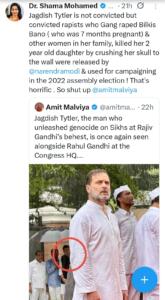
She drew attention to the Bilkis Bano case, where 11 men convicted of gang raping a pregnant woman and murdering her family members during the 2002 Gujarat riots were released by the Gujarat government in 2022 and later seen campaigning for the BJP.
Shama Mohammad wrote:
“Jagdish Tytler is not convicted but convicted rapists who gang-raped Bilkis Bano and killed her 2-year-old daughter were released by Narendra Modi and used for campaigning. That’s horrific. So shut up Amit Malviya.”
The 1984 Anti- Sikh Riots
The controversy is especially sensitive given that Tytler has been under the scanner for nearly four decades.
The CBI chargesheet filed in May 2023 accused him of “inciting, instigating and provoking the mob” near the Pul Bangash Gurudwara in Delhi on November 1, 1984.
According to eyewitness accounts cited in the chargesheet, Tytler allegedly arrived in his car and provoked the mob by saying: “Kill the Sikhs, they have killed our mother.”
The mob then attacked the gurdwara, set it ablaze, looted nearby shops, and killed three people.
An affidavit filed before the Nanavati Commission claimed that Tytler had privately complained that “only nominal killing of Sikhs” had occurred in his constituency compared to other areas, and that he had promised large-scale violence but was “let down.”
The riots overall left at least 3,000 Sikhs dead in Delhi alone, with independent estimates putting the national toll closer to 8,000. Survivors and rights groups have consistently accused Tytler of orchestrating attacks, though he has repeatedly denied any involvement.
Analysts believe the optics of Tytler’s presence alongside Rahul Gandhi could damage Congress’ efforts to reach out to Sikh voters, particularly in Punjab where memories of 1984 remain raw and painful.
While Congress insiders maintain that Tytler’s attendance at party functions is routine and should not be viewed as an endorsement of the allegations, critics argue that his visibility undermines the party’s moral authority and provides ammunition to the BJP.
The episode underscores how the legacy of 1984 anti-Sikh riots continue to haunt Indian politics, shaping narratives and deepening fault lines even on a day meant to unite the country in celebration of independence.