
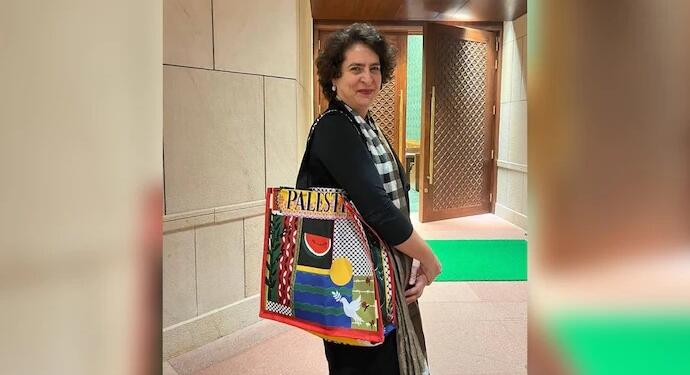
Congress Leader Priyanka Gandhi recently took to social media to express grief over death of Al Jazeera journalists in Gaza. On August 11, 2025, Priyanka wrote on X (formerly Twitter) to condemn the killing of journalists. Her message was unequivocal:
“The cold-blooded murder of five Al Jazeera journalists is yet another heinous crime committed on Palestinian soil… The Israeli state is committing genocide. It has murdered over 60,000 people, 18,430 of whom were children. It has starved hundreds to death including many children and is threatening to starve millions.” She Wrote “Enabling these crimes by silence and inaction is a crime in itself. It is shameful that the Indian Government stands silent as Israel unleashes this devastation on the people of Palestine.”
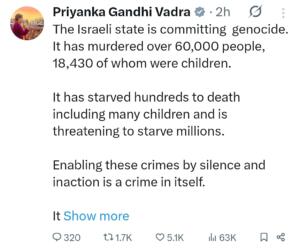

While Gandhi’s statement was seen by some as a display of humanitarian concern, it has also drawn sharp criticism, especially for what many view as a pattern of selective empathy.
Israeli Envoy Terms it ‘Shameful Deceit’
Priyanka Gandhi’s comments on Israel saying enabling such action through silence and inaction is a ‘crime in itself’. However, the Israeli Envoy has termed it as shameful deceit. Responding to her remarks, Ambassador of Israel to India Reuven Azar tweeted: “What is shameful is your deceit. Israel has killed 25,000 Hamas Terrorists. The terrible cost in human lives derives from Hamas’s henious tactics of hiding behind civilians, their shooting of people trying to evacuate or recieve assistance and their rocket fire.”
He further wrote: “Israel facilitated 2 million tonnes of food into Gaza while Hamas tries to sequestrate them, thereby creating hunger. Gaza population has grown 450% in the last 50 years, no genocide there. Don’t buy Hamas numbers.”
Political Hypocrisy and ‘Communal Virtue Signaling’
Almost simultaneously, figures from the BJP and other political corners criticized Gandhi and the Congress for what they termed selective empathy and “communal virtue signaling.” They highlighted the lack of simultaneous attention to crises affecting Hindus particularly in Bangladesh and elsewhere.
Critiques questioned why Gandhi and the Congress had not similarly addressed attacks on Hindu temples in Canada or other global minority concerns, such as-
Attacks on Hindu communities in Bangladesh, where homes and temples have been vandalized during festivals like Durga Puja.
Religious persecution in Pakistan, including abductions and forced conversions of Hindu girls under the country’s blasphemy laws.
Targeted killings of Hindus in Murshidabad, West Bengal, which shocked the nation but received little political attention from Congress leaders.
No reaction to the decades-long plight of Kashmiri Pandits, who remain displaced from their homeland.
These omissions are not lost on voters, many of whom are asking: Why does Priyanka Gandhi speak out on Gaza but stay silent on crimes against Hindus?
This interplay highlights a recurring tension in Indian political communication: the framing of concern. While moral outrage toward large-scale tragedies such as those in Gaza garners global attention, regional or minority-specific matters like those in Bangladesh may be perceived as less prominent.
This dynamic plays into partisan narratives where one side labels humanitarian advocacy as genuine empathy, while the other dismisses it as performative politics or cudgel for vote banks.
Priyanka Gandhi’s Gaza statement amplified global concerns about press freedom and civilian suffering. But the backlash revealed how consistency in advocacy often decides whether statements are seen as principled or partisan.
The timing, tone, and context of her remarks have reignited old allegations against the Congress party, of appeasing Muslim voters while consistently ignoring violence against Hindus, both in India and abroad.