

















The NIA court’s verdict acquitting all seven accused in the Malegaon blast case exposed years of ideological bias and political conspiracy. Sadhvi Pragya Singh Thakur hailed it as a “triumph of Sanatanis,” directly calling out Congress for defaming patriots with the false label of Hindu terrorism. After years of torture, defamation, and character assassination, the truth has finally spoken in court and it vindicates the falsely accused and shames the political machinery that enabled the witch hunt.
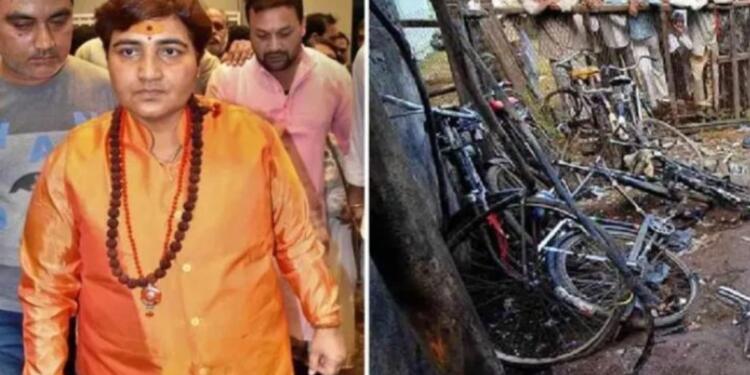
In a landmark decision on Thursday, a special NIA court in Mumbai acquitted all seven accused in the 2008 Malegaon bomb blast case, citing lack of evidence. Among the acquitted was former BJP MP Sadhvi Pragya Singh Thakur, who hailed the ruling as a victory of “Sanatan Dharma” and a vindication for all patriots who have long been defamed by the narrative of “saffron terrorism.”
Pragya Thakur’s Emotional Reaction: A Victory for All Sanatanis
Following the acquittal, Sadhvi Pragya took to social media platform X, declaring, “The Congress, along with all other non-believers, who are the originators of saffron terrorism and Hindu terrorism, have been disgraced. The victory of saffron, Hindutva, and Sanatan has led to the triumph of all Sanatanis and patriots. Jai Hindurashtra, Jai Shri Ram.”
Thakur, who had spent years battling not only legal challenges but also severe health complications allegedly worsened by custodial torture, called the verdict both a personal and spiritual vindication. “I was living a life of asceticism. I was arrested, tortured, and branded a terrorist. But Bhagwa has prevailed. The truth has finally spoken,” she said through tears.
Due to her health, the court had allowed her to remain seated in the witness box during proceedings.
Delivering the verdict, Special Judge A.K. Lahoti concluded that the prosecution had failed to prove the charges beyond a reasonable doubt. The court also exonerated Lt Col Prasad Purohit, Major (Retd) Ramesh Upadhyay, Sudhakar Chaturvedi, Ajay Rahirkar, Sudhankar Dhar Dwivedi (alias Shankaracharya), and Sameer Kulkarni. All were cleared of charges under the Unlawful Activities (Prevention) Act, Arms Act, and various sections of the Indian Penal Code.
The case, stemming from a motorcycle bomb explosion near a mosque in Malegaon on September 29, 2008, had claimed six lives and injured 95 others. Initially, 14 people were arrested, but only seven were eventually brought to trial.
Leaders Slam Congress for ‘Hindu Terror’ Narrative
The verdict sparked sharp reactions from political leaders who long criticized the Congress party for propagating the term “Hindu terror.”
Maharashtra Deputy Chief Minister Devendra Fadnavis welcomed the acquittal and said, “Terrorism was never saffron, is not, and will never be. The false stigma against the Hindu community has finally been lifted. The Congress must apologize for maligning patriots.”
Echoing similar sentiments, Deputy CM Eknath Shinde stated, “The term ‘Hindu terrorism’ was a political tool used to defame nationalists. After 17 years of agony, truth has triumphed. Shiv Sena always stood with Colonel Purohit and Sadhvi Pragya because we knew the accusations were unjust.”
A Politically Charged Investigation and Trial
The NIA took over the investigation from the Maharashtra Anti-Terrorism Squad in 2011. Over the span of the trial, the court reviewed testimony from 323 prosecution witnesses and 8 defense witnesses. The court found that the prosecution failed to link the accused to the actual crime scene or present credible forensic evidence. It also ordered a high-level investigation into allegations that explosives were planted at Sudhakar Chaturvedi’s residence.
Lt Col Prasad Purohit, who had served in the Indian Army with distinction, remarked, “This has been a harrowing journey. We volunteered for narco tests, but when results contradicted the narrative, they were ignored. The case wasn’t about institutions but individuals within them misusing their power.”
Major (Retd) Ramesh Upadhyay recounted the physical, emotional, and financial torture endured by his family. “The tag of terrorism haunted us. Today, we have finally reclaimed our dignity.”
Former Madhya Pradesh Chief Minister Uma Bharti became visibly emotional while reacting to the verdict, stating that what Sadhvi Pragya endured was “beyond what any woman should bear.” She accused Congress of weaponizing the term “Bhagwa terror” purely for electoral gain.
Advocate JP Mishra, representing some of the accused, said the case was a textbook example of political conspiracy before the 2009 Lok Sabha elections. “The judgment proves that saffron terror was a fabricated narrative,” Mishra told ANI. “Even Union Home Minister Amit Shah recently affirmed that no Hindu can be a terrorist.”
Legal Closure or a New Chapter?
While the verdict brings relief to the acquitted, legal experts caution that the case may not be closed yet. The lawyer representing the families of blast victims has announced plans to appeal the acquittals in the Bombay High Court, stating, “Justice for the victims is yet to be served.”
The court has directed the Maharashtra government to compensate families of the deceased with Rs 2 lakh and Rs 50,000 to those injured.
A Win for Truth, A Loss for Political Agendas
The Malegaon verdict is not just a courtroom outcome but a socio-political reckoning. It exposes how investigative agencies and political forces can sometimes converge to target individuals for ideological reasons. The term “saffron terror,” once weaponized to discredit an entire faith and its followers, has now been discredited itself.
This ruling marks a critical moment in India’s legal and political discourse, reaffirming the judiciary’s role in upholding truth against false narratives. For Sadhvi Pragya and the other acquitted, it is a long-awaited vindication. For those who coined divisive labels for electoral gain, it is a moment of disgrace.





