
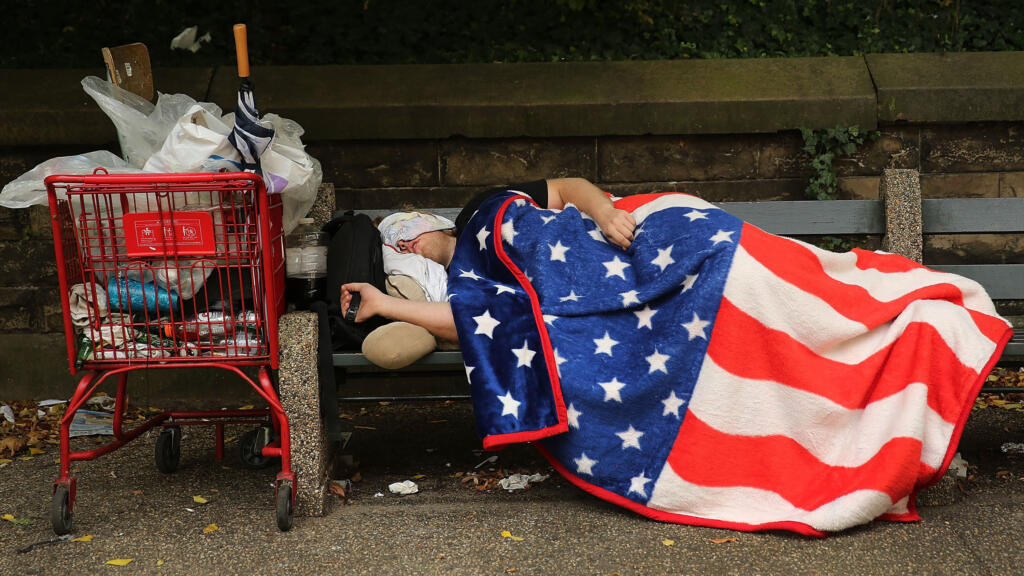
Behind America’s image as the world’s richest nation lies a stark reality—(conservative estimates) over 37.9 million people (11.5% of the population) live in poverty, 44 million (13%) face hunger, 650,000 (0.2%) are homeless, and millions are crushed by medical debt. Stagnant wages and soaring costs reveal how wealth concentrates at the top while ordinary citizens struggle for survival. U.S. prosperity is a façade that hides deep inequality and mass suffering.
The United States is often portrayed as the richest and most powerful nation in the world, yet beneath the surface of global dominance lies a paradox: a vast number of ordinary Americans are struggling for survival. For millions, life is reduced to a cycle of debt, medical insecurity, and paycheck-to-paycheck existence. Poverty in the U.S. is not merely about low income—it is about a systemic weakening of social safety nets, a collapse of affordable healthcare and education, and a society increasingly shaped by corporate capture and financial exploitation.
Living Paycheck-to-Paycheck
The most striking feature of poverty in the U.S. is how widespread financial fragility has become. Surveys consistently show that 58–78% of Americans live paycheck-to-paycheck. A CNBC survey in 2024 found that 58% of respondents identify as living paycheck-to-paycheck (CNBC, 2024), while Payroll.org’s 2023 survey placed the figure much higher at 78% (Investopedia, 2023). Forbes Advisor (2024) similarly reported 78%, with 70% saying their income does not even cover standard expenses (Forbes, 2024).
Generationally, the burden falls heavier on the young. LendingTree found that 68% of middle aged live paycheck-to-paycheck, compared to ~40% of elders, and that 64% of all Americans report this condition, with 46% saying it happens “all the time” (LendingTree, 2024).
This constant financial stress means that even minor disruptions—such as a medical bill or car repair—can push families into a deep financial crisis.
The Weight of Debt
Debt has become the defining feature of the American household. As of mid-2025, total household debt stands near $18.4 trillion (New York Fed, 2025), averaging $105,000 per household (Motley Fool, 2024).
The breakdown is stark:
Mortgages: ~$12.9 trillion
Student loans: ~$1.64 trillion
Auto loans: ~$1.65 trillion
Credit card debt: ~$1.2 trillion (Motley Fool, 2024; NY Fed, 2025)
Even more worrying is the rising delinquency rate. Student loan delinquencies jumped from 0.8% in 2024 to nearly 13% by mid-2025 (NY Fed, 2025). Credit card and auto loan defaults are also climbing, while Americans now spend roughly 11% of disposable income servicing debt (Motley Fool, 2024).
Healthcare: A Debt Trap
Nowhere is poverty more visible than in the U.S. healthcare system. Despite the world’s highest per-capita healthcare spending, America fails to provide universal coverage. Over 60% of personal bankruptcies are linked to medical expenses (Wikipedia – Bankruptcy in the U.S.).
An estimated $200 billion in medical debt is owed by Americans, with about 70 million adults struggling to pay medical bills (Wikipedia – Medical debt). Alarmingly, 60% of people with medical debt were insured at the time, and 63% avoided further treatment because of costs (Wikipedia – Medical debt).
For many families, a health emergency is not just a life risk but also a financial catastrophe.
The Erosion of Savings and Safety Nets
American households lack the buffers seen in many other societies. A Federal Reserve survey reported that 37% of Americans cannot cover a $400 emergency expense with cash or savings (Investopedia, 2024).
LendingTree adds that 22% of households have less than $50 left after essentials, while 66% have less than $500 (LendingTree, 2024).
Such fragility means any shock can result in missed rent, eviction, or reliance on predatory lenders.
Homelessness: Poverty in Plain Sight
Homelessness has exploded into a national emergency. In January 2024, the Department of Housing and Urban Development recorded 771,480 people homeless on a single night—the highest ever (Reddit summary of HUD data, 2024). California alone accounted for 187,084 homeless individuals, representing 0.48% of its population (Wikipedia – Homelessness in California).
Youth homelessness is particularly severe: between 2–4 million young Americans experience homelessness annually, and 41,000 aged 13–25 are unhoused on any given night (Wikipedia – Youth homelessness).
The fastest-growing group is families with children, showing how ordinary working households are now falling through the cracks.
The Corporate and Political Dimension
The crisis is worsened by the capture of government policy by corporate interests. Lobbying ensures that healthcare, finance, and defense policies benefit corporations rather than citizens. For example, Big Pharma and insurers shape healthcare rules, Wall Street deregulation enriches the wealthy, and military contractors profit from endless wars.
At the same time, outsourcing and offshoring gutted the U.S. industrial base. Once plentiful low-skill jobs were moved abroad, leaving unskilled Americans in insecure service roles. While wages stagnated, stock market gains disproportionately benefited the elite: the top 10% of Americans now own ~90% of all U.S. stocks, while the bottom 50% own only ~2% ([multiple economic surveys, 2024–2025]).
The Black Hole of Tariffs and Debt
The recent tariffs bomb and the burgeoning debt has further complicated the life of the common man in the U.S.
Tariffs in the U.S. are steadily driving up consumer prices, raising costs on essentials such as food, electronics, and vehicles. For ordinary families already grappling with stagnant wages and inflation, this has translated into shrinking purchasing power and rising household debt. Since tariffs were announced, grocery inflation rose 2.2% and dining out costs climbed 3.9%. Overall CPI increased 2.7% year-over-year, while core CPI rose 3.1%, with the trend showing a steadily worsening burden of tariff-driven consumer inflation on the common man, as corporations pass costs down the supply chain to households.
If the present tariff negotiations collapse, global trade with the U.S. will contract as countries cut exports, redirecting supply chains elsewhere. Reduced imports will escalate shortages and further inflate costs for American consumers. More critically, frustrated trading partners will accelerate dedollarisation, bypassing the U.S. financial system. This weakens America’s economic leverage, isolates its markets, and deepens the struggles of its citizens already burdened by inequality and debt.
Rising U.S. national debt and diminishing global confidence in America’s fiscal stability worsen the plight of the average citizen. As borrowing costs climb and the dollar’s credibility erodes, inflation spikes, social services strain, and ordinary people shoulder the consequences.
Social Consequences: A Declining Quality of Life
The social effects of poverty are visible everywhere:
Mental health: Rising depression, suicides, and loneliness.
Gun violence: Nearly 50,000 gun deaths annually.
Addiction: The opioid crisis devastates entire communities.
At the cultural level, consumerism and individualism have replaced traditional family support systems. With neither state nor family able to provide stability, many Americans face crises in isolation—deepening despair and fueling political and social unrest.
A New Migration: Seeking Better Lives Abroad
Ironically, poverty in America has pushed some citizens abroad. Retirees, digital nomads, and middle-class families are relocating to countries like Mexico, Thailand, Vietnam, and the Philippines for affordable healthcare, housing, and education. While still a minority, this trend underlines a shocking reality: many Americans believe they can live a safer and more dignified life in developing countries than at home.
Conclusion
The narrative of the United States as the land of opportunity now conflicts with the lived reality of millions. Poverty in the U.S. is not just about low wages but about systemic failure—corporate domination of policy, unaffordable healthcare and education, massive debt burdens, and collapsing savings and safety nets.
The result: a majority are living paycheck-to-paycheck, record debt, surging homelessness, and rising despair. While American elites remain global winners, ordinary citizens face conditions that resemble poverty traps more commonly associated with the very nations the U.S. once derided as “Third World.”
Poverty in America is no longer hidden. It is visible, measurable, and increasingly driving ordinary people to think not of prosperity, but of basic survival.