
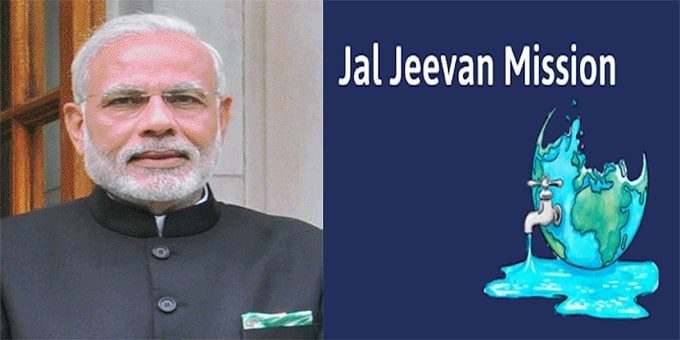
Six years ago, Prime Minister Narendra Modi launched the Jal Jeevan Mission (JJM) with a vision to achieve Har Ghar Jal safe and reliable tap water in every rural household. In 2019, just 17% of rural homes had tap water access. Today, that figure has leapt nearly fivefold to about 81%, revolutionising life in India’s villages.
Over 15.7 crore rural households now enjoy tap water connections, a dramatic jump from just 3.2 crore in 2019. More than infrastructure, JJM has improved health, empowered women, reduced drudgery, generated rural livelihoods, and restored dignity to millions of households.
The Vision: Tackling a Generational Challenge
JJM was launched on August 15, 2019, to provide Functional Household Tap Connections (FHTCs) to all 19.36 crore rural households by 2024. Its ambitious goal: ensure 55 litres per person per day of safe drinking water.
PM Modi’s approach was shaped by his experience in drought-prone Gujarat, where he prioritised water conservation through campaigns such as Jal Mandir. The mission’s design combines infrastructure with source sustainability rainwater harvesting, greywater management, and community-led water governance via Village Water and Sanitation Committees (VWSCs).
Backed by an investment of ₹3.6 lakh crore, JJM aligns with Sustainable Development Goal 6.1 and aims to bridge the rural-urban divide. It seeks not just to supply water, but to free rural families especially women from the back-breaking daily struggle of fetching it.
Progress Across States: The Success Story
Since 2019, JJM has transformed water access from aspiration to reality. As of October 2024:
-
15.5 crore rural households (80.39%) have tap water connections.
-
Average rollout: 85,000 new connections daily.
-
11 states/UTs including Goa, Gujarat, Haryana, Telangana, Punjab, and Himachal Pradesh—have achieved 100% coverage.
-
In aspirational districts, connections rose from 31 lakh to 1.16 crore, with 123 districts and 1.53 lakh villages fully covered.
However, states like Uttar Pradesh, Jharkhand, West Bengal, Rajasthan, and Kerala still lag behind due to difficult terrain, funding delays, and water contamination issues. To address this, the government has prioritised vulnerable regions with additional funding weightage 30% for difficult terrain and 10% for SC/ST-dominated areas. Partnerships with UNOPS and Denmark are also helping tackle water scarcity in Bundelkhand, Vindhya, and other challenging zones.
A Lifeline for Hilly and Remote Areas
For India’s mountainous regions, where geography makes water delivery complex, JJM has been a breakthrough.
-
Ladakh: Achieved 100% household coverage by October 2024, using winter-proof pipelines to prevent freezing in extreme cold.
-
Himachal Pradesh & Uttarakhand: Over 31,000 households in 320 villages now have FHTCs.
Women in these areas, who once spent hours trekking dangerous paths to collect water, now enjoy doorstep access. Community-led maintenance, supported by NGOs like Himmotthan Society, ensures sustainability even in harsh climates. These adaptations show JJM’s ability to create region-specific solutions for lasting impact.
Social and Economic Ripple Effects
The Jal Jeevan Mission’s impact goes far beyond water delivery:
-
Women’s empowerment: In Tripura, 95% of women and girls say they’ve been freed from the drudgery of water-fetching. In states like Bihar and Assam, women’s participation in agriculture has surged by over 28%, as noted in SBI Research’s findings.
-
Health improvements: Water quality monitoring and treatment systems have slashed waterborne diseases by up to 93% in some areas. Leh saw disease incidence drop from 4% to 1.3%, while Karnataka villages reported reduced healthcare costs.
-
Education gains: 12 states have achieved 100% tap water coverage in schools, improving hygiene, reducing absenteeism, and keeping girls in classrooms.
The mission has also boosted rural economies through local ownership of water systems VWSCs, often with over 50% women members, collect tariffs, oversee maintenance, and run awareness programmes. Reduced time spent fetching water has freed people to pursue livelihoods, further fuelling rural growth.
Leadership and Scale: PM Modi’s Driving Force
The speed and scale of JJM reflect PM Modi’s personal commitment. He has often said, “The value of water is understood by those who face scarcity.” His model of decentralisation empowering Gram Panchayats and Pani Samitis with over ₹2.25 lakh crore—has turned the mission into a women-led grassroots movement.
Key innovations include:
-
IoT-based sensors for real-time water monitoring.
-
Climate-resilient infrastructure for drought-prone and flood-hit areas.
-
Transparency through the Jal Jeevan Mission App and Water Quality Monitoring Framework.
In just five years, JJM has covered 600,000 villages, connecting households at a pace unmatched in the previous seven decades.
Jal Jeevan Mission A Blueprint for Future Development
The Jal Jeevan Mission is far more than a water supply programme it is a nationwide movement that has restored dignity, improved health, and created opportunities for millions. From Ladakh’s high-altitude villages to Assam’s floodplains, it has brought safe drinking water to 15.5 crore households and empowered communities to sustain it.
While some states still face challenges, the mission’s achievements in just six years set a global benchmark for public welfare programmes. Driven by PM Modi’s vision and executed with grassroots participation, JJM proves that with political will, community ownership, and innovative solutions, India can solve its most deep-rooted problems.
Clean water is not just a basic need—it is the foundation for a healthier, more equitable future. JJM stands as a legacy of transformation, showing how inclusive, people-powered development can change the course of rural India for generations to come.