













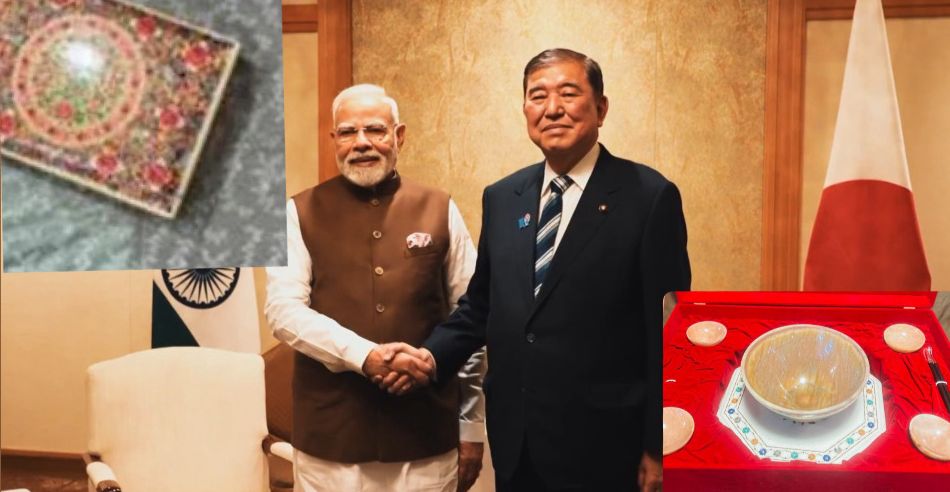
As Prime Minister Narendra Modi wrapped up a high-profile two-day visit to Japan, he presented thoughtfully curated gifts to his Japanese counterpart, Prime Minister Shigeru Ishiba, and his spouse—each piece a reflection of India’s rich artistic heritage and cultural finesse.
PM Modi gifted a unique set of Ramen Bowls with Chopsticks to his counterpart Shigeru Ishiba—an elegant confluence of Indian craftsmanship and Japanese culinary traditions.
The centrepiece is a large, vintage brown moonstone bowl accompanied by four smaller ones, drawing inspiration from Japan’s donburi and soba customs.
The moonstone, sourced from Andhra Pradesh, is known for its glowing adularescence and is traditionally believed to symbolise love, balance, and protection.
Elevating the artistry, the base of the main bowl is carved from pristine Makrana marble, famous for its use in the Taj Mahal.
It’s adorned in the intricate parchin kari inlay technique of Rajasthan, with semi-precious stones adding depth and dimension to the piece—a harmonious fusion of form and symbolism.
For the Japanese First Lady, PM Modi chose a timeless Kashmiri Pashmina shawl, housed in an exquisite hand-painted papier-mâché box.
The shawl, handwoven by master artisans of Kashmir, showcases the centuries-old craft that continues to define elegance. With an ivory base, its surface is delicately embroidered with floral and paisley motifs, hallmarks of classic Kashmiri design.
The accompanying box, decorated with floral and bird patterns, adds yet another layer of cultural resonance—making it not just a gift, but a piece of living heritage from the Valley.
Earlier, Prime Minister Narendra Modi was also presented with a Daruma doll by the Chief Priest of Shorinzan Daruma-Ji Temple in Tokyo during his visit.
The Daruma doll is a traditional Japanese doll which symbolises good luck. The Daruma doll is a hollow, round, Japanese traditional doll modelled after Bodhidharma, the founder of the Zen tradition of Buddhism. Believed to bring good luck, these dolls embody the Japanese idiom of “fall down seven times, get up eight.”
These dolls, though typically red and depicting the Indian monk, Bodhidharma, vary greatly in colour and design depending on region and artist.
Traditionally, Japanese people colour one eye of the doll before setting a personal goal with the intention of achieving it. The other eye remains blank until the goal is fulfilled. It acts as a constant reminder to act toward achieving your goal.
PM Modi was in Tokyo to attend the 15th India-Japan Annual Summit, following an invitation from PM Ishiba.
Reflecting on the visit, the Prime Minister posted on X, “This visit to Japan will be remembered for the productive outcomes which will benefit the people of our nations. I thank PM Ishiba, the Japanese people and the Government for their warmth.”
Beyond the ceremonial, the visit also had a strong technological and industrial focus. PM Modi and PM Ishiba traveled together aboard Japan’s iconic bullet train from Tokyo to Sendai—a journey symbolic of the nations’ shared commitment to speed, innovation, and deeper ties.
In Sendai, the leaders toured major industrial hubs, including a cutting-edge semiconductor facility and a bullet-train coach manufacturing unit. Modi highlighted the sector’s promise in a post on X:
“PM Ishiba and I visited the Tokyo Electron Factory. We went to the Training Room, Production Innovation Lab and interacted with top officials of the company. The semiconductor sector is a key area for India-Japan cooperation. In the last few years, India has made many strides in this sector. A lot of youngsters are getting associated with it as well. We seek to continue this momentum in the times to come.”
Wrapping up the visit, the Prime Minister listed the many outcomes of the summit and affirmed his hopes for the future of bilateral ties.
“May India-Japan friendship scale newer heights in the times to come,” he said.
From artistry to innovation, and tradition to technology—PM Modi’s visit to Japan underscored the growing synergy between the two democracies, rooted in mutual respect and a shared vision for the future.