











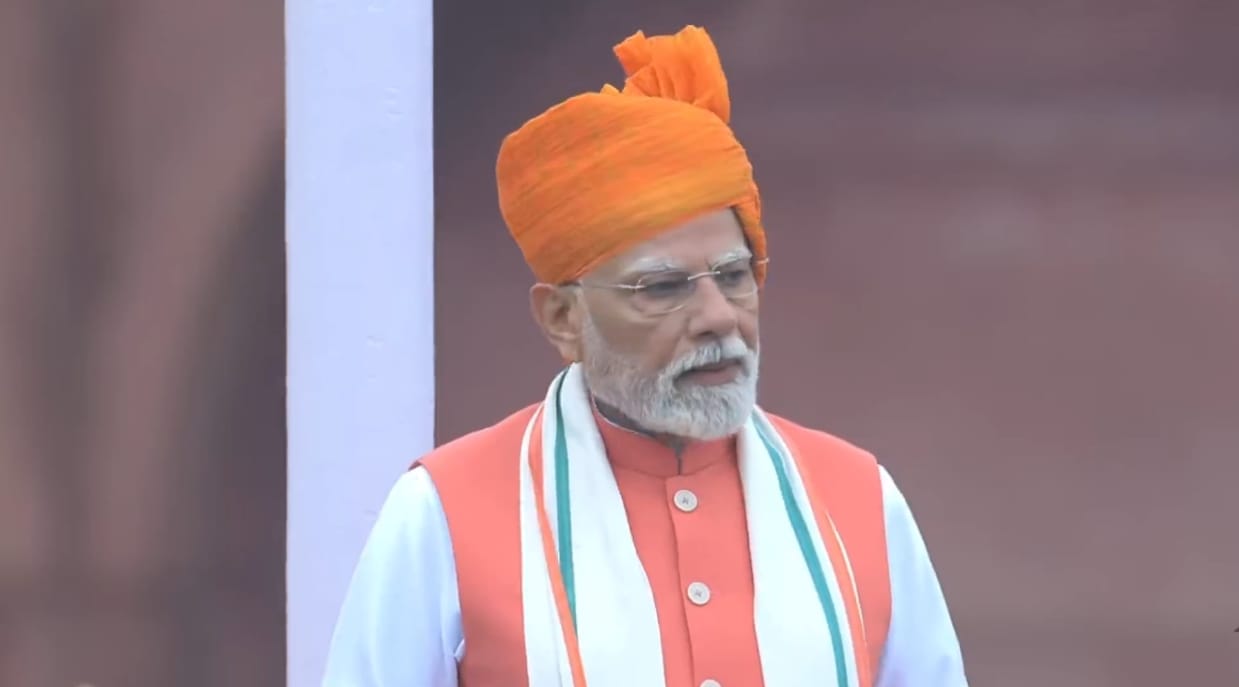
Prime Minister Narendra Modi addressed the nation in a speech from Red Fort that celebrated India’s 79th Independence Day while outlining a bold vision for the nation’s future. He highlighted the significance of “Har Ghar Tiranga,” paid tribute to India’s constitutional architects, honored armed forces, and emphasized self-reliance across defense, technology, and energy.
Tribute to Freedom Fighters and Constitutional Architects
PM Modi began by recalling the unseen potential of 1947 and the challenges India faced at independence.
He cited Mahatma Gandhi’s principles and the vision of India’s founding constitutional leaders such as Dr. Rajendra Prasad, B.R. Ambedkar, Pt. Jawaharlal Nehru, Sardar Vallabhbhai Patel, Sarvepalli Radhakrishnan, and the role of women in shaping India.
He also paid homage to Dr. Shyama Prasad Mukherjee on his 125th birth anniversary, noting his sacrifices for the Indian Constitution, notably the first person to do so. The abrogation of Article 370 was framed as a tribute to Dr. Mukherjee.
He recognised 100 years of RSS- Rashtriya Swayamsevak Sangh and paid tribute to the efforts of Swayamsevaks who dedicated their whole lives for the welfare of Nation.
The PM highlighted the participation of panchayat members and representatives from the “Lakhpati Didi” initiative, describing it as a reflection of India’s grassroots democracy- “Laghu Bharat.”
National Security and Military Achievements
Modi addressed the recent Uttarkashi tragedy, emphasizing coordinated rescue and rehabilitation efforts by the state and central governments.
He lauded Operation Sindoor, saluting the bravery of soldiers who punished the enemy in strategic operations, including responses to the Pahalgam attack.
The Prime Minister underscored India’s determination to respond to nuclear threats and terrorism, stating that those sponsoring terrorism will no longer be considered separate from the enemy of humanity. PM Modi said that by this India established a ‘new normal order’, and years of nuclear blackmail won’t be tolerated.
He stressed India’s position on the Indus Water Treaty, declaring India’s water share as non-negotiable and a matter of national interest, that there will be no compromise on the interests of Indian farmers. He said that blood and water will not flow together.
Self-Reliant India: Aatma Nirbhar Bharat
Modi highlighted the importance of self-reliance across imports, exports, and domestic capability, emphasizing that Operation Sindoor showcased “Made in India” power in the hands of the Indian Army.
He spoke on the technological century of the 21st century, including initiatives in semiconductors, energy, and defense:
Semiconductor mission:
six units operational, four more approved, aiming for Made in India chips by year-end.
Energy independence:
Expansion of solar energy by 30% in 11 years, new dams, green hydrogen mission, nuclear energy expansion (10 new reactors), and initiatives to reduce dependence on fossil fuels.
Space and technology:
Preparation for Gaganyaan, India’s own space station, and fostering innovation through 300+ startups.
Pharma and healthcare:
Vaccine development under Bio 3 policy, UPI leadership in fintech, EV industry self-reliance, and fertilizer utilization.
Economic Reforms and Development Initiatives
PM Modi emphasized structural reforms and ease of doing business: abolition of 1,500+ outdated laws, overhaul of income tax through Income Tax Act 2025, and upcoming next-generation GST reforms.
Highlighted initiatives for youth employment, including PM Viksit Bharat Rozgar Yojana, and financial empowerment of women through Mudra loans and “Lakhpati Didi” schemes.
Agriculture and fisheries progress: India ranks second globally in fish production, rice, wheat, and oilseeds. Animal vaccination programs and PM Dhan Dhanya Krishi Yojana target food security in 100 districts.
Social Equity and Inclusive Growth
Modi referenced social reformers like Mahatma Jyotiba Phule (200th anniversary) and Guru Teg Bahadur (350th anniversary), highlighting initiatives for backward classes, tribals, and marginalized communities.
Development in red corridor areas: Naxalism reduced from 125 to 20 districts in Chhattisgarh, transforming them into “Green Corridors.”
Demography, infiltration, and national security: PM Modi announced a high-powered demography mission to safeguard resources and societal stability.
Cultural Heritage and National Pride
PM Modi celebrated India’s linguistic, cultural, and spiritual heritage: classical languages, Pandu lipi manuscripts, and initiatives to digitize and preserve knowledge.
Reiterated unity in diversity, drawing inspiration from Krishna’s Sudarshan Chakra and Rashtriya Seva Sangh’s centenary values of service, dedication, and organization.
Health, Governance, and Citizen-Centric Initiatives
Stress on doorstep governance: Jan Dhan accounts, Ayushman Bharat, PM Awas Yojana, PM Swanidhi Yojana, and direct benefit transfers for poverty alleviation.
Emphasis on “Nation First” policies and financial discipline: inflation under control, strong forex reserves, and globally recognized financial ratings.
Sports, Environment, and Future Readiness
Sports promotion via National Sports Policy and Khelo Bharat initiative.
Environmental measures: reduction in oil consumption, green energy initiatives, and proactive climate policies.
India’s preparedness for technology-driven national security: predictive systems for warfare and a security blanket for strategic locations by 2035.
PM Modi concluded with a vision for 2047: “Viksit Bharat,” self-reliant, secure, technologically advanced, socially inclusive, and globally respected.
He emphasized the mantra of “Reform, Perform, Transform” and called upon every citizen to contribute to India’s journey towards strength, prosperity, and unity.
The overarching message was clear: India’s strength lies in its unity, self-confidence, and collective effort, ensuring that every citizen contributes to building a nation that is resilient, innovative, equitable, and globally respected on its centenary of independence.





