
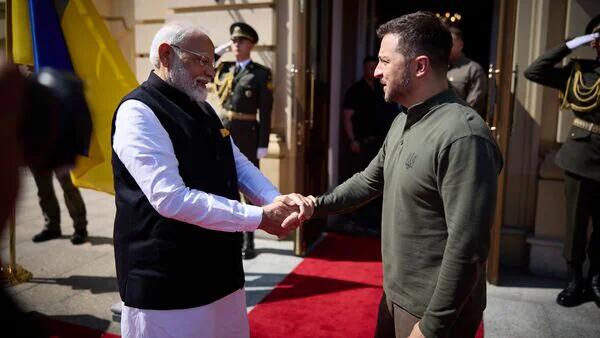
Ukrainian President Volodymyr Zelensky held a telephonic conversation with Indian Prime Minister Narendra Modi on Monday (August 11), discussing the ongoing Russia-Ukraine war and possible future cooperation. The call comes at a politically sensitive time, as both leaders are expected to meet in person during the United Nations General Assembly (UNGA) in September.
The backdrop to this development is tense US President Donald Trump has been openly pushing and even threatening India over its purchase of Russian oil, accusing New Delhi of indirectly funding Moscow’s war efforts. Despite these accusations, India has maintained its position of pursuing an independent foreign policy, balancing its national interest with humanitarian diplomacy.
Focus on Bilateral Partnership and Mutual Interests
According to a statement from the Prime Minister’s Office, Modi and Zelensky reviewed the progress of the India-Ukraine bilateral partnership, exploring ways to enhance cooperation in areas of mutual benefit. Over the years, India and Ukraine have engaged in trade, defence collaboration, and educational exchanges, but the war has disrupted several of these avenues. Both leaders agreed that restoring economic stability and securing humanitarian safety are crucial to keeping bilateral ties functional amid the ongoing conflict.
Zelensky highlighted that Ukraine is looking to strengthen cooperation with India not only in economic areas but also in international advocacy. Ukraine views India as a critical player on the global stage, whose voice carries weight in international forums. Modi reiterated India’s commitment to dialogue and peaceful resolution, reaffirming that India’s stance has consistently been one of neutrality paired with humanitarian aid, rather than choosing sides militarily.
Zelensky’s Account of the War Situation
During the call, Zelensky briefed Modi on recent Russian attacks on Ukrainian cities and villages. He specifically mentioned a missile strike on a bus station in Zaporizhzhia, which left dozens of civilians injured. This attack, according to Ukrainian authorities, was not a military target but a deliberate strike on a civilian facility.
Zelensky used this example to underline his claim that Russia shows no signs of pursuing a ceasefire, instead continuing its campaign of occupation and destruction. He expressed frustration at what he described as Moscow’s unwillingness to engage in meaningful peace negotiations. For Kyiv, keeping the global community engaged and informed about these incidents is essential in ensuring sustained diplomatic and humanitarian support.
India’s Role in Peace Efforts and the Ukraine Position
Zelensky publicly acknowledged India’s support for Ukraine’s peace initiatives, noting that New Delhi shares the position that all matters concerning Ukraine must involve Ukraine’s direct participation. He stressed that any settlement or negotiation conducted without Kyiv’s involvement will not yield lasting results. This is a significant point, as some global powers have occasionally floated the idea of alternative negotiation formats, which Ukraine fears could compromise its sovereignty.
The Ukrainian president also called on leaders with influence over Russia to send clear and firm messages to Moscow, urging an end to hostilities. While he did not directly name India as a power capable of influencing Russia’s decisions, his remarks implied that countries maintaining open lines of communication with both Moscow and Kyiv like India have a responsibility to push for peace.
The US Pressure Factor and India’s Strategic Balancing
The conversation between Modi and Zelensky comes at a time when Washington has increased pressure on India over its energy imports from Russia. US President Donald Trump has been vocal in accusing India of indirectly funding Russia’s war by continuing to buy discounted Russian oil. India, however, has stood firm, arguing that its energy purchases are guided by economic needs and national interest, not political alliances.
This balancing act maintaining robust relations with Russia for defence and energy, while engaging diplomatically with Ukraine and supporting peace efforts—has become a hallmark of India’s foreign policy under the Modi government. Despite criticism from certain Western quarters, India has sent humanitarian aid to Ukraine, engaged in dialogue with Zelensky multiple times, and has also urged restraint in its discussions with Russian President Vladimir Putin.
The upcoming meeting between Modi and Zelensky during the UNGA in September could therefore carry symbolic importance, showing the world that India is willing to directly engage with both sides in the conflict while resisting external pressure to align entirely with one camp.
India’s Independent Diplomacy in a Polarised World
India’s engagement with Ukraine underlines New Delhi’s evolving role as a global mediator, one that is unwilling to be drawn into the binary politics of major power blocs. The Modi-Zelensky conversation demonstrates that India can maintain deep ties with Russia while simultaneously supporting Ukraine’s sovereignty and humanitarian needs.
With the possibility of a face-to-face meeting at the UNGA next month, India has an opportunity to position itself as a bridge-builder in the Russia-Ukraine conflict. Whether this dual-track diplomacy will yield tangible peace outcomes remains uncertain, but what is clear is that India continues to put its national interest and strategic autonomy at the forefront, even in the face of mounting international pressure from the US and other Western powers.