
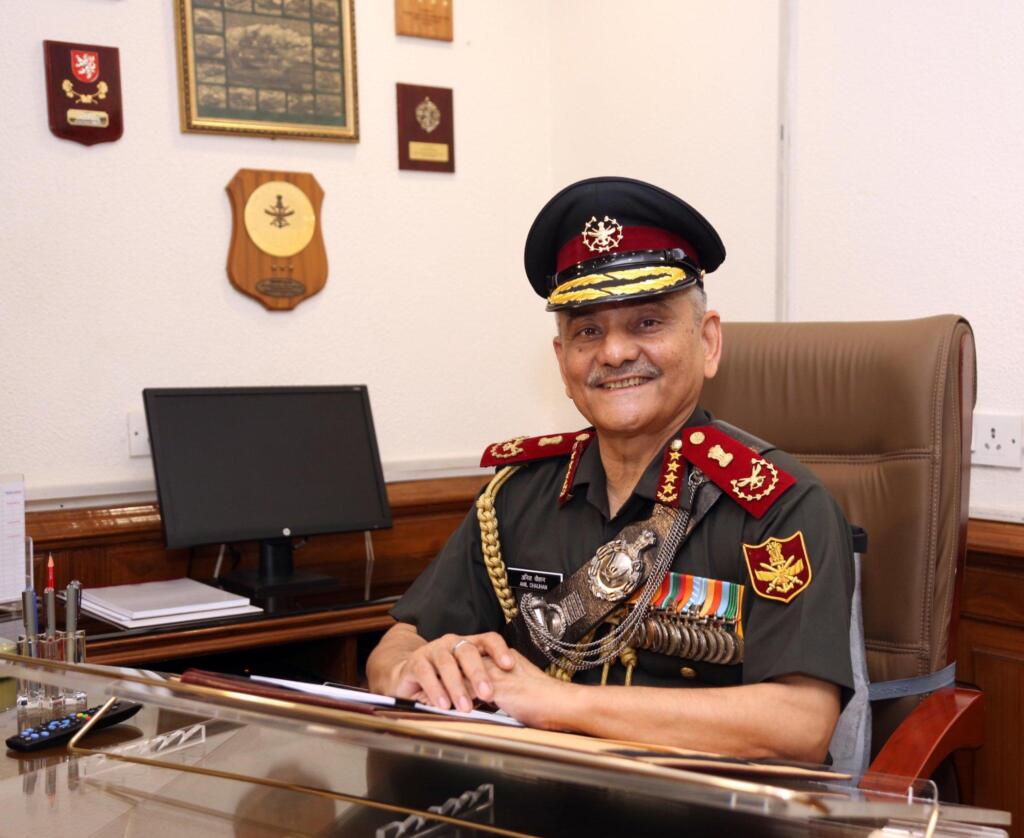
Chief of Defence Staff (CDS) General Anil Chauhan on Tuesday reaffirmed India’s commitment to peace but cautioned that it should not be misconstrued as pacifism, asserting that “peace without power is utopian.”
Speaking at the two-day ‘Ran Samvad’ conclave held at the Army War College in Mhow, General Chauhan issued a veiled warning to Pakistan and stressed that Operation Sindoor — India’s military response to the April 22 Pahalgam terror attack — remains ongoing.
“India has always stood on the side of peace. We are a peace-loving nation, but don’t get mistaken, we cannot be pacifists. I think peace without power is utopian. I like to state a Latin quote which translates, ‘if you want peace, prepare for war’,” said CDS Chauhan.
The conclave, being conducted from August 26 to 27, brings together serving military professionals to engage in strategic dialogue. Defence Minister Rajnath Singh is scheduled to deliver the plenary address on the final day.
Operation Sindoor: Lessons and Continuity
While not delving into specific operational details, General Chauhan acknowledged the importance of the military operation in shaping India’s current defence thinking.
“Operation Sindoor was a modern conflict from which we learned a number of lessons, and most of them are under implementation, some have been implemented. The operation is still on. We are not here to discuss Operation Sindoor. We are here to discuss something beyond Operation Sindoor,” he said.
Four Trends Shaping Future Conflicts
General Chauhan highlighted four emerging trends that, in his view, will define the nature of future warfare.
“I hope this particular seminar, apart from technology, will also focus upon what kind of wars will happen in the future, the background for this,” he said.
“In my view, there are four essential trends that I foresee. First, there is an increased propensity amongst nations and governments to use force, and this is happening because political objectives today can be achieved by short-duration conflicts,” he said.
“The second trend which I see is a lack of distinction between war and peace, this particular era, which we knew in the past of declared wars, I think that’s all over. Contemporary warfare today is a kind of continuum of five C’s – competition, crisis, confrontation, conflict and combat, between wars,” he added.
Highlighting the evolving nature of warfare, he added, “The third important thing is importance of people. In the past wars, because of territory and ideology, people and soldiers were sacrificed. The fourth important trend I think we can debate is the matrices of victory and how we perceive victory. In the past, matrices of victory were probably defined by losses inflicted in terms of men and equipment. In 1971, we had 95,000 Pakistanis captured. But in today’s warfare, probably the new matrices of warfare or victory are the speed and tempo of operations, effects of long-range precision strikes.”
Towards a Stronger, Self-Reliant India
The CDS underscored the need to align military preparedness with the national vision of a developed and self-reliant India.
“As a Viksit Bharat, we also need to be ‘Shashastra’, ‘Suraksit’ and ‘Aatmanirbhar’. Not only in technology, but also in ideas and in practice. Hence, there is a need to increase awareness on all fragments of our society on doctrinal and conceptual aspects, that’s the academic pursuits of how war is fought and practical and actual war fighting techniques and tactics,” he said.
On Monday, General Chauhan also highlighted the evolving nature of modern warfare and the need for India’s armed forces to respond in a unified, swift and decisive manner.
“At a time when the character of conflict is evolving rapidly across land, sea, air, cyber and space, our response must be unified, swift and decisive,” he stated.
CDS General Anil Chauhan said on Monday said, “India’s response to future challenges must be “unified, swift and decisive” as new technologies reshape the contours of warfare across land, sea, air, cyber and space domains; and tomorrow’s battlefields will not recognise service boundaries and will demand joint thinking, planning and execution.”
“Jointmanship is no longer aspirational. It is the foundation of our ongoing transformation through theaterisation, integrated logistics and joint training,” Chauhan said, introducing Ran Samwad — a top military conclave being held at the prestigious Army War College at Mhow in Madhya Pradesh.
In his Independence Day speech, Prime Minister Narendra Modi touched upon the changing nature of warfare as he announced the creation of a formidable military capability to defend India’s military and civilian installations against aerial attacks and set a 10-year deadline for developing an indigenous air defence shield integrated with offensive weapons under Mission Sudarshan Chakra.
Three joint doctrines on multi-domain operations, Special Forces operations, and airborne and heliborne operations will also be released during Ran Samwad, which is being attended by defence attaches of several countries.