
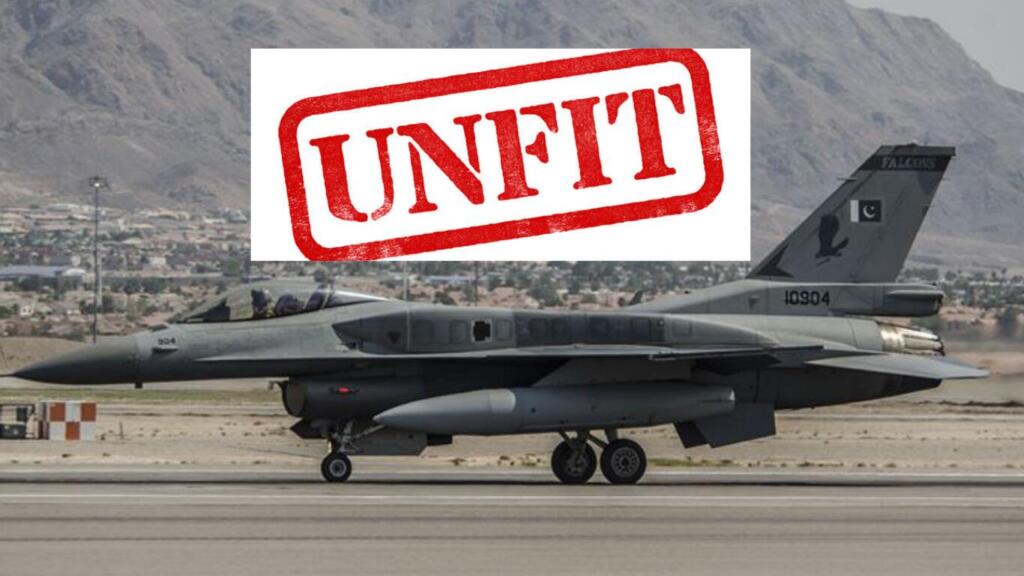
The American-supplied F-16 fighter jets once considered as the back bone of Pakistan Air Force (PAF), are now on the verge of being rendered obsolete. In what could be a massive blow to Pakistan’s aerial defence strategy, the PAF may be forced to gradually phase out the F-16 fleet altogether. Severe engine reliability issues, critical shortages of spare parts, and mounting US export restrictions have created a cascading crisis. As the operational availability of these aircraft plummets, Pakistan finds itself dangerously exposed in terms of air defence, struggling to keep its only advanced fighter fleet functional in an increasingly hostile regional environment.
US Export Controls Crippling Fleet Support
Pakistan’s fleet of F-16s, powered by the Pratt & Whitney F100 engines specifically the F100-PW-200 and the F100-PW-229 variants has been showing signs of accelerated aging. Over the past three years, dozens of these engines have either failed or been deemed unfit for continued operation due to excessive wear, structural issues, and technical malfunctions. This has not only disrupted fleet operations but also left a significant number of jets grounded at any given time.
The crisis is exacerbated by Pakistan’s growing inability to secure essential replacement parts. With the F-16s now several decades old, the sourcing of authentic OEM components has become more complicated, expensive, and subject to diplomatic strings. In the absence of a domestic supply chain or alternate international vendors, the PAF is grappling with a rapidly shrinking inventory of flyable aircraft.
The core obstacle in resolving this crisis lies in the stringent export control measures imposed by the United States. Under the Foreign Military Sales (FMS) programme, any supply of spares, maintenance kits, or technical support is closely monitored and controlled by Washington. This makes even routine engine overhauls a bureaucratic challenge. Compounding this issue is Pakistan’s delayed payments and financial distress, which have reportedly led to frozen or suspended parts shipments from the US.
Recent FMS-related clauses also limit the F-16’s operational flexibility. The jets must operate from designated bases, are subjected to end-use monitoring, and cannot be freely deployed outside certain mission parameters. This has not only hindered PAF’s strategic manoeuvrability but also made regular maintenance cycles dependent on American goodwill—a fragile arrangement in today’s geopolitical climate.
JF-17: An Imperfect Substitute
As the F-16 crisis deepens, the Pakistan Air Force has begun relying more heavily on the JF-17 Thunder, a joint China-Pakistan production powered by the Russian-made RD-93 engine. However, this aircraft brings its own set of limitations. Due to Western sanctions on Russia, even the RD-93 engine and associated spares are facing logistical bottlenecks. The JF-17’s technical capabilities are also inferior to the F-16 in several respects, including radar coverage, endurance, and multirole combat performance.
This dependency shift, though intended as a temporary measure, is exposing serious capability gaps. Pakistan’s air defence, which for decades banked on the technological superiority of its F-16 fleet, is now facing a generational downgrade without a suitable replacement in sight.
Defence Pivot to China and Turkey
In response to the impending collapse of its F-16 capability, Pakistan is now leaning heavily on its defence partnerships with China and Turkey. The procurement of artillery systems, drones, and UAVs has been accelerated through the National Aerospace Science & Technology Park (NASTP). The PAF, via Gwalpha Tech Pvt. Ltd., is coordinating large-scale acquisitions of unmanned aerial systems, signalling a shift in combat strategy to cheaper, autonomous alternatives.
China’s NORINCO continues to be Pakistan’s largest supplier of defence equipment, including rocket artillery and support systems. Turkey is also expanding its footprint in Pakistan’s defence market by offering aircraft upgrades, drone technology, and maintenance support. However, none of these arrangements provide a direct solution to the F-16 crisis, making them stopgap measures rather than permanent fixes.
Pakistan’s Air Defence Stands on Shaky Ground
With dozens of F-16s already grounded and more heading the same way, Pakistan’s air force is facing a deep and growing strategic void. The inability to maintain and deploy its most advanced fighter jets weakens the country’s deterrence posture, limits rapid-response capability, and opens critical gaps in national security. Even as Pakistan turns to China and Turkey for alternative solutions, the operational quality and reliability offered by the F-16s remain unmatched. Unless Islamabad finds a viable path forward either through renewed US cooperation or an equally capable replacement the country’s air superiority dreams may permanently fade from the skies.