
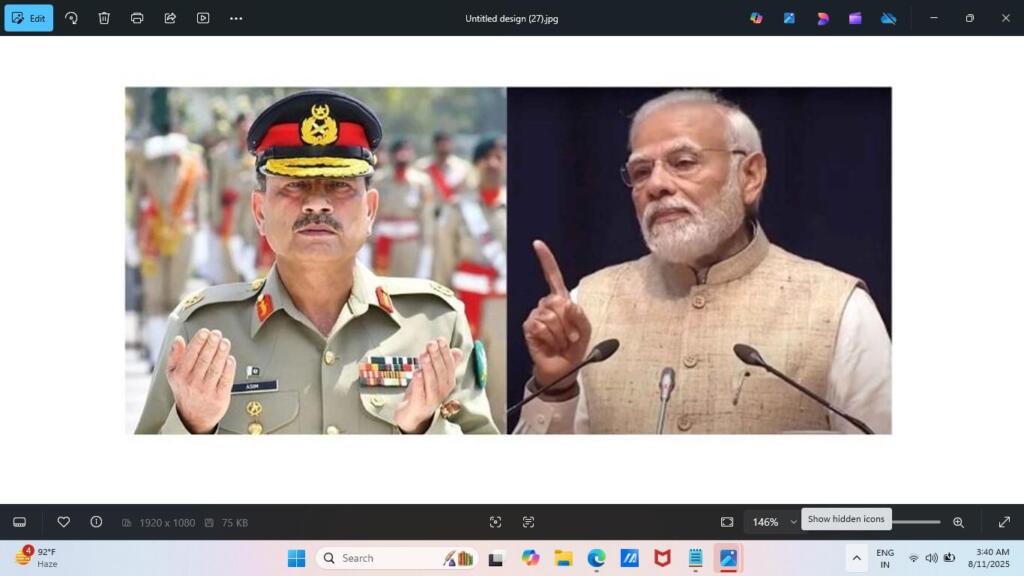
Tensions between India and Pakistan have once again escalated after Pakistan’s Army Chief, Field Marshal Asim Munir, issued a highly provocative statement during a private gathering in Tampa, Florida. Speaking to members of the Pakistani diaspora, Munir threatened to “destroy” Indian dams on the Indus River “with ten missiles” if India proceeds with their construction. “We will wait for India to build a dam, and when it does so, phir 10 missile sey faarigh kar dengey,” he declared, a chilling metaphor signaling overt aggression.
In swift retaliation, Indian government sources cited by media labeled Pakistan “an irresponsible state with nuclear weapons,” warning of the “real danger” posed by Munir’s remarks and the possibility of nuclear technology or weaponry falling into the hands of non-state actors. The backlash denounced the pattern of repeat provocations, attributing them to Pakistan’s military-dominated governance.
Ministry of External Affairs published in an official statement, “Our attention has been drawn to remarks reportedly made by the Pakistani Chief of Army Staff while on a visit to the United States. Nuclear Sabre- rattling in Pakistan’s stock-in-trade. The international community can draw its own conclusions on the irresponsibility inherent in such remarks, which also reinforce the well- held doubts about the integrity of nuclear command and control in a state where the military is hand-in-glove with terrorist groups.”
MEA also wrote “It is also regrettable that these remarks should have been made from the soil of a friendly third country. India has already made it clear that it will not give in to nuclear blackmail. We will continue to take all steps necessary to safeguard our national security.”
Indus Waters Treaty in Limbo
Munir’s bombastic statements occur against the backdrop of stalled India-Pakistan relations, especially after India suspended its commitments under the 1960 Indus Waters Treaty, citing the reason of Pakistan’s alleged sponsorship of terrorism following the Pahalgam attack that claimed 26 tourist lives. The treaty, long considered a cornerstone of bilateral cooperation, has historically governed the sharing of six himalayan rivers namely Jhelum, Chenab, Ravi, Beas, Sutlej and Indus.
Munir had earlier described water security as non-negotiable for Pakistan, saying “Water is Pakistan’s red line, and we will never compromise on this basic right of 240 million Pakistanis” during a May speech to academics, shortly after hostilities broke out between the two countries.
Echoes of Escalation
The Tampa incident is not the first time Munir has raised the stakes. In similar addresses, he earlier invoked the “jugular vein” metaphor for Kashmir and warned that any Indian aggression would meet a “befitting reply.” These statements, particularly when directed at diaspora audiences or framed in nationalist rhetoric, have only intensified anxiety in New Delhi over the long-term stability of the region and the security of its nuclear arsenal.
Diplomatic Strain Intensifies
Pakistan has imposed targeted restrictions on basic amenities for staff at the Indian High Commission in Islamabad, according to Indian government sources. Despite gas pipelines being installed by Sui Northern Gas Pipelines Ltd at the mission’s premises, Pakistan has deliberately withheld gas supply. Local vendors have reportedly been instructed not to provide cooking fuel or mineral water to Indian diplomats, forcing them to seek scarce and expensive alternatives.
Additionally, newspaper vendors have been told to stop delivering publications to the mission, limiting the staff’s access to local news. These measures are seen as deliberate acts of harassment, violating the Vienna Convention on Diplomatic Relations, which protects the functioning and dignity of diplomatic missions.
Officials describe these actions as part of a pattern of petty retaliation orchestrated by Pakistan’s Inter-Services Intelligence (ISI) following India’s Operation Sindoor and the firm enforcement of the Indus Water Treaty. The restrictions exacerbate the already strained India-Pakistan relations, which have seen no high-level talks since 2019. The Indian government views these moves as attempts to isolate its diplomats and disrupt normal diplomatic operations, further undermining prospects for dialogue between the two countries.
Asim Munir’s remarks have not only escalated the already tense India-Pakistan relations but have also raised serious security concerns across South Asia. The uncertain future of the Indus Waters Treaty and the lack of meaningful dialogue on water issues continue to fuel unrest on both sides. Moreover, the risks associated with nuclear weapons cannot be overlooked, especially in a context dominated by military authority and heightened hostility.
As the Indus Waters Treaty remains in abeyance and military commanders trade increasingly bellicose rhetoric, the global community watches closely hoping cooler heads prevail before the rhetoric becomes reality.