
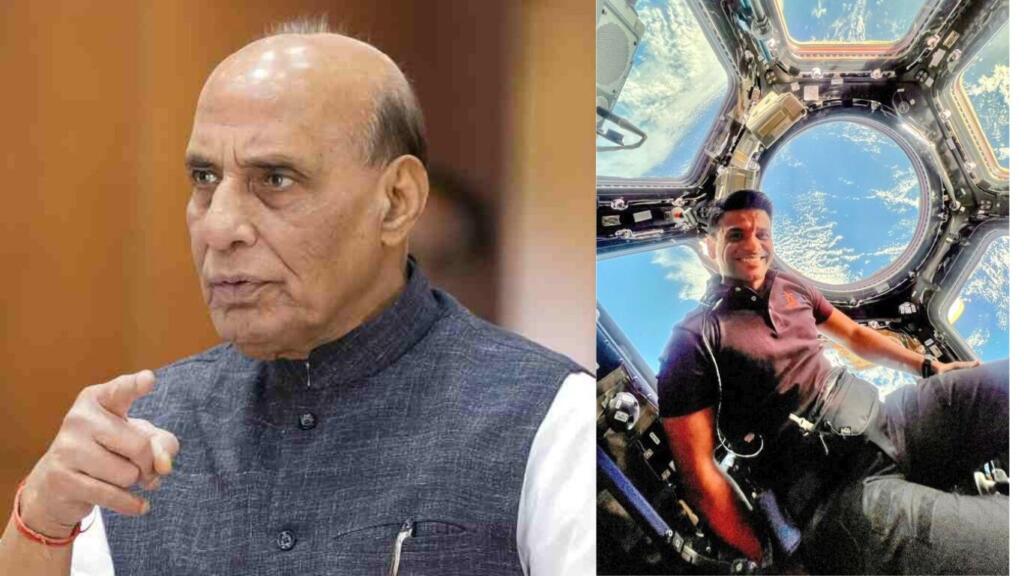
India marked a proud milestone as Group Captain Shubhanshu Shukla of the Indian Air Force returned after his historic space journey to the International Space Station (ISS). But instead of celebrating this national achievement, Parliament witnessed protests and sloganeering that derailed a special discussion meant to honour him. Defence Minister Rajnath Singh expressed deep disappointment, calling the Opposition’s behaviour “extremely unfortunate” and urging political leaders to keep space above partisan battles.
A Hero’s Journey Cut Short by Politics
Parliamentary Affairs Minister Kiren Rijiju had announced that the Lok Sabha would hold a special discussion to honour Group Captain Shubhanshu Shukla’s journey to the ISS. He appealed to Opposition parties to set political differences aside and celebrate India’s growing stature in space exploration.
However, when the House met, Opposition MPs launched protests against the Election Commission, raised slogans, and disrupted the session. The uproar forced the Chair to adjourn proceedings, denying the occasion the dignity it deserved.
During the chaos, Defence Minister Rajnath Singh voiced his displeasure on X (formerly Twitter), stressing that the debate was not about politics but about India’s pride. “This discussion was on India’s space program and its role in Viksit Bharat 2047. It is directly linked to national achievement, pride, and future scientific progress. The way the Opposition obstructed it is extremely disappointing,” he wrote.
“Keep Space Above Politics,” Says Rajnath Singh
In his remarks, Rajnath Singh underlined the need for unity when celebrating achievements that go beyond political divisions. He noted that under Prime Minister Narendra Modi’s leadership, India has scaled “unprecedented heights” in space exploration, and constructive inputs from all sides would have strengthened the debate.
“Topics like space, which are vital for India’s scientific and strategic vision in the 21st century, must be kept above partisan politics,” the Defence Minister said. He urged Opposition MPs to recognise the symbolic importance of Shukla’s achievement as a national milestone, not a political opportunity.
Union Minister for Space and Technology Dr. Jitendra Singh echoed this sentiment, urging the Opposition to at least show encouragement to India’s scientists and astronauts. “You may have disagreements with the BJP or the government, but this is about a man who has made the entire country proud,” he said. His appeal fell on deaf ears as protests continued.
BJP MPs Call Out Opposition “Disrespect”
BJP MP Dilip Saikia, who was presiding over the House, reminded Opposition MPs that the nation was watching. “Every day you come with posters and banners. This is a moment of pride for 140 crore Indians, yet you don’t want to discuss such an important issue,” he said. Despite repeated attempts, the protests persisted, forcing an adjournment.
Outside Parliament, BJP leaders hit out at what they described as the Opposition’s “disrespect” to a national hero. The incident has sparked debate on whether political parties can rise above daily battles to honour collective achievements.
Interestingly, Congress MP Shashi Tharoor distanced himself from his party’s stance. In a post on X, Tharoor openly praised Group Captain Shukla and his contribution to India’s space program. “This mission was a stepping stone to our own human spaceflight program, Gaganyaan. It provided ISRO with invaluable experience and data that simulations cannot replicate,” Tharoor wrote. His remarks revealed not just his admiration for the astronaut but also the strained dynamics within the Congress.
Shukla’s Mission: A New Chapter for India in Space
Group Captain Shubhanshu Shukla made history as part of NASA’s Axiom-4 Space Mission, where he spent more than two weeks aboard the ISS. The mission, launched on June 25 from NASA’s Kennedy Space Centre, concluded with a safe return to Earth on July 15.
Shukla’s contribution goes far beyond symbolic value. His first-hand insights into spacecraft systems, pre-launch procedures, and the psychological effects of microgravity will help ISRO de-risk and refine its ambitious Gaganyaan mission. The experience also strengthens India’s role in global space diplomacy, with Shukla’s mission showcasing the country’s willingness to engage in international cooperation.
He now stands as only the second Indian to travel to space after Rakesh Sharma’s Soviet mission in 1984, inspiring a new generation to pursue careers in science, technology, engineering, and space research.
National Pride Above Party Lines
The Opposition’s decision to boycott the special discussion on Group Captain Shubhanshu Shukla’s space odyssey has drawn widespread criticism. While political differences are natural in a democracy, moments of national pride demand unity. Rajnath Singh’s appeal to keep space above partisan politics reflects a larger truth: achievements in science and technology are national assets, not political trophies.
India’s space ambitions under the Gaganyaan mission and beyond will require collective support, encouragement, and pride from all sides. Shukla’s journey is not just about one man’s courage but about India’s aspirations to lead in space exploration. As the Defence Minister rightly said, space is a domain where India must rise together—not be pulled apart by politics.