
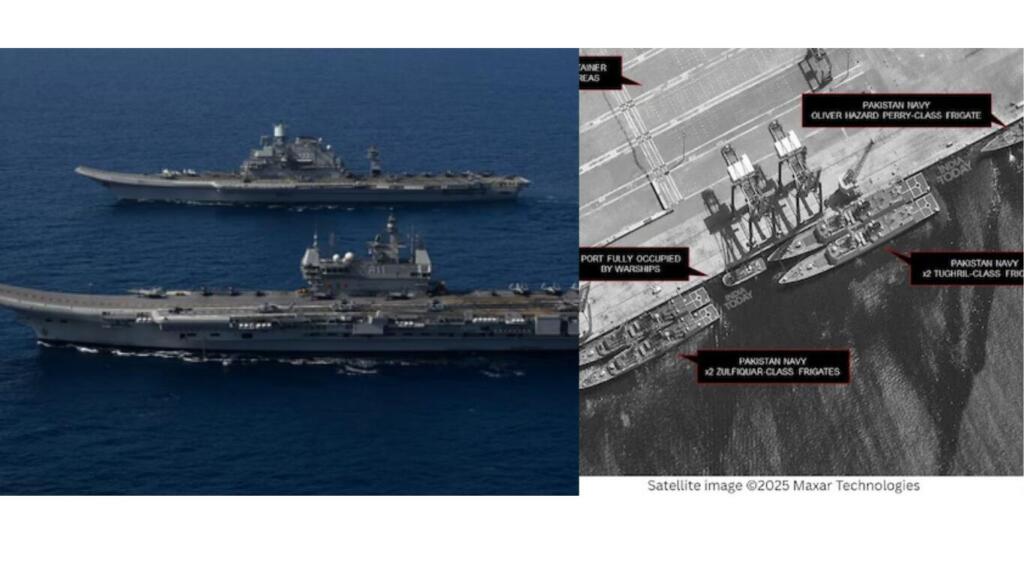
When India launched Operation Sindoor in May 2025, it sent shockwaves through Islamabad’s military establishment. What Pakistan earlier boasted of as “resilience and strong response” was, in reality, an embarrassing retreat. Satellite imagery has now confirmed what many suspected the Pakistan Navy was forced to scatter its warships, hide them inside commercial ports, and even push them 100 km away from Karachi towards Gwadar, close to the Iranian border.
The images, released by India Today, reveal Pakistan’s humiliating naval retreat right after India’s retaliatory strikes following the Pahalgam terror attack that killed 26 innocent civilians. Far from standing its ground, Pakistan’s Navy had to hide its assets from the threat of Indian firepower, exposing the hollowness of its earlier propaganda.
Karachi Dockyards Stand Empty, Warships Hide Among Cargo Ships
The satellite images from May 8 exposed a dramatic shift in Pakistan’s naval posture. Karachi’s naval dockyard usually teeming with activity appeared unusually bare. Instead, several frontline warships had been shifted to Karachi’s commercial docks and container terminals, embarrassingly positioned alongside cargo ships.
At least four Pakistani naval vessels could be spotted at these commercial berths. Among them were the PNS Alamgir (a Babur-class corvette) and a Damen Offshore Patrol Vessel, docked precariously close to merchant vessels engaged in routine loading and unloading. Another frigate was spotted at a container terminal, a clear sign that Pakistan’s Navy had abandoned its own bases out of fear of Indian strikes.
This strategy of hiding behind civilian infrastructure underlined not only Pakistan Navy’s vulnerability but also its desperation. By relocating warships to commercial hubs, Islamabad hoped to shield its fleet from possible Indian targeting — essentially using civilian facilities as cover.
Gwadar: From Struggling Port to Naval Hideout
The embarrassment for Pakistan did not end in Karachi. The satellite evidence further revealed that several of Pakistan’s key warships were repositioned westwards to Gwadar, just 100 km from the Iranian border.
Gwadar, once promoted as the jewel of the China-Pakistan Economic Corridor (CPEC), had struggled for years to emerge as a viable commercial hub. But under pressure during Operation Sindoor, Gwadar was hastily reconfigured as a fallback naval base.
According to naval analysts, Gwadar’s 600-meter berth was suddenly packed with warships and replenishment tankers, acting as a makeshift shelter. Former officers noted that Pakistan’s submarine arm was already under strain, with several boats sidelined for maintenance and refits. This severely weakened Pakistan’s undersea deterrence and forced the country to over-rely on Gwadar as a safe zone.
In essence, Gwadar instead of serving as a rising economic hub was reduced to a hiding place for Pakistan’s battered naval fleet.
India’s Naval Supremacy Reasserted
Operation Sindoor was not just an air strike; it was a demonstration of joint military power. Vice Admiral (Retd.) Shekhar Sinha emphasized that the Pakistan Navy remains “subservient in an Army-dominated operational structure,” which limits its effectiveness. In contrast, India executed a flawless joint operation involving the Army, Air Force, and Navy.
India’s Navy had remained forward-deployed in the Arabian Sea throughout the operation, with full readiness to strike Karachi if necessary. As Vice Admiral A.N. Pramod later confirmed, India’s forces were prepared to hit “select targets on land and sea, including Karachi, at the time of our choosing.”
The Indian Navy did not even need to fire missiles from the sea during Operation Sindoor, as the Air Force’s precision strikes had already achieved the mission objectives. Yet, the mere threat of a naval strike was enough to scatter Pakistan’s fleet into hiding.
This reinforced a powerful message India’s Navy holds unquestionable superiority in the Arabian Sea, and Pakistan’s maritime assets remain highly vulnerable
India’s Punitive Retaliation: A Calculated Strike
On the night of 7th and 8th May 2025, Indian armed forces executed a swift and precise retaliation under Operation Sindoor. Within just 25 minutes, between 1:05 am and 1:30 am, India launched 24 precision missile attacks on nine terror hubs across Pakistan and Pakistan-occupied Kashmir (PoK).
The targets included Muridke and Bahawalpur, infamous as command centers for terrorist outfits Lashkar-e-Taiba (LeT) and Jaish-e-Mohammed (JeM). This was not a symbolic gesture but a calibrated strike meant to punish those directly responsible for orchestrating the Pahalgam massacre.
The Indian government clarified that the strikes were not intended to escalate into a full-scale war, but to send an unmistakable message — terror attacks on Indian soil will invite a swift and punitive response.
A Retreat That Exposed Pakistan’s Hollow Bluster
Operation Sindoor stands as a textbook case of how precision, planning, and joint-force synergy can decisively rattle an adversary. Pakistan’s Navy, which had boasted of new missile systems and deterrence capabilities just months earlier, was reduced to hiding warships in commercial docks and scrambling them westward to Gwadar near the Iranian border.
For all its loud proclamations of resilience and “strong response,” Islamabad’s military posture was laid bare. The satellite imagery did not just expose tactical movements it exposed a strategic retreat that undercut Pakistan’s narrative.
While India struck nine terror hubs with precision, Pakistan could only respond by shifting ships into hiding. It was a moment that highlighted both India’s growing dominance and Pakistan’s shrinking options.
Operation Sindoor was more than a military strike it was a psychological victory. It showed the world that India’s armed forces can punish terror with clinical precision, while forcing Pakistan’s military machine into retreat.