
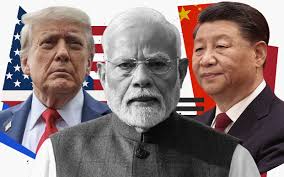
When Prime Minister Modi was welcomed by Xi Jinping in Tianjin, it wasn’t just another diplomatic courtesy. For India, it was a reminder that the world no longer runs to Washington’s tune. Ironically, the catalyst was none other than US President Donald Trump himself whose obsession with a Nobel Peace Prize and reckless tariff policies may have achieved what no “Track-II diplomacy” could: pushing the elephant and the dragon into the same frame.
A recent New York Times report hinted that India’s refusal to nominate Trump for the Nobel was a hidden factor behind Washington’s growing irritation with New Delhi. If true, then Trump’s bruised ego, coupled with his tariff tantrums, has turned into a strategic windfall for India.
America’s Bullying, India’s Strategic Clarity
For years, the U.S. sold the illusion of a “democratic partnership” with India, framing New Delhi as the counterweight to Beijing. From the Quad, to defense deals, to tech shifts it all fit into Washington’s Indo-Pacific narrative.
But when Trump slammed India with a 50% tariff, expecting New Delhi to bend, he misunderstood the fundamentals of Indian foreign policy: we don’t bow. Instead, Modi walked into Tianjin, shook hands with Xi, and reminded the world’s so called superpower that India has options.
China, ever quick to exploit an opening, denounced U.S. tariffs as “bullying” and extended support to India. That’s irony thick enough to cut with a knife the same Beijing that once dismissed India now finds it useful to stand beside us.
And to those in Washington who assumed India would always play pawn to America’s king, Tianjin was the reality check.
Modi’s Diplomacy: The Elephant That Doesn’t Dance to Washington’s Tune
Seven years after his last visit, Modi’s presence in China sent a message deeper than any speech: India makes moves based on its own interests, not because it is herded by the West. The Galwan wounds of 2020 still hurt, but Modi’s choice to engage Xi was not weakness it was strategy.
Their hour-long meeting touched on “mutual trust and sensitivity” phrases unthinkable just a year ago. For Modi, this was not about sentiment but calculation: India represents 1.4 billion people, China 1.4 billion more. Together, they carry the weight of one-third of humanity. A world order without India’s voice or China’s, for that matter is incomplete.
That is not just diplomacy; that is hard reality. And Trump’s tariffs may have just accelerated India’s pivot from a reactive partner to a decisive player.
The SCO: From “Talk Shop” to Power Club
The Shanghai Cooperation Organization (SCO), long mocked in the West as irrelevant, suddenly matters. With China, Russia, India, Iran, and Central Asian states as members and heavyweights like Saudi Arabia and Turkey as partners the SCO now controls nearly 40% of the global population and much of the world’s energy.
Modi’s decision to attend the Tianjin summit wasn’t just symbolic; it was surgical. Instead of retaliating to U.S. tariffs with anger, he arrived as a statesman, ready to widen India’s options. His presence alongside Xi and Putin sent Washington a blunt message: India is not America’s pawn. It is Asia’s pole.
For years, U.S. strategists dreamed of India as their “democratic giant” to contain China. Yet in Tianjin, India showed it doesn’t exist to contain anyone it exists to lead.
Washington’s Worst Nightmare: The Elephant and the Dragon in Step
American policymakers will find those smiling photos from Tianjin difficult to digest. For decades, they thrived on playing India and China against each other, reaping dividends from mistrust. But should India and China learn to manage rivalry rather than escalate it, Washington loses leverage.
The long-forgotten Russia–India–China (RIC) grouping could revive, strengthening multipolarity and weakening U.S. dominance. And make no mistake: this shift didn’t begin in Beijing or New Delhi it began in Washington, when an American president, desperate for a Nobel, thought he could bully India into submission.
Thank You, Mr. Trump From India, With Sarcasm
The irony is poetic. Trump calls tariffs “the most beautiful thing.” Yet his “beautiful” tariffs forced Asia’s two giants into a frame that America least wanted to see.
For India, this is not about forgiving China or forgetting Galwan. It’s about proving that we are not chained to anyone’s camp. We engage on our terms, build alliances where they serve our interests, and reject the arrogance of Western entitlement.
So yes, if photos could talk, the caption beneath that handshake in Tianjin would read: “Thank you, Trump. You may have just redrawn Asia and even the entire global geo-politics without even realizing it.”