
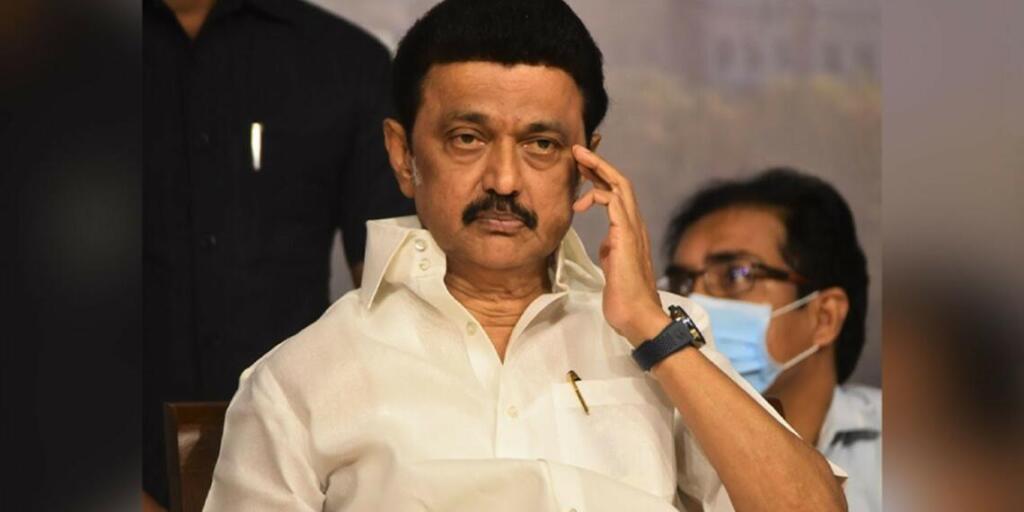
Amid the ongoing national debate over language and education reforms, Tamil Nadu Chief Minister MK Stalin on Friday unveiled the State Education Policy (SEP), reinforcing the government’s firm stance against the Centre’s National Education Policy (NEP) 2020.
The newly released SEP, developed by a committee headed by retired High Court Judge Justice D Murugesan, comes after months of consultations and deliberations.
It upholds the two-language formula—Tamil and English—in all schools, rejecting the three-language system proposed under the NEP.
Speaking at the launch, Chief Minister Stalin said the policy is rooted in the principles of equality and rationality.
“We will not allow ‘pirooku’ (reactionary thinking) in our education. Our State Education Policy is built on the ideals of samathuva kalvi (education for equality) and pagutharivu kalvi (education with rational thought). It will serve as a platform for students to compete with international standards,” he stated.
The Chief Minister also honoured 901 students from government schools who secured admissions to premier institutions such as IITs, NITs, and top universities.
He noted that 75 per cent of students who passed the Class XII exams this year have enrolled in higher education, and vowed to raise that figure to 100 per cent in the coming years.
Opposition to NEP
Tamil Nadu has consistently rejected the Centre’s NEP 2020, calling it an attempt to impose Hindi and a threat to social justice. The DMK-led government has argued that the policy disregards the state’s unique linguistic and educational identity.
In May, the state moved the Supreme Court, alleging that the Union government had withheld nearly ₹2,200 crore in central funds due to Tamil Nadu’s refusal to implement the NEP. The state contends that this move is unconstitutional and violates federal principles.
The petition states that the Centre unlawfully linked funding under the Samagra Shiksha scheme to the adoption of NEP 2020 and the PM SHRI Schools Scheme. “The glaring reason for such non-disbursement is that the Defendant has linked the release of Samagra Shiksha Scheme funds with the implementation of the NEP-2020… despite these being separate schemes,” the plea noted.
Tamil Nadu’s legal challenge also objects to Clause 4.13 of NEP 2020, which mandates the three-language formula. The state has consistently maintained that it will not compromise on its two-language policy.
The state is seeking the immediate release of Rs 2,291.30 crore from the Centre, along with 6% annual interest on Rs 2,151.59 crore from May 1 until the amount is fully disbursed.
Additionally, it has urged the Supreme Court to direct the Centre to comply with the Right of Children to Free and Compulsory Education Act, 2009, and ensure timely release of its 60% share of grants-in-aid ahead of each academic year.