
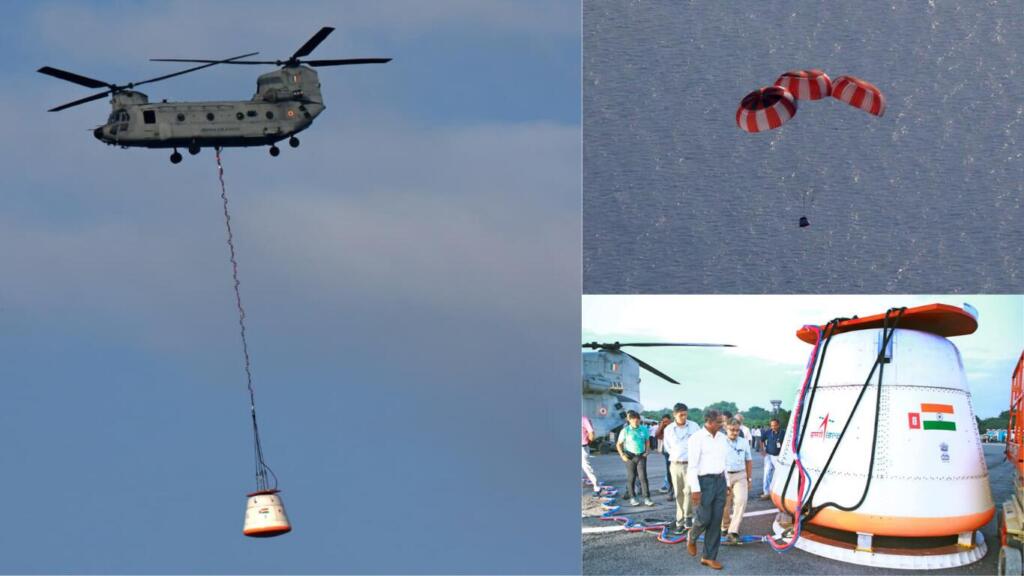
The Indian Space Research Organisation (ISRO) has successfully accomplished its first Integrated Air Drop Test (IADT-01), marking a significant milestone in the preparation for the Gaganyaan human spaceflight mission. Conducted with support from the Indian Air Force, Defence Research and Development Organisation (DRDO), Indian Navy, and Indian Coast Guard, the test validated the parachute-based deceleration system that will ensure the safe return of astronauts.
The exercise simulated an end-to-end recovery sequence, deploying the full suite of parachutes designed for the crew module. It involved two drogue parachutes for initial deceleration, followed by pilot chutes, and finally three massive main parachutes to stabilise and slow the module before splashdown. This system will be vital for ensuring astronaut safety during re-entry and landing.
Gaganyaan: India’s First Human Space Mission
Formally announced by Prime Minister Narendra Modi in 2018, the Gaganyaan project aims to send a three-member Indian crew into a 400 km orbit for a three-day mission in 2027. If successful, India will join an elite group of nations capable of independent human spaceflight.
Earlier this year, during his visit to the Vikram Sarabhai Space Centre (VSSC) in Thiruvananthapuram, Prime Minister Modi revealed the names of the four chosen astronauts Group Captain Prasanth Balakrishnan Nair, Group Captain Ajit Krishnan, Group Captain Angad Pratap, and Group Captain Shubhanshu Shukla.
Known as “Gaganyatris,” these officers from the Indian Air Force are undergoing rigorous training for the historic mission.
Defence Minister Rajnath Singh Felicitates Gaganyatris
Union Defence Minister Rajnath Singh recently felicitated the four Gaganyatris at an event hosted at Subroto Park, New Delhi. Addressing the gathering, Singh called them “gems of the nation,” reflecting the pride and expectations that the mission carries.
“We do not see space only as a field of research, but as the future of tomorrow’s economy, security, energy, and humanity,” Singh said.
The event, attended by Chief of Defence Staff Gen Anil Chauhan and Air Chief Marshal A P Singh, underlined the strong synergy between India’s armed forces and space research community in supporting the Gaganyaan programme.
Progress on Gaganyaan’s Core Technologies
Significant groundwork for the mission has already been laid. Union Minister of State for Science and Technology Dr Jitendra Singh recently updated Parliament on the progress made so far.
Key achievements include:
-
Development and testing of propulsion systems for the Crew Module and Service Module.
-
Realisation of the Environmental Control and Life Support System (ECLSS) engineering model.
-
Development and testing of five types of motors for the Crew Escape System (CES).
-
Completion of ground infrastructure such as the Gaganyaan Control Centre, Crew Training Facility, and modifications at the Second Launch Pad.
ISRO has also successfully carried out Test Vehicle Demonstration (TV-D1) to validate the Crew Escape System. Preparations are underway for the next TV-D2 test flight and the first uncrewed mission (G1), which will pave the way for India’s maiden crewed spaceflight.
The Crew Recovery Operations Plan has also been finalised, with the Indian Navy playing a lead role in ensuring safe retrieval of astronauts after splashdown.
A Giant Leap Towards Human Spaceflight
The success of the Integrated Air Drop Test (IADT-01) reaffirms that ISRO is marching towards realising the dream of Gaganyaan human spaceflight mission. By validating the parachute-based deceleration system, India has taken a crucial step in guaranteeing astronaut safety the most critical element of human spaceflight.
As the mission inches closer to reality, with technology demonstrators, uncrewed flights, and astronaut training moving in tandem, India is poised to mark its entry into the exclusive league of human spacefaring nations.
The Gaganyaan mission is not just a technological triumph; it symbolises India’s aspirations, resilience, and vision to secure its place among global space powers.