
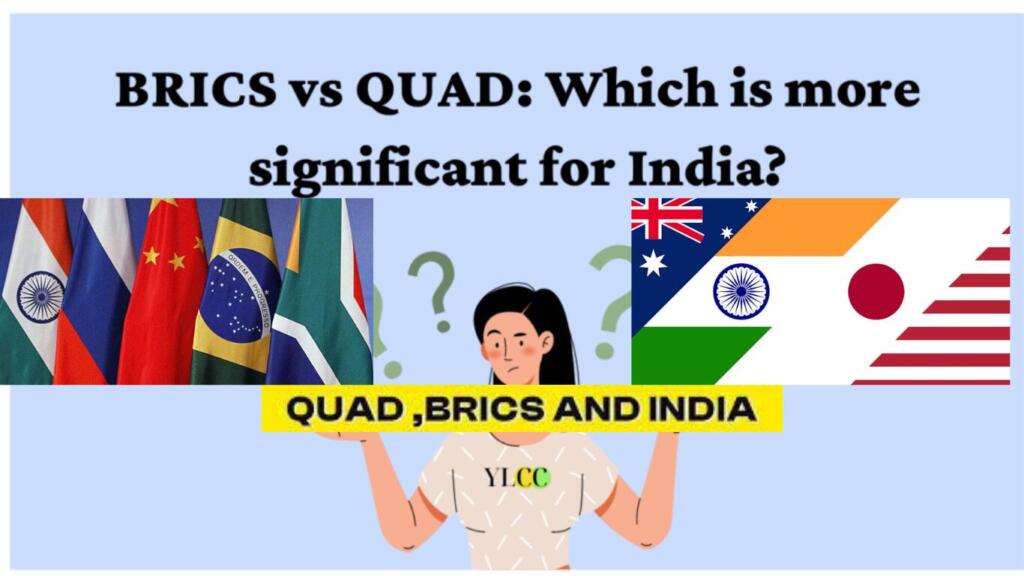
The Asian continent stands at a crossroads. Prime Minister Narendra Modi’s visit to Japan and his meeting with Prime Minister Shigeru Ishiba should have been a reaffirmation of QUAD unity. Instead, questions are louder than ever: Can QUAD survive when one of its founding members, the United States, is cornering India with punitive tariffs and unfair pressure over Russian oil? Meanwhile, economists suggest India’s role in BRICS is strengthening, with the bloc now commanding a larger share of global output than the G7. As Modi prepares to meet Xi Jinping and Vladimir Putin in China, shockwaves are certain in Washington.
Modi in Japan: QUAD and Its Fragile Glue
During his two-day visit to Tokyo, Prime Minister Modi declared that India and Japan are poised to “jointly influence the Asian century’s trajectory towards stability, growth and prosperity.” Addressing the India-Japan Economic Forum, he underlined India’s transformation over the past 11 years political stability, transparency, and the world’s fastest-growing major economy. “Very soon, we will become the third-largest economy,” he said.
Yet, the fragility of the QUAD structure, adding that unless QUAD addresses common strategic issues inclusively, “its future is not bright.” If QUAD is only about countering China, the glue binding it is weak. If not, then its purpose is unclear.
The question arises: Can QUAD remain relevant when its own members are pulling in different directions?
Trump’s Tariffs: A Self-Inflicted Wound for America
As Modi engages allies in Tokyo, back home India faces unprecedented trade tensions with Washington. US President Donald Trump has doubled tariffs to 50 percent on many Indian goods, citing India’s continued purchase of Russian oil. The move, meant to punish India, risks backfiring.
American economist Richard Wolff likened the US approach to “a mouse hitting its fist against an elephant.” He argued that India, now the world’s largest country by population and a top-five economy, will simply redirect its exports to other markets most notably within BRICS. “Like Russia found another place to sell its energy, India will sell its exports no longer to the United States, but to BRICS,” Wolff said in a podcast.
His warning was stark: Trump’s tariffs may unintentionally nourish BRICS, accelerating its evolution into a viable economic alternative to the West. Already, BRICS’ share of global output (35%) surpasses that of the G7 (28%). If India pivots further toward BRICS, QUAD risks losing its most critical partner.
Modi, Xi, and Putin: A Meeting the US Never Wanted
Perhaps the most significant development is yet to come. Modi is scheduled to meet Chinese President Xi Jinping and Russian President Vladimir Putin during the SCO summit in Tianjin his first visit to China in seven years. These engagements will be closely watched worldwide, as they signal India’s balancing act between QUAD commitments and BRICS opportunities.
For Washington, this is a nightmare scenario. The US has long sought to draw India firmly into its camp, using QUAD as a strategic counterbalance to Beijing. But Trump’s unilateral tariffs and heavy-handed pressure on Russian oil purchases have alienated New Delhi. Now, Modi meeting Xi and Putin just as American sanctions hit sends precisely the shockwaves Washington wanted to avoid.
If India deepens ties with BRICS while remaining formally in QUAD, the US risks losing leverage in Asia. This contradiction is no accident; it is the direct outcome of Washington’s miscalculated policies.
The BRICS Advantage: An Emerging Counterweight
While QUAD struggles to define itself, BRICS has been expanding aggressively. From five members, it has now grown to include ten nations Brazil, Russia, India, China, South Africa, Egypt, Ethiopia, Indonesia, Iran, and the UAE. This expansion broadens not only its economic clout but also its geopolitical reach.
BRICS presents itself as an alternative to Western financial dominance, exploring mechanisms to bypass the dollar. With innovation, novelty, and the promise of scaling up like the established superpowers, BRICS appeals to emerging markets seeking autonomy. For India, the benefits are obvious: access to vast new markets, freedom from Western diktats, and a platform where its voice is amplified rather than suppressed.
Economists like Wolff argue that America’s confrontational approach is creating the very competitor it fears. Instead of isolating Russia or disciplining India, Trump’s tariffs are uniting BRICS into a coherent counterweight. If this trajectory continues, QUAD risks being overshadowed not by China alone, but by a collective of nations India itself is helping shape.
Is QUAD Doomed by America’s Missteps?
Prime Minister Modi’s Japan visit and his upcoming SCO engagements reflect the tightrope India walks between two worlds QUAD and BRICS. But the question must be asked: How long can this balance hold? With Trump’s tariffs doubling down on confrontation, India has every incentive to lean toward BRICS, where it is respected as a central player rather than cornered as a subordinate.
If QUAD does not evolve beyond vague rhetoric and US-centric strategies, it risks irrelevance. For Washington, this is the ultimate irony: in trying to punish India, it may have handed BRICS the momentum to emerge as the true engine of the Asian century. The elephant will march on with or without QUAD