
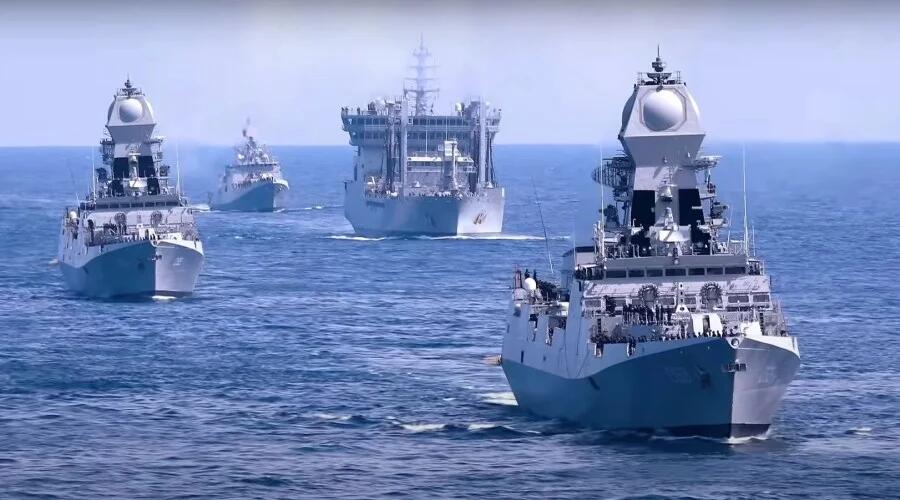
Amid growing regional instability and global military realignments, India is preparing to launch its most powerful naval platform to date the Project-18 destroyer. Designed to dominate maritime theatres with unmatched missile firepower and advanced stealth capabilities, this next-generation warship will stand as the Indian Navy’s largest and most sophisticated surface combatant. Developed in response to shifting security dynamics in Ukraine, the Indo-Pacific, and the Middle East, Project-18 signals India’s determination to project power across the high seas and counter rising threats, particularly from China’s expanding naval presence.
At 13,000 tonnes displacement, the Project-18 destroyer will outsize and outgun every warship currently in the Indian Navy’s fleet, including the Visakhapatnam-class destroyers. With cutting-edge sensors, electronic warfare suites, and an array of vertical launch missiles, this warship marks a significant leap in indigenous naval engineering and technological self-sufficiency under the Make in India initiative.
Unmatched Missile Loadout and Hypersonic Edge
What sets Project-18 apart is its extraordinary missile carrying capacity. The destroyer will boast 144 vertical launch system (VLS) cells, the highest missile count on any Indian warship. These will be configured for layered offensive and defensive roles:
-
32 VLS cells at the rear will house PGLRSAM long-range air defence missiles, capable of intercepting enemy aircraft and ballistic threats up to 250 km.
-
48 cells will deploy BrahMos Extended Range cruise missiles and other long-range indigenous strike weapons for land and sea targets.
-
64 short-range VLS cells will provide close-in air defence through quick-reaction missiles.
-
8 slant launchers are expected to be reserved for future hypersonic BrahMos-2 missiles, currently under development.
This arsenal equips the warship to simultaneously engage aerial, surface, sub-surface, and land-based threats. With its multi-layered defence system, Project-18 will serve as a true multi-role battleship designed for contested environments.
Next-Gen Radar and Integrated Electronic Warfare
The warship’s dominance won’t just stem from its firepower. Project-18 will feature an advanced sensor suite jointly developed by the Defence Research and Development Organisation (DRDO) and Bharat Electronics Limited (BEL). Four high-capability Active Electronically Scanned Array (AESA) radars — including S-band and volume-search radars — will provide seamless 360-degree surveillance and target tracking beyond 500 km.
A state-of-the-art multi-sensor mast will integrate navigation, tracking, and electronic warfare functionalities. Additionally, an onboard electronic warfare system will be tuned for cyber warfare resilience, jamming resistance, and operational reliability in dense signal environments — a crucial asset in modern naval conflicts.
Make in India at the Core of Project-18
At least 75% of Project-18’s systems are expected to be sourced from Indian defence manufacturers, underlining New Delhi’s commitment to defence indigenisation. The ship will feature Integrated Electric Propulsion (IEP) technology for fuel efficiency and silent operations. Its stealth shaping will reduce radar cross-section significantly, making it harder to detect.
The warship will also support two multi-role helicopters and autonomous underwater drones for anti-submarine warfare (ASW) and mine detection. A rail-less helicopter handling system is being introduced for faster operations. With these enhancements, Project-18 will become a pivotal asset in India’s push for a robust blue-water navy.
India’s Future Flagship of Maritime Power
The Project-18 destroyer isn’t just another warship it represents a paradigm shift in India’s maritime capabilities. Slated to become operational in the 2030s, this warship will anchor the Indian Navy’s ambition to expand to 170–175 warships by 2035. With design completion expected by 2028 and construction to follow at Mazagon Dock and GRSE, the Project-18 class will be crucial in countering China’s growing naval reach in the Indian Ocean and asserting India’s influence across vital Indo-Pacific sea lanes.
As regional tensions escalate, India’s decision to invest in this formidable warship highlights a clear strategy: to deter threats, safeguard its maritime interests, and emerge as a credible naval power on the global stage.