
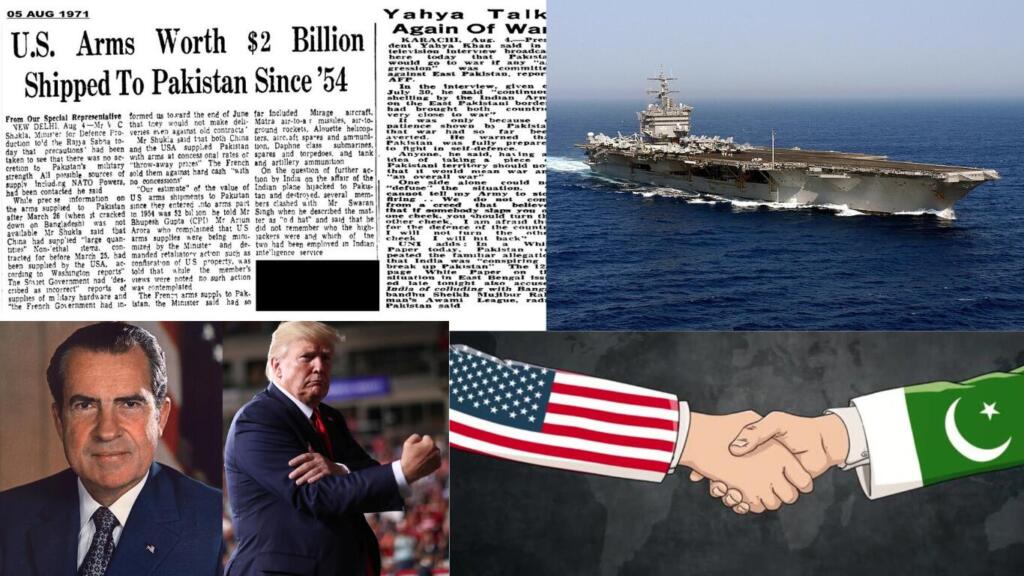
As tensions between India and the United States flare up once again over trade and energy policies, the Indian Army has taken a historical dig at Washington’s long-standing strategic favoritism toward Pakistan. In a pointed social media post, the Eastern Command of the Indian Army reminded the public of America’s role in arming Pakistan during the run-up to the 1971 India-Pakistan war. The post, shared just a day after U.S. President Donald Trump threatened India with higher tariffs over its continued purchase of Russian oil, adds fuel to a growing diplomatic standoff between the two nations.
A Flashback to 1971: Arms to Pakistan at ‘Throwaway Prices’
On August 5, the Indian Army’s Eastern Command posted an old newspaper clipping from 1971 with the caption: “This day, that year – build-up of war.” The article dated August 5, 1971, detailed how the U.S. had been supplying arms to Pakistan for years leading up to the Bangladesh Liberation War. Then Defence Production Minister V.C. Shukla had informed the Rajya Sabha that despite requests to major powers to halt the arms supply, the United States continued to arm Pakistan, while the Soviet Union and France declined to do so.
The article further stated that both the U.S. and China provided Pakistan with weapons at “throwaway prices,” effectively supporting Pakistan’s military aggression against India and Bangladesh. The Indian Army’s post serves as a timely reminder of America’s questionable alliances in South Asia message likely meant to resonate in the context of current U.S. policy moves.
Trump’s Tariff Threats Against India Over Russian Oil
The Army’s historical reminder came on the heels of a controversial statement from U.S. President Donald Trump, who continues to shape the Republican agenda in the U.S. In a Truth Social post, Trump accused India of buying “massive amounts” of Russian oil and profiting from resale on the open market. He warned that India would face “substantially higher tariffs” on its exports to the U.S. as a consequence.
Trump wrote, “India is not only buying massive amounts of Russian Oil, they are then, for much of the Oil purchased, selling it on the Open Market for big profits. They don’t care how many people in Ukraine are being killed by the Russian War Machine. Because of this, I will be substantially raising the Tariff paid by India to the USA.”
This warning comes despite the fact that the U.S. itself continues to trade with Russia. More significantly, Trump’s administration has gone soft on Pakistan, lowering tariffs from 29% to 19%, even as Islamabad maintains strategic ties with Beijing and benefits from American military and economic support.
India Hits Back: Hypocrisy and Double Standards
India’s response to Trump’s accusation was swift and calculated. The Ministry of External Affairs reminded the U.S. that it had initially “encouraged” India’s crude imports from Russia to stabilize global energy markets following the Ukraine war. Indian officials slammed the criticism as hypocritical, pointing out that many Western countries—particularly in Europe—have continued trade with Russia at much higher volumes than India.
In its statement, the foreign ministry emphasized that India’s energy imports are driven by necessity and not political alignment. “While India’s imports are a necessity compelled by the global market situation, the very countries criticizing us have robust trade relations with Russia, not even based on vital compulsion,” the statement said.
The ministry also cited hard numbers: In 2024, the European Union had a bilateral trade volume of €67.5 billion in goods and €17.2 billion in services with Russia. LNG imports from Russia to Europe in 2024 hit a record 16.5 million tonnes, more than any previous year—including during peak tensions in 2022.
Selective Outrage: Pakistan Gets a Free Pass
India’s concern goes beyond trade. The current U.S. approach appears to selectively target India for political pressure while continuing to support Pakistan with tariff cuts and military aid. This inconsistency is not lost on Indian observers. While India is being penalized for transparent oil imports, Pakistan continues to receive favorable treatment despite its poor track record on democracy, terrorism, and human rights.
Analysts suggest that this double standard in U.S. foreign policy reflects a lingering Cold War mentality, where Pakistan remains a convenient geopolitical pawn despite shifting global realities. Trump’s recent tariff cut for Pakistan, despite its alliance with China and history of harboring terror networks, further exposes the U.S.’s outdated and biased strategic calculus in South Asia.
Strategic Clarity in a Shifting World
India’s strategic autonomy has always been rooted in its ability to make decisions based on national interest, not foreign pressure. The recent threats from Donald Trump and the broader U.S. inconsistency on trade and diplomacy—only strengthen India’s resolve to diversify its alliances and maintain its independent foreign policy.
The Indian Army’s subtle yet strong historical reminder serves as a wake-up call: The United States has a long history of backing India’s adversaries. As the global order reshapes, India must prioritize self-reliance and national dignity over appeasing fickle allies. With rising geopolitical tensions and shifting alliances, strategic clarity is not a luxury it is a necessity.