











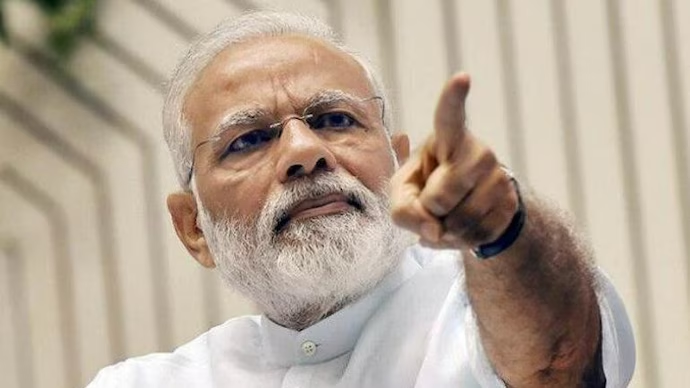
In a bold and unapologetic statement, Prime Minister Narendra Modi responded strongly to US President Donald Trump’s aggressive move to impose a 50% tariff on Indian goods. The US administration had doubled the tariff from 25% to 50% after India refused to halt its purchase of Russian oil.
Addressing MS Swaminathan Centenary International Conference on Thursday, PM Modi said, “For us, the interest of our farmers is our top priority. India will never compromise on the interests of farmers, fishermen and dairy farmers. I know personally, I will have to pay a heavy price for it, but I am ready for it. Today, India is ready for the country’s farmers, fishermen and dairy farmers…” His words were a clear and powerful message to Washington, emphasizing India’s unwavering commitment to national priorities over foreign pressure.
Donald Trump wrote in his executive order “I find the Government of India is currently, directly or indirectly, importing Russian Federation oil… in my judgement I determine it necessary to impose an ad valorem duty on imports of articles from India…”
US Hypocrisy on Russian Trade Exposed
While the United States has justified its sanctions on India by citing India’s continued import of Russian oil, the irony remains glaring: the US itself continues to import billions of dollars’ worth of uranium and chemical fertilizers from Russia. This duplicity has not gone unnoticed.
When US President Donald Trump was recently questioned by a reporter about America’s own continued imports from Russia, he dodged the issue, saying, “I don’t know anything about that.” This evasive response has only deepened suspicions about the actual motivations behind the tariffs and highlighted the selective application of American sanctions.
In his executive order, President Trump accused India of directly or indirectly supporting Russia through its oil imports and declared, “India has not been a good trading partner.” Yet, by ignoring its own dependence on Russian commodities, the US has exposed a double standard that weakens its moral position.
India’s Firm Diplomatic Rebuttal
In response to the unilateral and punitive tariff hike, India’s Ministry of External Affairs (MEA) issued a strong statement condemning the US move as “unfair, unjustified, and unreasonable.”
The MEA emphasized that India’s energy policy is dictated by market dynamics and is rooted in the imperative of securing affordable and uninterrupted energy supply for its 1.4 billion citizens. “It is therefore extremely unfortunate that the US should choose to impose additional tariffs on India for actions that several other countries are also taking in their own national interest,” the ministry said.
The statement added that India would take all necessary steps to safeguard its national interest and would not accept discriminatory treatment while others importing Russian oil remain untouched by similar sanctions.
Agriculture: The Bigger Flashpoint
Beyond oil, agriculture continues to be a flashpoint in India-US trade relations. President Trump has long pressured India to open its markets to American agricultural and dairy products. However, India has remained firm in its stance, protecting its rural economy that supports millions of small farmers.
Differences over Non-Veg milk, genetically modified crops, food safety standards, and price support mechanisms have repeatedly stalled trade negotiations. With the latest tariff hike, the gulf between the two nations appears wider than ever.
PM Modi’s declaration in support of farmers is not just rhetoric; it is a reaffirmation of India’s core policy that prioritizes food security, rural livelihoods, and self-reliance over foreign economic coercion.
India’s Resolve vs America’s Bullying
President Trump’s attempt to arm-twist India through economic sanctions has backfired. Instead of capitulating, India has responded with dignity, strength, and clarity. PM Modi’s unwavering support for Indian farmers and his refusal to yield to unfair demands underscore a leadership that puts national interest above all else.
While the US continues to selectively apply sanctions while benefiting from Russian resources itself, India has laid bare this hypocrisy for the world to see. Rather than buckle under pressure, New Delhi has reminded Washington that diplomacy rooted in respect and fairness must prevail over one-sided economic warfare.
India stands strong, united, and resolute. And under PM Modi’s leadership, it refuses to be bullied.





