
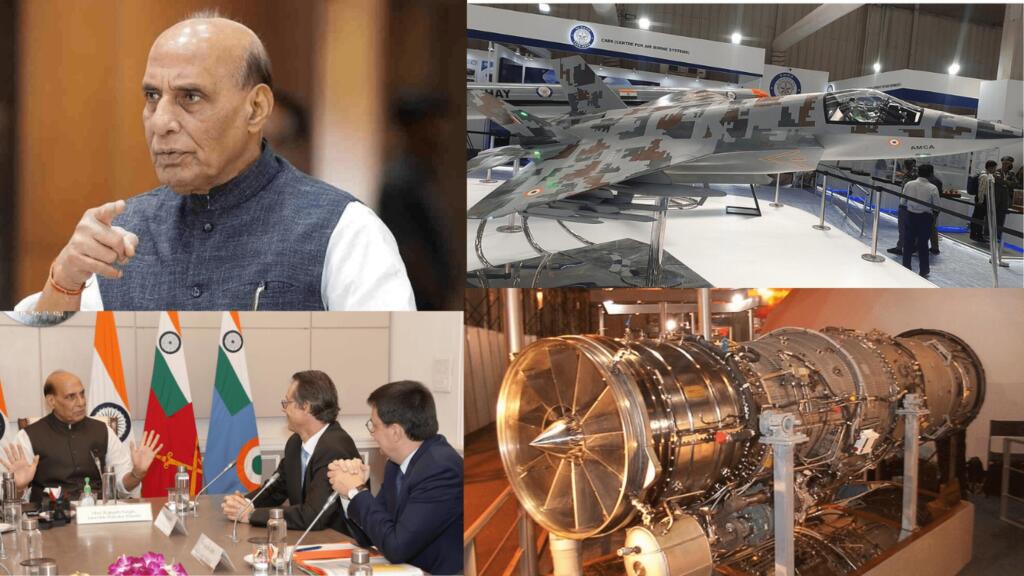
India’s dream of producing its own fifth-generation fighter jets just took a historic leap. At the ET World Leaders Forum in New Delhi, Defence Minister Rajnath Singh announced that India will develop advanced jet engines with French aerospace giant Safran, marking one of the most crucial milestones in India’s defence journey.
“Today, we have also taken steps forward in the direction of building Fifth Generation fighter aircraft. We have also moved towards manufacturing the said aircraft’s engine in India itself. We are about to start engine manufacturing work in India with the French company Safran.” said Defence Minister Rajnath Singh
This move is not just about powering the next generation of fighter aircraft it is about strategic independence, global defence leadership, and a bold step towards Aatmanirbhar Bharat.
A New Era of Fighter Jet Development
For decades, India’s indigenous fifth generation aircraft programme faced some hurdles: the lack of a world-class jet engine. While the Tejas fighter has showcased India’s engineering brilliance, dependence on foreign-made engines has remained its Achilles heel.
That is now set to change. The partnership with Safran, one of the world’s leading aerospace firms, will transfer advanced technology, enabling India to manufacture and eventually design engines that will power the Advanced Medium Combat Aircraft (AMCA) India’s very own fifth-generation stealth fighter.
Singh described Tejas as a “landmark in India’s defence journey,” and positioned the AMCA as the natural progression. “It’s not that we aren’t facing challenges, but we will resolve every problem. We will definitely establish full capability to build fighter aircraft in India,” he said.
Safran’s Deepening Investment in India
This partnership is not starting from scratch. In July 2022, a high-level delegation of Safran Group, led by CEO Olivier Andries, had met Singh in New Delhi and laid the groundwork. At that time, Safran announced:
-
A $150 million MRO facility in Hyderabad for overhauling LEAP-1A and LEAP-1B engines used by Indian and foreign airlines.
-
A new aircraft engine parts manufacturing unit in Hyderabad with an investment of €36 million.
-
Safran Electrical & Power India Pvt Ltd, to produce electrical harnesses for both civil and military aircraft.
-
A joint venture with HAL in Bengaluru for rigid piping used in fighter and helicopter engines.
These facilities, together expected to generate over 700 high-skilled jobs, highlighted Safran’s long-term commitment to India. Now, with co-production of fighter jet engines on the table, the Indo-French defence partnership has entered its most critical phase.
AMCA and India’s Big Leap in Defence
The Advanced Medium Combat Aircraft (AMCA) is India’s answer to global fifth-generation fighters like the American F-35 and China’s J-20. Designed with stealth, supercruise, advanced avionics, and heavy payload capacity, the AMCA will be powered by the very engines being developed with Safran.
The project is central to India’s plan to not only modernise its Air Force but also emerge as a net security provider in the Indo-Pacific. By mastering jet engine technology, India can break free from its dependence on the US, Russia, or Europe for propulsion systems a strategic vulnerability that has held back its aerospace sector for decades.
Prime Minister Narendra Modi himself, during his Independence Day address, underscored the importance of developing jet engines indigenously. He said that India must not rely on others for critical technologies like propulsion, semiconductors, and AI. This joint development with Safran answers that call directly.
Strengthening Global Supply Chains
Rajnath Singh also positioned India as a key stabiliser in a world facing supply chain disruptions. With many nations rethinking their dependence on China, he made a clear case for India.
“Amid talks of China Plus One, please tell me who can do it but India? India has the capability to stabilise global supply chain disruptions,” Singh declared. He linked the engine manufacturing deal with India’s broader role in the global economy, stressing that ‘Make in India’ is not just about India it’s about making for the world.
The Defence Minister also highlighted government missions on AI and semiconductors, noting that by the end of 2025, India-made semiconductors will hit the global market.
Open Call to Global Defence Investors
Singh invited foreign companies to invest in India’s rapidly growing defence ecosystem, assuring them of clearances, hand-holding, and global market access. “When you Make in India, you make for the world,” he said.
This echoes Modi’s Aatmanirbhar Bharat vision, where India is not seen as an isolated market but as a hub for global development, innovation, and peace.
India’s Decisive Step Toward Strategic Independence
The Indo-French collaboration on jet engines is not just another defence deal it is the fulfilment of a long-pending national aspiration. For decades, India has flown advanced aircraft but relied on imported engines. Now, as it prepares to field the AMCA stealth fighter and expand its aerospace footprint, it will do so with engines made in India, for India, and for the world.
This is India’s boldest step towards self-reliance in defence, and a message to the world that the age of dependence is over. With Safran as a partner, AMCA in development, and Modi’s vision steering the future, India is ready to soar higher than ever before on the wings of its own power.