
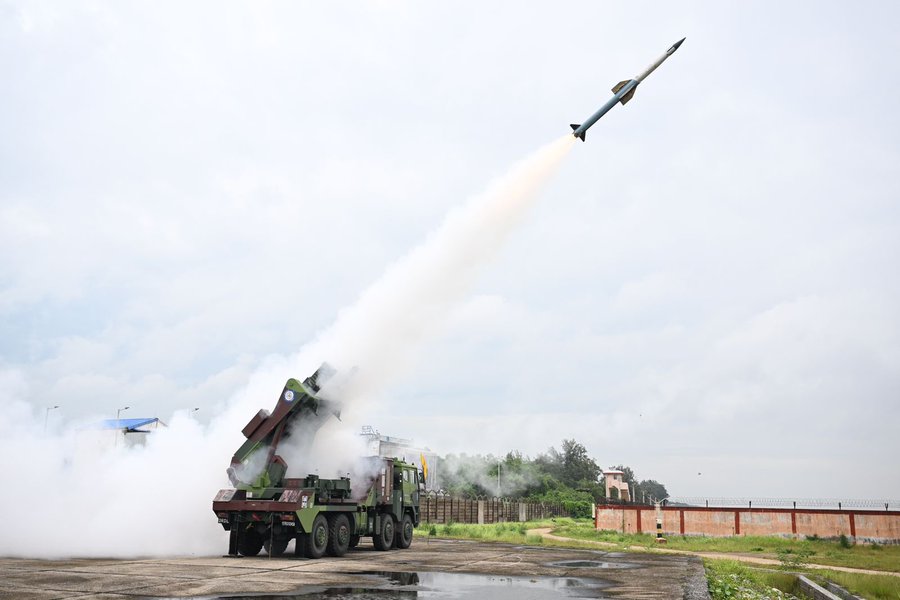
India on Saturday (August 23, 2025) successfully carried out the maiden flight test of its Integrated Air Defence Weapon System (IADWS), a major step towards strengthening the country’s defence capabilities and bolstering self-reliance in cutting-edge military technology. The trial, conducted off the coast of Odisha around 12:30 pm, marked a landmark achievement for the Defence Research and Development Organisation (DRDO).
A Multi-Layered Shield Against Aerial Threats
The IADWS is designed as a multi-layered air defence system capable of countering a wide spectrum of threats, including drones, fighter aircraft, missiles, and precision-guided munitions. It integrates three indigenous technologies
-
Quick Reaction Surface-to-Air Missiles (QRSAM),
-
Very Short Range Air Defence System (VSHORADS) missiles, and
-
a high-power laser-based Directed Energy Weapon (DEW).
The defence ministry said the maiden test involved three different targets, including two high-speed fixed-wing unmanned aerial vehicles and a multi-copter drone. All were simultaneously detected, tracked, and neutralised by the QRSAM, VSHORADS, and DEW at varying altitudes and ranges.
According to officials, the missile systems, radar, communication setups, and the command-and-control centre performed seamlessly, with data validated by the Integrated Test Range (ITR) at Chandipur.
Defence Minister Rajnath Singh hailed the breakthrough, stating: “This unique flight test has established the multi-layered air defence capability of our country and will strengthen area defence for important facilities against enemy aerial threats.”
Operation Sindoor and Pakistan’s Failed Aerial Attacks
The successful trial comes against the backdrop of Operation Sindoor, India’s military retaliation following the April 22 Pahalgam terror attack in which 26 people were killed. The operation, launched on May 7, saw Indian forces strike multiple terror camps and military installations inside Pakistan and Pakistan-occupied Kashmir (PoK).
During the brief but intense four-day conflict, Pakistan launched waves of drone and missile attacks on Indian border cities and defence assets. Many of these were intercepted by India’s multi-tiered air defence grid, in which the locally developed “Akashteer” air defence control system emerged as a critical player.
Akashteer, linked with the Indian Air Force’s Integrated Air Command and Control System (IACCS), ensured prompt detection, tracking, and engagement of Pakistani missiles and drones, preventing a wider escalation into full-scale war.
The lessons from Operation Sindoor accelerated India’s pursuit of an integrated indigenous defence shield, making the success of the IADWS trials all the more significant.
A Step Towards Mission Sudarshan Chakra
The IADWS is expected to become a core component of Mission Sudarshan Chakra, the ambitious national security initiative announced by Prime Minister Narendra Modi in his Independence Day speech.
Drawing inspiration from the Mahabharata’s legendary weapon of Lord Shri Krishna, the Prime Minister described Sudarshan Chakra as a “formidable shield and sword” that would defend Indian airspace while enabling swift retaliatory strikes.
“In the next 10 years, by 2035, I want to expand, strengthen and modernise this national security shield,” Modi declared.
Under the mission, India aims to build an integrated, indigenous air defence shield combining missile systems, directed energy weapons, electronic warfare, and offensive strike capabilities into a cohesive network. The maiden IADWS flight trial, therefore, is not just a technological success but a strategic milestone in fulfilling this long-term vision.
Indigenous Technology Places India in Elite League
India’s successful test of a laser-based Directed Energy Weapon earlier this year already placed it among a handful of nations alongside the US, Russia, China, the UK, Germany, and Israel with the ability to neutralise drones, missiles, and surveillance systems with directed energy.
By integrating DEW with QRSAM and VSHORADS in the IADWS, India has achieved a unique, layered capability tailored to counter modern threats ranging from drone swarms to high-speed missile barrages.
The system’s centralised command and control centre, developed by DRDO’s Defence Research and Development Laboratory (DRDL) in Hyderabad, ensures real-time coordination between detection, decision-making, and engagement units. This integration gives India a technological edge in rapid-response scenarios where seconds can determine the outcome of an aerial strike.
Officials also underlined the significance of this success for India’s Aatmanirbhar Bharat (self-reliance) initiative, noting that every component of the IADWS is indigenously developed in collaboration with Indian industries.
Towards a Stronger and Self-Reliant India
The maiden success of the Integrated Air Defence Weapon System (IADWS) is more than just a technological feat. It represents India’s transition into a new era of indigenous defence capability, where the nation is no longer solely dependent on imports for safeguarding its skies.
Coming in the wake of Operation Sindoor and escalating regional threats, the IADWS provides India with a formidable, multi-layered shield against future aerial attacks while serving as a vital step in achieving the long-term goals of Mission Sudarshan Chakra.
As Defence Minister Rajnath Singh put it, the achievement has “established the multi-layered air defence capability of our country.” With the successful trial, India has not only strengthened its national security but also demonstrated its growing ability to stand shoulder-to-shoulder with global powers in advanced defence technology.