
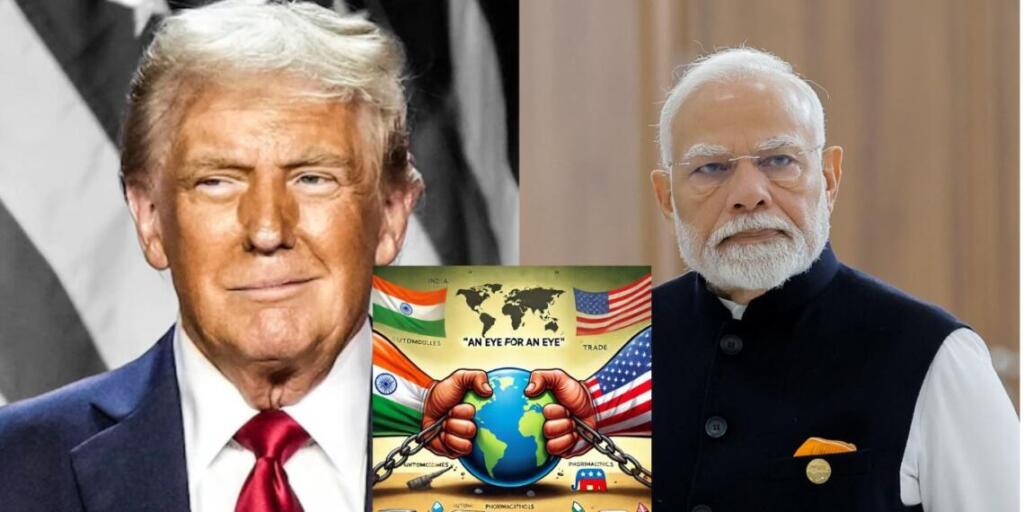
In a bold and unapologetic response, India has fired back at US President Donald Trump following his threat to hike tariffs on Indian goods over New Delhi’s purchase of Russian oil. In what can only be described as a diplomatic slapdown, the Indian government has not only rejected Trump’s accusations but also exposed the blatant double standards of the US and European Union. At a time when global cooperation is paramount, the US President’s rhetoric reflects a dangerous blend of economic blackmail and geopolitical hypocrisy. India has made it clear: it will not be bullied, and it will protect its national interest at any cost.
Double Standards on Russia Trade Laid Bare
India’s Ministry of External Affairs (MEA) issued a powerful statement late Monday, emphasizing that New Delhi’s energy imports from Russia are a necessity compelled by the global market. The MEA didn’t hold back, reminding Washington that it had initially encouraged Indian purchases of Russian oil following the Ukraine conflict to stabilize global energy markets. But now, when India continues that same policy, it is suddenly being targeted.
India pointed out that the very nations criticizing its imports are still deeply entrenched in trade with Moscow. The MEA highlighted that the European Union had a bilateral trade of €67.5 billion in goods with Russia in 2024, along with services worth €17.2 billion. European LNG imports from Russia reached a record 16.5 million tonnes in 2024 – far exceeding India’s oil imports. The hypocrisy could not be clearer.
The US itself has not cut its own Russian imports. America continues to buy Russian uranium hexafluoride for its nuclear sector, palladium for electric vehicles, and even fertilizers and chemicals. So, while Trump rages about India’s “massive” oil purchases, his own country is quietly profiting from similar trade.
India’s Shift to Russian Oil: A Market-Driven Reality
India’s decision to import discounted oil from Russia came only after traditional suppliers from the Middle East diverted shipments to Europe. As a sovereign nation, India adjusted its strategy to meet its energy security needs. This is not profiteering, as Trump alleges, but responsible governance in response to global disruption.
What makes Trump’s accusations even more absurd is that during the initial phase of the war, the US privately and publicly encouraged India to buy Russian oil to keep global markets stable. This makes Trump’s moral grandstanding now not only hypocritical but completely detached from diplomatic reality.
Trump’s social media attack, claiming India is “selling oil for big profits” while turning a blind eye to Ukraine, reeks of political opportunism rather than a genuine concern for human rights or global peace.
India Vows to Defend Economic Sovereignty
India’s response to Trump’s tariff threat was unflinching. “India will take all necessary measures to safeguard its national interests and economic security,” the MEA declared. New Delhi made it clear that targeting India was both “unjustified and unreasonable.”
Trump has already announced a sweeping 25% tariff on Indian goods starting August 7 and has threatened further penalties unless India stops buying Russian energy. But this aggressive posture has only solidified India’s resolve. With strong domestic manufacturing, strategic partnerships across Asia, and diversified markets, India is more than capable of weathering economic storms.
External Affairs Minister S. Jaishankar, speaking in New Delhi earlier on Monday, reinforced India’s desire for a “fair global order,” not one dominated by a select few. “We do not believe in the hegemony of power, but in mutual respect and fairness,” he said.
Trump’s Tariff Rhetoric: Dangerous and Counterproductive
Trump’s threat to impose tariffs up to 100% on countries buying Russian oil, unless a peace deal is reached by August 7-9, raises serious concerns about how US foreign policy is being weaponized for domestic politics. His comments targeting India are particularly alarming, given the two countries’ close strategic and defense ties.
Such statements not only threaten bilateral relations but also risk pushing India further toward economic self-reliance and diversification away from the US market. For a country that the US counts as a democratic partner in the Indo-Pacific, these strong-arm tactics are both shortsighted and damaging.
India Refuses to Be Lectured or Coerced
India’s strong rebuttal to the US tariff threats is not just a defense of its energy policies but a bold assertion of its sovereignty. New Delhi has reminded the world that selective outrage and moral posturing will not go unchallenged. The double standards of the US and EU have been exposed, and India has made it clear that it will not sacrifice its economic stability to appease an inconsistent foreign partner.
In a time of global uncertainty, India’s clarity of purpose and strategic autonomy send a powerful message: national interest is non-negotiable. The world would do well to respect it.