
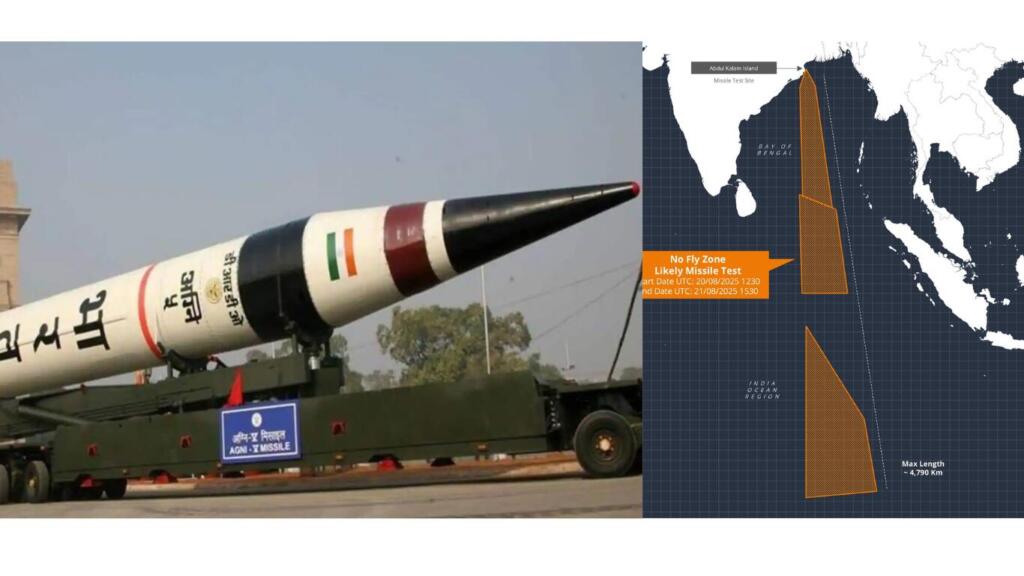
In a powerful signal of its growing defence capabilities, India has issued a Notice to Airmen (NOTAM) stretching an unprecedented 4,795 kilometres into the Indian Ocean for a major missile test scheduled on August 20–21. The sheer size of this no-fly, no-sail zone far beyond previous test ranges points to a high-powered trial that could involve a cutting-edge variant of the Agni series or even an advanced intercontinental ballistic missile (ICBM).
Defence watchers see this as more than a routine launch. It’s a demonstration of New Delhi’s resolve to strengthen its deterrence, expand its operational reach deep into the Indo-Pacific, and ensure India remains ahead in the strategic competition with regional adversaries.
The 4,795 km NOTAM: A Bold Statement of Capability
The NOTAM, issued by Indian authorities, marks a massive danger zone starting from the Odisha coast and stretching deep into the Indian Ocean Region (IOR). Such notices are essential to safeguard civilian air and maritime traffic during live-fire trials. But in this case, the length and direction of the zone have triggered widespread speculation.
Experts believe the extended range could mean tests of either the Agni-6 — a next-generation ICBM capable of exceeding 6,000 km — or a hypersonic missile system under development by the Defence Research and Development Organisation (DRDO). This distance puts nearly the entire Asian landmass, parts of Europe, and Africa within hypothetical strike range — a leap in capability that would place India firmly among the world’s elite missile powers.
DRDO’s Push for Long-Range Self-Reliance
This test comes on the heels of over 10 missile and weapons system trials conducted by India in 2025 alone. These include:
-
Pralay Quasi-Ballistic Missile – Precision strikes up to 500 km.
-
Akash Prime – An upgraded surface-to-air missile, tested successfully in July.
-
Ongoing BMD (Ballistic Missile Defence) trials – Designed to intercept incoming threats before they can hit Indian soil.
India’s missile programme — under the Atmanirbhar Bharat (self-reliant India) banner — aims to cut dependency on foreign technology, create a fully indigenous long-range strike arsenal, and strengthen national security. DRDO’s sustained progress has already delivered the Agni-V (5,000+ km range) and boosted India’s second-strike capability.
Strategic Context: Responding to Regional Threats
The upcoming trial carries enormous strategic weight. China has rapidly expanded its long-range missile inventory, while Pakistan continues to invest in nuclear-capable delivery systems and operates terror camps that have targeted India for decades.
By extending its missile reach, India is signalling both defensive preparedness and offensive deterrence. Long-range capabilities give New Delhi the ability to safeguard shipping lanes, project power across the Indo-Pacific, and respond decisively to any aggression — conventional or nuclear.
India’s missile arsenal today includes:
-
Surface-to-Air Missiles (SAMs) – Defence shield against aerial threats.
-
Air-to-Air Missiles (AAMs) – For air superiority and beyond-visual-range engagements.
-
Surface-to-Surface Missiles – Tactical and strategic precision strike options.
-
Ballistic Missile Defence systems – Multi-layered protection against hostile missile attacks.
India’s Missile Test Signals a New Strategic Era
With a 4,795 km NOTAM, India isn’t just testing a missile — it’s testing the limits of its strategic influence and technological mastery. This high-stakes trial will showcase the country’s readiness to defend its borders, secure its maritime interests, and deter adversaries far beyond its shores.
Every successful long-range test strengthens India’s place among global powers capable of not just defending their territory, but shaping the security environment of entire regions. In an era where deterrence is as critical as diplomacy, India’s missile programme ensures that the nation’s sovereignty is non-negotiable and its defence capabilities uncompromising.