
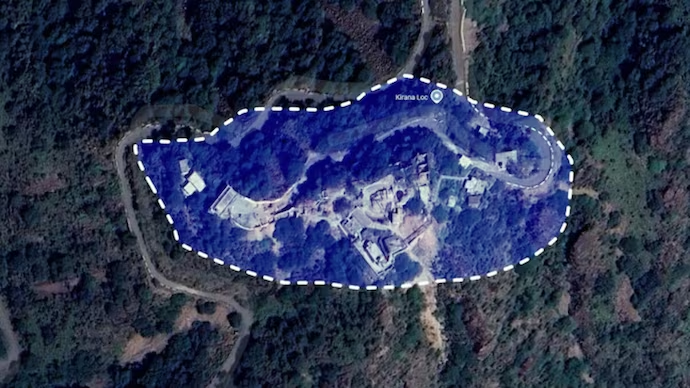
When Indian missiles rained down during Operation Sindoor, Islamabad’s nuclear deterrence strategy was shaken. But the alleged strike at Kirana Hills, a suspected nuclear storage site has now become the centerpiece of a bigger geopolitical storm.
What began as speculation about India striking Pakistan’s nuclear-linked Kirana Hills has escalated into a far bigger claim: that New Delhi may have inadvertently destroyed a secret American nuclear stockpile hidden in Pakistan’s Punjab province.
The claim comes from none other than former ambassador Shri Deepak Vohra, who has suggested that Washington’s unusual unease with India in recent weeks is not merely over New Delhi’s daring strike across the border, but over a direct hit on a covert U.S. nuclear stockpile that was hidden in case it has to target Russia.
The Kirana Hills
Located in Sargodha district of Pakistan’s Punjab province, the Kirana Hills is a rugged terrain and a designated area under Pakistan ministry of defence in Sargodha district. Locally referred to as the “Black Mountains” due to its brownish terrain, it stretches between the township of Rabwah and the city of Sargodha., linked via underground tunnels to the Mushaf Airbase, is widely believed to host part of Pakistan’s nuclear weapons infrastructure.
During Operation Sindoor, when India retaliated against Pakistan’s escalations in May 2025, social media was flooded with videos of smoke plumes rising from the base of the Kirana Hills. Rumors spread immediately that India has attacked Pakistan’s nuclear command. The New York Times quoted a former US official familiar with Pakistan’s nuclear programme, noting, “Pakistan’s deepest fear is of its nuclear command authority being decapitated.”
At the time, the Indian military denied targeting Kirana Hills. But in July 2025, Damien Symon, a respected geo-intelligence researcher and Open-Source Intelligence (OSINT) expert, released fresh analysis of Google Earth imagery from June 2025.


“Imagery update from Google Earth of the Sargodha region, Pakistan, captured in June 2025, shows the impact location of India’s strike on Kirana Hills in May 2025,” Symon wrote on X.
He clarified that the impact scar suggested a surface-level warning strike rather than a deep subterranean penetration but emphasized that the strike nevertheless showed India’s capability to hit nuclear-linked infrastructure if provoked.
The Kirana Hills were not the only target. India’s strikes during Operation Sindoor reportedly hit critical Pakistani airbases, including Nur Khan Airbase in Chaklala near Rawalpindi, uncomfortably close to the headquarters of Pakistan’s nuclear command authority.
By hitting both strategic airbases and signaling the ability to reach Kirana Hills, India sought to shatter Pakistan’s long-standing nuclear deterrence bluff.
The American Twist
But the story took an unexpected turn when Shri Deepak Vohra claimed that the strike may not just have rattled Pakistan, but also the United States.
According to him, the target at Kirana Hills wasn’t merely Pakistan’s nuclear stockpile, it was a U.S. nuclear cache secretly stationed there to target Russia during the Cold War era and allegedly maintained afterward.
If this claim is accurate, it would mean India’s strike didn’t just embarrass Islamabad but also dealt a direct blow to America’s covert strategic interests. Such a scenario would explain why Washington, despite its growing partnership with New Delhi, has appeared visibly unsettled in the weeks following Operation Sindoor.
For now, the official narrative remains unchanged:
The Indian military denies striking Kirana Hills.
OSINT experts insist the evidence shows only a warning strike with no deep damage.
Pakistan has remained relatively muted on the subject, perhaps wary of confirming any vulnerability in its nuclear storage sites.
Yet, with a senior Indian diplomat Deepak Vohra suggesting that America’s nuclear secrets may have been caught in the crossfire, the story has grown from a regional skirmish to a potential global strategic flashpoint.