
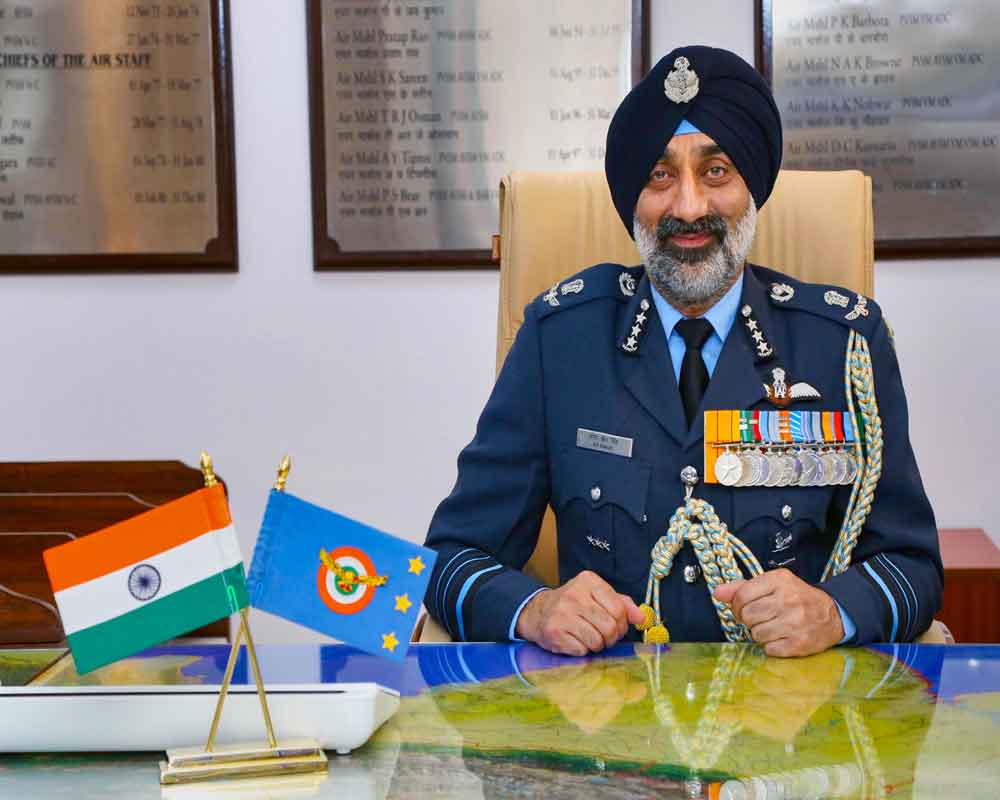
In a forthright disclosure, Indian Air Force (IAF) Chief Air Chief Marshal A.P. Singh has outlined the extensive damage inflicted on Pakistan’s air assets during Operation Sindoor, carried out between May 7 and May 10 this year. Speaking at the Air Chief Marshal L.M. Katre Memorial Lecture in Bengaluru, Singh revealed that Indian forces destroyed five Pakistani fighter aircraft and a specialised surveillance plane, marking one of the most significant air defence operations in recent history.
According to Singh, the operation targeted high-value Pakistani Air Force facilities in retaliation for the Pahalgam terror attack. Notable among these strikes was the bombardment of parked F-16 jets at Shahbaz Airbase in Jacobabad, as well as the destruction of an Airborne Early Warning and Control (AEW&C) or ELINT (Electronic Intelligence) aircraft at Bholari airbase.
“Shahbaz Jacobabad was one of the major airfields we hit. Half of an F-16 hangar was destroyed, and it is certain that several aircraft inside sustained heavy damage,” Singh said. He added that strikes also crippled at least two command-and-control centres at Murid and Chaklala, along with six radar installations of varying capacities.
Singh said that one of the most remarkable feats of the operation was the long-range surface-to-air missile engagement, which brought down a large Pakistani surveillance aircraft from a distance of approximately 300 kilometres, the longest such kill on record. “We have confirmation of at least five fighter jets and one large aircraft being destroyed,” he said, adding that satellite imagery confirmed the extent of the damage.
Precision Targeting and Strategic Message
The IAF Chief emphasised that the selection of targets was deliberate and strategic. Unlike previous operations, the focus was not confined to militant launchpads. “We made it clear that the message this time would be emphatic and unmistakable. We went beyond launchpads to challenge the terror leadership directly,” Singh said.
The operation was a coordinated effort involving all three services and eight different intelligence and security agencies. Nine key targets were chosen, including militant headquarters in Bahawalpur and Muridke. Singh credited India’s newly inducted S-400 air defence system for denying Pakistan the ability to use its long-range glide bombs, forcing their aircraft to operate well outside their intended strike range.
Lessons from Balakot
Drawing a contrast with the 2019 Balakot strikes, Singh said that while Indian intelligence had clear evidence of the damage and militant casualties back then, the lack of visible proof made it difficult to convey the success to the public. “This time, we were able to demonstrate and share the results with clarity, putting to rest the doubts that lingered after Balakot,” he noted.
What Led to Ceasefire?
Operation Sindoor concluded on May 10 after Pakistan’s Director General of Military Operations approached India seeking a ceasefire. Singh defended the government’s decision to stop the operation at that point. “Our aim was to teach terrorists a lesson, not to engage in a prolonged war. In just 80 to 90 hours, we inflicted significant damage, making it evident to Pakistan that continued hostilities would cost them dearly,” he said.
The IAF Chief stressed the importance of balancing military success with strategic restraint. “Some people urged me to continue the strikes, but the nation cannot be in a constant state of war. Once objectives are met, we must look for windows to de-escalate,” he remarked.
Singh attributed the operation’s success to strong political resolve and the absence of operational restrictions. “Air power has once again proven to be the first responder in such crises. This was a high-tech, precision operation, a demonstration of our capabilities and determination,” Singh concluded.
Operation Sindoor, now officially acknowledged in detail for the first time, stands as one of the most decisive and strategically impactful aerial campaigns conducted by the Indian Air Force in recent years.