














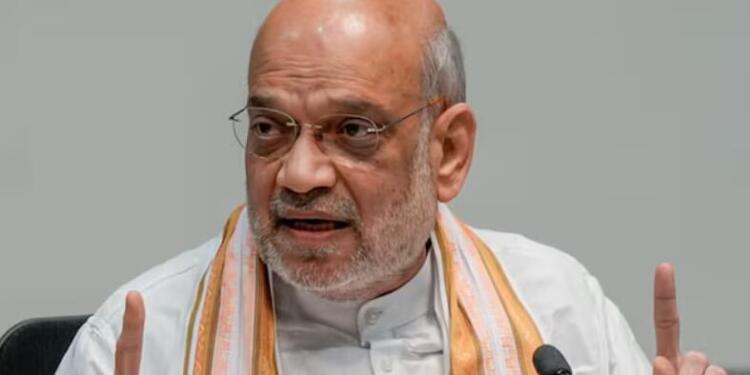
Union Home Minister Amit Shah cut through the noise around the NDA’s vice-presidential candidate CP Radhakrishnan’s Rashtriya Swayamsevak Sangh roots. Speaking in an interview on Monday, Shah turned the opposition’s charge on its head asking if serving the nation through an organisation that has nurtured generations of leaders should be considered a liability. “The Prime Minister has a connection with RSS, I also have a connection with RSS. Has the country chosen us because we are from RSS? Is having connection with RSS a minus point? Atal Bihari Vajpayee, Advani, Modi all are also connected with RSS… Even I’m connected with RSS” Shah Said with this pointed remark. Ffor Home Minister, the attack on RSS is nothing but an attack on India’s cultural backbone and democratic ethos.
RSS Is Not a Liability, But a Source of Leadership
Amit Shah was categorical in rejecting the opposition’s “RSS bogey.” He reminded that some of the tallest leaders of India’s post-independence era from Atal Bihari Vajpayee to LK Advani, and now Prime Minister Narendra Modi have had deep roots in the RSS. Far from being a weakness, Shah argued, it was the Sangh’s discipline, training, and commitment to service that shaped their leadership.
“Is it wrong to be connected with an organisation that has devoted itself for nearly a century to nation-building, social service, and character-building?” Shah asked. The Home Minister highlighted how the RSS has been instrumental in disaster relief, rural development, and cultural preservation. Instead of being maligned, it should be celebrated as a nursery of leadership.
By endorsing CP Radhakrishnan, a veteran with decades of political and administrative experience, the NDA has reaffirmed its belief that RSS-bred leaders are not only competent but deeply rooted in India’s ethos.
CP Radhakrishnan: A Lifetime of Service Beyond Politics
Shah strongly backed the NDA’s choice of Maharashtra Governor CP Radhakrishnan for the vice-presidential race, dismissing opposition claims that it was a move to woo Tamil Nadu voters. “Radhakrishnan has a long political life. He has been a two-time MP, a party president in Tamil Nadu, and has served as Governor in multiple states. He has led a clean public life and is a mature politician,” Shah said.
Born in Tiruppur, Tamil Nadu in 1957, Radhakrishnan’s political journey began in the Jan Sangh and RSS. His breakthrough came with his 1998 Lok Sabha victory from Coimbatore, after which he became one of the BJP’s most prominent southern leaders. Over the decades, he has been entrusted with key responsibilities from party-building in Tamil Nadu to gubernatorial stints in Jharkhand, Telangana, Puducherry, and Maharashtra.
Shah added that there was also a natural balance in choosing a vice-presidential candidate from the South, given that the President hails from the East, and the Prime Minister represents the West and North. This, he argued, reflects the NDA’s respect for India’s federal spirit and regional inclusiveness.
130th Constitutional Amendment: A Reform Against Political Immorality
Another key highlight of Shah’s interview was his defense of the 130th Constitutional Amendment Bill, which mandates that any Chief Minister, Union Minister, or even the Prime Minister, if jailed for more than 30 days on charges carrying a minimum five-year sentence, must resign.
“This is not about destabilising governments, it is about upholding the dignity of democracy,” Shah said. “Can a Prime Minister or Chief Minister run the government from jail? Will officers report to a leader who is behind bars? The Opposition wants to keep loopholes open so that they can misuse power even when convicted or under trial.”
Shah reminded that far from shielding himself, Prime Minister Modi has applied the amendment to his own office. In stark contrast to Indira Gandhi’s 39th Amendment, which sought to shield the PM from judicial scrutiny, Modi has pushed through reforms that would force him to resign if jailed. “This shows the difference in intent we are not here to protect power, we are here to protect democracy,” Shah asserted.
Opposition’s Hypocrisy and the Politics of Disruption
Amit Shah also took on the opposition for branding the reform bills as “black laws” and stalling parliamentary discussions. He argued that the very purpose of Parliament was debate and legislation, not endless disruption.
“Every party can give its opinion, every MP can vote according to conscience. But is it democratic to not even allow a bill to be tabled?” Shah asked. He accused opposition parties of fearing accountability, because many of their top leaders face corruption cases and judicial proceedings.
“The country cannot be run from jail cells. Our democracy deserves better,” Shah thundered, adding that the BJP fully rejects the notion that governance should be held hostage to the personal fortunes of a single leader or dynasty.
RSS Roots, National Responsibility
In his interview, Amit Shah reframed the debate on the RSS connection. The opposition, he said, wants to stigmatise the RSS because it represents cultural nationalism and selfless service values that run counter to dynastic politics. But the reality is that the RSS has given India leaders who have restored dignity to public life, from Vajpayee’s statesmanship to Modi’s transformative governance.
Backing CP Radhakrishnan’s candidacy, Shah underscored that RSS affiliation should not be a point of shame, but of pride. For the NDA, the question is not whether someone was shaped by the Sangh, but whether they embody integrity, maturity, and dedication to national duty.
As Shah reminded the nation: “The Prime Minister has a connection with RSS, I also have a connection with RSS. Has the country chosen us because we are from RSS? Is having connection with RSS a minus point?” For millions of Indians, the answer is clear it is not a minus, but a foundation of trust.