
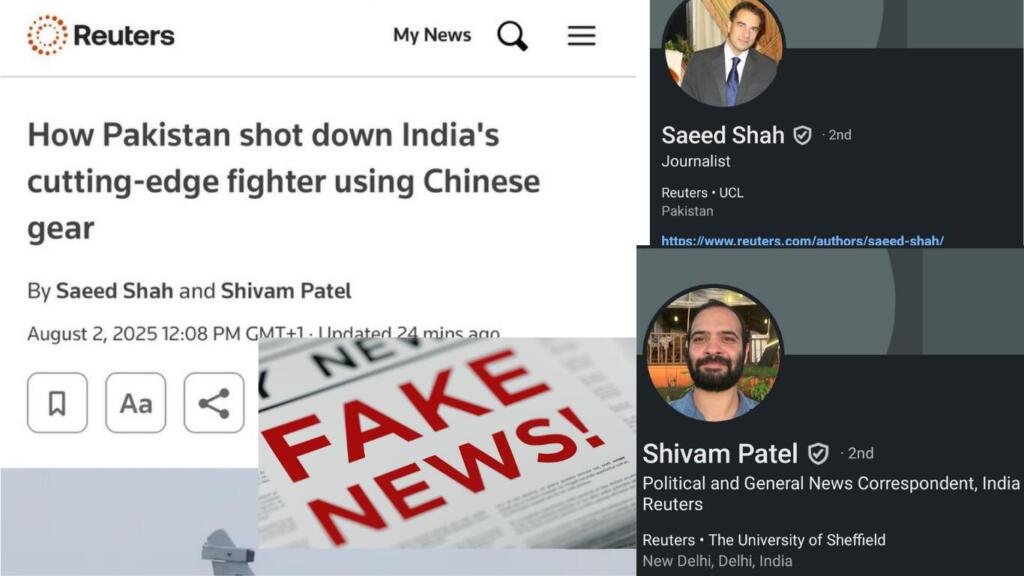
In a shocking new article published on August 2, Reuters once again proved it has veered far from journalism into outright propaganda. This time, it claimed without any verified sources that Pakistan’s Chinese-imported J-10C jets shot down Indian Rafale fighter aircraft during Operation Sindoor. The article was co-written by Shivam Patel, who earlier falsely claimed that India attacked Pakistani Kashmir, and Saeed Shah, a known Pakistani propagandist operating under the guise of a journalist. This baseless piece isn’t just poor reporting it’s part of an orchestrated campaign by Reuters to malign India’s image, promote Pakistani military success fantasies, and present Chinese technology as superior without factual backing.
Peddling Pakistani Fantasy as News
The August 2 report shamelessly claimed that Indian fighter jets were shot down using Chinese-made PL-15 missiles from J-10C jets in possession of Pakistan. Reuters cited anonymous officials and gave the narrative almost entirely from the Pakistani side. There was no confirmation from Indian authorities, no evidence presented by Pakistan, and no eyewitness accounts to verify the alleged downing of Indian aircraft. In fact, even two months after Operation Sindoor, neither India nor Pakistan has presented verifiable proof that Indian aircraft were shot down. But that didn’t stop Reuters from publishing a narrative that reads more like a Chinese arms manufacturer’s advertisement than a neutral report.
The so-called “exclusive” didn’t even bother to include a single quote or viewpoint from the Indian side. No Indian Air Force spokesperson, no defence analyst from India, and no official documentation just a story shaped around Pakistani claims and unnamed sources.
Colonial Hangover and Anti-India Bias
Reuters, a British news agency headquartered in London, has long harboured a colonial-era lens while reporting on India. Despite India being the world’s largest democracy and the fourth-largest economy in 2025, Reuters continues to project the country as unstable, weak, or a regional bully. Its reporting is increasingly marked by condescension, one-sided sourcing, and misleading headlines.
During Operation Mahadev in Kashmir, when Indian forces neutralized three Pakistani terrorists responsible for the murder of 26 civilians in Pahalgam, Reuters ran a headline referring to them as “men.” The article read like an obituary for the terrorists rather than a factual report on a counterterrorism operation. Following public backlash, Reuters quietly altered the headline but offered no apology or correction.
This pattern isn’t isolated. In article after article, Reuters refers to Jammu and Kashmir as “Indian-administered Kashmir” while calling Pakistan-occupied territories simply “Pakistani Kashmir,” revealing an unmistakable bias in terminology that aligns with Islamabad’s talking points.
Falsehoods About India’s Strategic Programs and Crises
Reuters has consistently spread misinformation about India’s strategic operations and national tragedies. During the 2025 Air India crash in Ahmedabad, before even the preliminary investigation report was made public, Reuters rushed to blame the Indian pilots. Their coverage aggressively framed the incident as human error, conveniently clearing Boeing of any scrutiny despite historical safety concerns with its aircraft models.
Even when the Aircraft Accident Investigation Bureau (AAIB) issued a preliminary report, Reuters used cherry-picked information to once again scapegoat the Indian crew. Not a word was said about potential technical or manufacturing faults, giving Boeing a suspiciously clean chit.
Similarly, during India’s covert operations like Operation Sindoor and Operation Mahadev, Reuters has systematically chosen narratives that elevate China and Pakistan while undermining India’s capabilities. Whether it’s lauding Pakistan’s military “successes” or exaggerating the efficacy of Chinese weapons, Reuters is consistently on the wrong side of the truth when it comes to reporting on India.
Manipulating Economic Narratives to Undermine India
Reuters has also attempted to meddle with India’s economic diplomacy. In one instance, it claimed that India had reduced oil purchases from Russia under pressure from the United States after President Trump’s tariff threats. The article cited unnamed “sources,” without clarifying their roles or credentials. This claim was promptly debunked by Indian government officials who clarified that no such instructions were given to oil companies.
Even The New York Times reported, citing Indian officials, that India’s energy policy remained unchanged and sovereign. Yet Reuters stuck to its narrative, portraying India as submissive to Western pressure, further revealing its intent to malign India’s global image rather than uphold facts.
Reuters No Longer Reports, It Propagandizes
Reuters’ August 2 article about Indian Rafales being shot down by Pakistani J-10Cs is just the latest entry in a long list of biased, unverified, and malicious reports designed to hurt India’s image and credibility. The outlet is no longer just a news agency it has become a megaphone for Chinese arms PR and Pakistani military fantasies. Whether it’s distorting facts around Kashmir, hiding behind anonymous sources, or deliberately excluding Indian perspectives, Reuters has shown it cannot be trusted as a fair or factual source on Indian affairs.
India has changed, but Reuters hasn’t. Its colonial mindset, pro-Pakistan tilt, and willingness to manufacture stories against India signal a deeper problem with the way some Western institutions still perceive and portray the global South. It’s time for Indian readers, officials, and institutions to call this out, demand accountability, and amplify narratives that truly reflect the nation’s strength, truth, and sovereignty.