
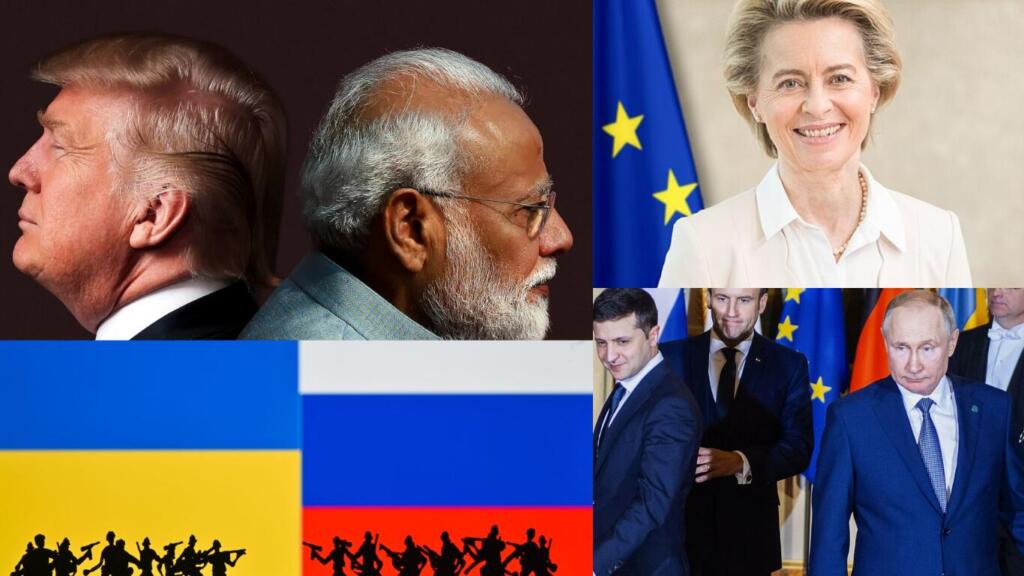
Global geopolitics is rarely straightforward but in 2025, the chessboard is more layered than ever. A trade war with the United States, a grinding conflict in Ukraine, and a shifting balance between Europe and Asia have all placed India at the very centre of this game. While US President Donald Trump escalates his tariff war by slapping a shocking 50% duty on Indian goods, New Delhi is simultaneously emerging as the only credible mediator capable of bringing Russia and Ukraine to the negotiating table.
But this development has rattled Europe. Germany, France, and the UK historically America’s closest allies now appear reluctant to let India broker peace, fearing their own stakes in Ukraine will be undercut. The recent German media report claiming Prime Minister Narendra Modi ignored Trump’s calls, which many see as a deliberate leak to embarrass India, is not just gossip it is a signal of how high the stakes truly are.
India’s Unexpected Role in a Potential Peace Deal
If the pieces are examined closely, the emerging pattern is striking. Trump has already held separate meetings with EU leaders, President Putin, and President Zelensky in pursuit of an end to the war. At the same time, Prime Minister Modi is set to meet Putin in China during the Shanghai Cooperation Organisation (SCO) summit, while Zelensky is reportedly preparing for his own visit to India. President Putin is also planning a state visit to New Delhi.
For Moscow, India presents the perfect bridge. Putin cannot be seen as bowing directly to Trump’s pressure. Instead, presenting Modi as a neutral mediator provides Moscow with political cover. For Kyiv, India’s growing global stature offers legitimacy without alienating Western backers. This positions India not just as another participant but as the linchpin for peace a rare role for any non-Western power in modern history.
Why Trump Wants Peace and Why Europe Does Not
The motivations of the players are sharply divergent. Trump has a clear incentive to push for a quick resolution. His primary interest lies in securing control over Ukraine’s $16 trillion worth of rare earth minerals and positioning American firms for lucrative reconstruction contracts. Ending the war swiftly would also lift sanctions on Russia, opening vast new trade opportunities.
Moreover, Trump’s own crypto fund, WLF, stands to benefit if de-dollarization accelerates and alternative trade systems take root once Russia is reintegrated into global markets. For Trump, a mediated settlement through India is not a foreign policy victory.
The EU on the other hand has already poured more than $200 billion into Ukraine, including loans, military aid, and economic support. France, Germany, and the UK view this as a long-term investment. A premature end to the war engineered under Trump’s leadership would mean Washington reaping the rewards while Europe loses leverage. By prolonging the conflict, European powers hope to recover loans, secure access to Ukraine’s resources, and ensure Zelensky remains dependent on European support.
The Tariff Twist: Why Trump is Squeezing India
This brings us to the puzzling question: if Trump needs peace, why did he hit New Delhi with such punishing tariffs?
Analysts point to three overlapping reasons:
-
Geopolitical Distraction – Trump campaigned on tough tariffs. By targeting India, he diverts domestic attention from the lack of major breakthroughs elsewhere. India becomes a symbolic “victory” he can showcase to his MAGA base.
-
Pakistan Angle – Reports suggest Trump is eyeing rare earth mineral rights in Pakistan’s Khyber Pakhtunkhwa region. By pressuring India, he also seeks to amuse Pakistan’s military establishment, particularly under Army Chief Asim Munir, who has already begun displacing locals in mineral-rich zones.
-
Dollar Anxiety – India’s advanced financial infrastructure and experiments with local-currency trade make it a prime example of how to bypass the dollar. By cornering India with tariffs, Trump signals to others that economic independence from the U.S. comes at a steep price. Yet paradoxically, this may only accelerate de-dollarization, as more nations look to India’s model of alternative trade and crypto integration.
In short, Trump’s tariffs are not just about economics they are tactical moves in his broader game of ego, arm-twisting, and strategic bargaining.
Europe’s Counter-Moves: Media Leaks and Ego Battles
The German media report alleging that Modi ignored Trump’s calls fits neatly into this puzzle. If true, it damages Trump’s image as a dealmaker who commands global attention. If false or exaggerated it still serves Europe’s purpose of sowing distrust between Washington and New Delhi.
Such leaks highlight Europe’s unease at being sidelined. For decades, transatlantic ties ensured Europe shared in America’s global power. But with Trump’s open hostility toward EU leaders and his transactional style, Europe risks irrelevance. By undercutting India’s mediating role, EU powers hope to delay peace until after Trump’s presidency, giving themselves more time to shape the eventual settlement.
In essence, Ukraine has become not just a battlefield for sovereignty but a geopolitical marketplace where the U.S., EU, Russia, and now India all jostle for advantage.
India at the Center of the Chessboard
The Russia-Ukraine war has become more than a regional conflict it is a global contest over resources, influence, and economic futures. For Trump, ending the war through Indian mediation would be a crowning achievement. For Europe, delaying peace ensures their investments yield returns. For Russia and Ukraine, India offers a neutral hand that neither Washington nor Brussels can provide.
And for India, the stakes are immense. Tariffs, media leaks, and diplomatic pressure all highlight its growing influence in shaping world affairs. By navigating these challenges, New Delhi is not just defending its interests but also redefining the very architecture of global diplomacy.
At this critical juncture, India is no longer just a participant in geopolitics it is the center of the board, the square around which the great powers are moving. Whether Modi chooses to seize this role as mediator could determine not only the future of the Russia-Ukraine war but also the balance of global power in the years to come.