
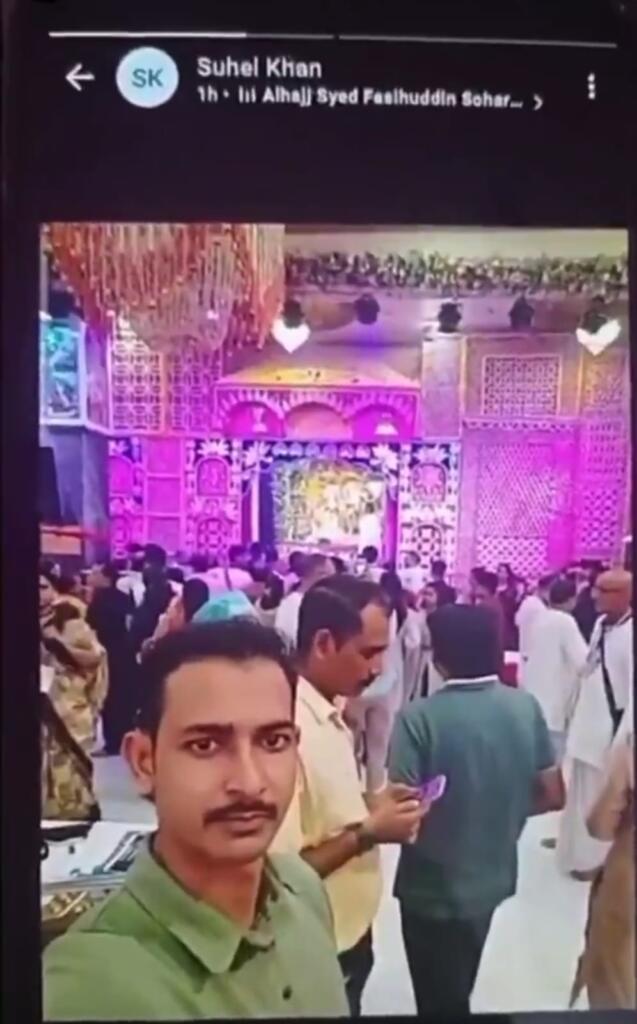
A police constable in Uttar Pradesh’s Ghaziabad has been benched and faces a departmental inquiry after a video he uploaded on social media created an upheaval. The constable, Sohail Khan, was stationed at the Madhuban Bapudham police station and had visited a temple on the occasion of Janmashtami.
During his visit, Khan clicked a selfie inside the temple premises and later uploaded it as his WhatsApp status. What turned the otherwise harmless photo into a controversy was the background music attached to the video. The song contained the words: “There is no god but Allah, and none is worthy of worship except Him.”
Outrage Over Religious Sentiments
The WhatsApp status quickly spread beyond Khan’s contact list and began circulating widely on social media platforms. Soon, it drew sharp reactions from Hindu organisations and activists who accused the policeman of hurting religious sentiments.
Members of groups like the Hindu Raksha Dal condemned the act, claiming that Khan’s use of the Islamic chant in a Hindu temple setting was deliberate and provocative. The organisation’s president, Pinky Chaudhary, went so far as to allege that the constable was using his police uniform to spread Islam and encourage conversions.
As criticism mounted, several social media users directly tagged the Ghaziabad Police, demanding action. Hashtags and posts calling for disciplinary measures against Khan gathered momentum, forcing the police administration to respond.
Confirming the controversy, Commissioner of Police Alok Priyadarshi acknowledged the seriousness of the matter. He announced that the case had been handed over to the Assistant Commissioner of Police (ACP) Kavinagar for a thorough inquiry.
Pending the outcome of the investigation, Sohail Khan has been relieved of his active duties and shifted to the bench. Alongside this, a departmental inquiry has been ordered to establish whether his actions were intentional and whether they violated the conduct expected of law enforcement personnel.
The incident has once again highlighted the sensitivity surrounding social media activity by men in uniform. Police personnel, by virtue of their role, are expected to remain neutral and secular in their public conduct. Even seemingly personal posts can quickly spiral into controversies when they touch upon religion, community, or politics.
Observers point out that such cases underline the need for stricter guidelines and awareness among police officers regarding the potential consequences of their digital footprints. In a country as religiously diverse as India, even a short video or WhatsApp status can carry far-reaching implications.
For now, the episode serves as a reminder of how personal expression on digital platforms can clash with professional responsibilities, particularly when religious sentiments are involved.