
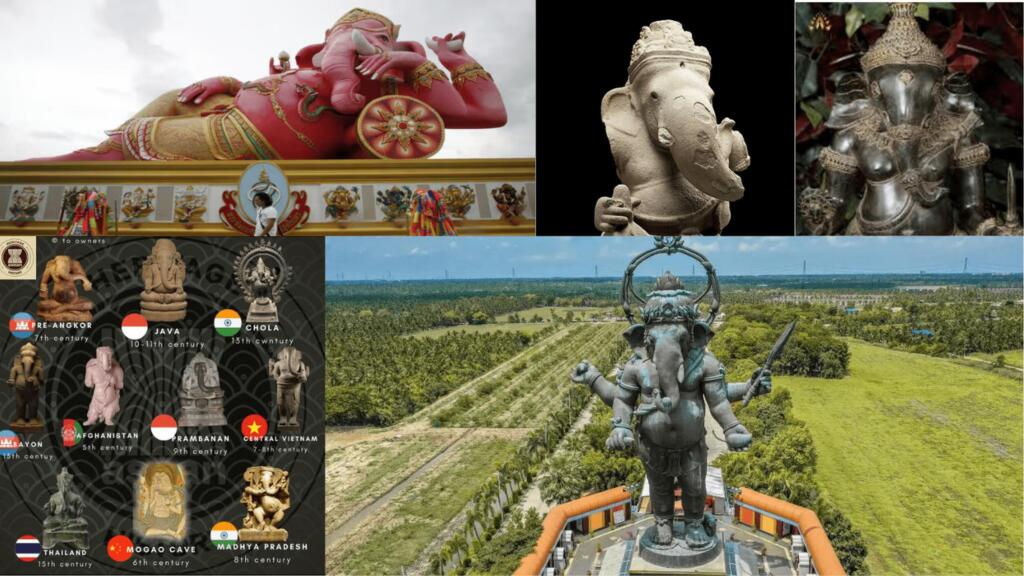
Across Southeast Asia, far from the sacred banks of the Ganga and Yamuna, Ganesha continues to command reverence as the Remover of Obstacles, the Lord of Beginnings, and the God of Wisdom and Prosperity. His presence in Cambodia, Vietnam, Indonesia, Thailand, and beyond is not merely an echo of India’s cultural past, but a testimony to the living power of Sanatana Dharma that transcended borders, carried by merchants, saints, artisans, and kings. Even today, the serene and majestic stone idols of Ganesha found in the temples of Angkor, Champa, or Java remind us that Hinduism has always been a global spiritual force uniting civilizations with its timeless values of dharma, prosperity, and inner strength.
Indian Influence in Ancient Cambodia and Beyond
The journey of Ganesha into Southeast Asia began with the spread of Hinduism through maritime trade and cultural exchange between India and early kingdoms like Funan, Chenla, and Champa. By the early centuries CE, Indian merchants and Brahmin scholars carried not only goods but also scriptures, rituals, and sacred images of Hindu gods. Among them, Ganesha gained a special place, worshipped alongside Shiva, Vishnu, and Devi.
In Cambodia, Ganesha was integrated into the Khmer pantheon, symbolizing the ideals of wisdom, intellect, and success. Kings such as Jayavarman II, who established the Khmer Empire in 802 CE, institutionalized Hinduism as the state religion. This led to the construction of magnificent temples such as Phnom Bakheng, Pre Rup, and Banteay Srei, where sculptures of Ganesha adorned sanctums and shrines.
His worship was not limited to India’s borders it became part of the fabric of Southeast Asia’s religious life, influencing art, politics, and daily rituals.
The Khmer Empire and Ganesha’s Enduring Presence
The Khmer Empire (802–1431 CE) stands as the high point of Hindu influence in Cambodia. Its temple complexes, especially Angkor, remain marvels of Hindu architecture, where gods like Shiva and Vishnu dominate, but Ganesha is never absent.
As the deity of beginnings, Ganesha was invoked at royal ceremonies, temple consecrations, and agricultural festivals. His presence symbolized auspicious beginnings and the removal of all obstacles in statecraft and personal life. Stone idols of Ganesha, often found at the entrances of temples, served as guardians ensuring prosperity and divine blessing upon the kingdom.
Even after Buddhism gradually became dominant in Cambodia, Ganesha’s image and worship survived. He continued to be revered in both Hindu and Buddhist traditions, embodying the universality and adaptability of Sanatana Dharma.
The Cham Civilization and the Vietnamese Stone Ganesha
Further east, in present-day Vietnam, the Cham civilization (2nd–17th century CE) carried forward the Hindu traditions brought from India. The Cham people, deeply influenced by Indian culture, built temples and sculptures dedicated to Shiva, Vishnu, and Ganesha.
The Stone Cham Ganesha sculptures, carved with exquisite craftsmanship, are among the most remarkable artifacts of this era. These statues, often made of sandstone, depict Ganesha with his elephant head, potbelly, and multiple arms holding sacred objects like the axe, lotus, or sweets. They showcase not only artistic brilliance but also spiritual depth.
In Cham society, Ganesha’s role as the remover of obstacles and patron of learning made him central to rituals and daily worship. His images were enshrined in temples and invoked before journeys, trade ventures, or religious ceremonies. The Cham Ganesha is thus a powerful reminder of how deeply Hindu traditions were woven into the very fabric of Southeast Asian civilizations.
Ganesha’s Pan-Southeast Asian Legacy
The reverence for Ganesha is not confined to Cambodia and Vietnam. Across Indonesia (Java and Bali), Thailand, Laos, and Myanmar, his image has been venerated for centuries.
-
In Java, the great Hindu-Buddhist empires of Majapahit and Sailendra placed Ganesha in temple complexes like Prambanan, where his idols still stand.
-
In Bali, Ganesha continues to be worshipped daily in homes and temples, integrated seamlessly into the island’s Hindu rituals.
-
In Thailand, Ganesha is known as Phra Phikanet, worshipped as the god of success and the arts, with shrines dedicated to him across the country.
-
In Myanmar, relics of Hindu temples dedicated to Ganesha survive, bearing witness to centuries of cultural fusion.
This widespread worship illustrates that Hinduism, and Ganesha in particular, offered Southeast Asian civilizations not just religious practices, but a civilizational framework of wisdom, prosperity, and divine order.
Ganesha as Southeast Asia’s Eternal Symbol of Dharma
Ganesha’s journey across Southeast Asia is not just history it is a civilizational story of how Sanatana Dharma spread, adapted, and thrived beyond India’s borders. From the grand temples of Angkor and Champa to the living Hindu traditions of Bali and Thailand, Ganesha remains a symbol of resilience, wisdom, and prosperity.
While Buddhism may dominate the region today, the presence of Ganesha in art, culture, and spirituality proves that Hinduism’s roots are deep and everlasting. His statues, carved centuries ago, still inspire awe, reminding us that the divine power of dharma can never be confined by geography.
For millions across Southeast Asia, Ganesha continues to be the remover of obstacles, the lord of auspicious beginnings, and the eternal guardian of prosperity and knowledge. His legacy stands as a timeless testimony to the strength of Hindu civilization an inheritance that continues to unite cultures across Asia.