
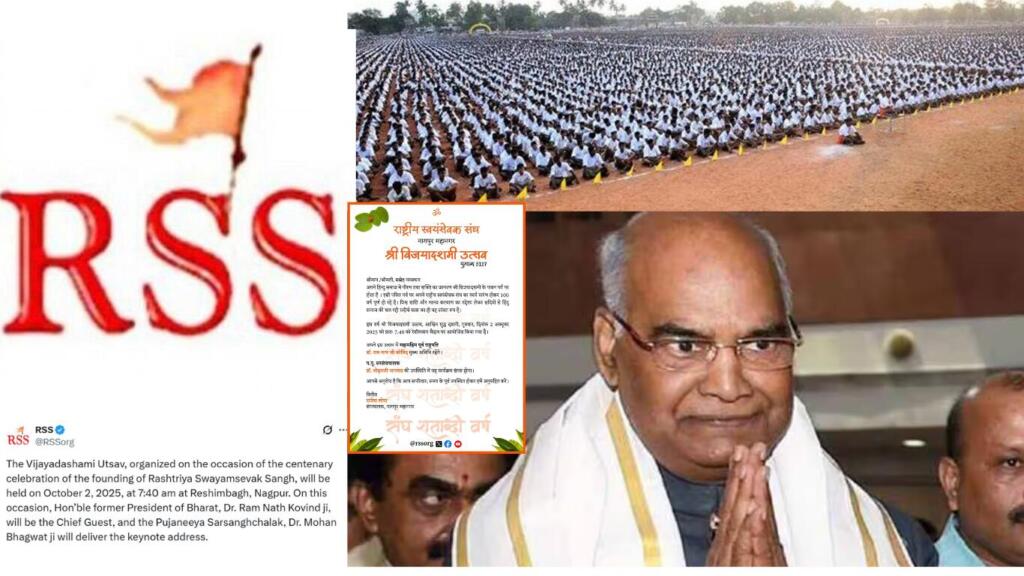
The Rashtriya Swayamsevak Sangh, the backbone of India’s cultural resurgence and the guardian of Sanatan values, is stepping into its centenary year with unmatched pride and vision. What began in 1925 at Reshimbagh as a modest effort to unite the Hindu society has today grown into the world’s largest voluntary organisation, shaping generations with discipline, character, and service to Bharat. As the Vijayadashami Utsav 2025 marks 100 glorious years of the RSS, this historic moment is not just a celebration of the past but a resolute declaration of the Sangh’s unstoppable journey into the future.
“The Vijayadashami Utsav, marking the centenary celebrations of the Rashtriya Swayamsevak Sangh (RSS), will be held on October 2, 2025, at 7:40 am at Reshimbagh, Nagpur. On this historic occasion, Former President of India, Dr. Ram Nath Kovind, will grace the event as the Chief Guest, while Pujaneeya Sarsanghchalak, Dr. Mohan Bhagwat, will deliver the keynote address”, read an RSS official statement on Friday.
Expanding Shakhas and Inclusive Outreach
For its centenary year, the Sangh has set a target: to reach every block in every state across India. Its local branches, or shakhas, are considered the backbone of the organisation. Currently numbering in the lakhs, RSS plans to increase their strength further, taking the number of daily shakhas beyond one lakh this year.
To mark this, the Sangh has also planned a mega outreach programme that will touch almost every section of society. At the heart of this outreach will be ‘Hindu Sammelans’—large-scale gatherings that will take place at the mandal level in rural areas and basti level in urban areas. With 58,964 mandals and 44,055 bastis across the country, this programme is designed to engage people at the grassroots.
The discussions in these sammelans will revolve around social festivals, harmony, and the Panch Parivartan (five transformations):
-
Samajik Samarasata (Social Harmony)
-
Kutumb Prabodhan (Family Enlightenment)
-
Paryavaran (Environmental Awareness)
-
Swa (Selfhood and Indigenous Identity)
-
Citizen Duties
In parallel, Samajik Sadhbhav Baithaks (social harmony meetings) will be organised at 11,360 towns, encouraging dialogue on ideas of Bharat, pride of Bharat, and Bharat’s swa. Under this programme, swayamsevaks will reach out to maximum households in every village, making the centenary not just a celebration but a movement of inclusive social integration.
Broader Vision: Panch Parivartan as the Guiding Message
The RSS leadership has made it clear that the centenary year is not just about remembering the past but about preparing the society for a balanced future. In its earlier statement, the Sangh underlined:
“The nation is progressing economically across all sectors, especially in the realm of technology. But while the country is moving forward, it is not enough to progress solely in terms of economy or technology. It is equally important to uphold the unique characteristics of our society and nation individual welfare, living together harmoniously, and being mindful of the environment.”
This, the RSS said, is why the vision of Panch Parivartan has been placed at the heart of its centenary celebrations. More than a thousand seminars will be organised across India to discuss these values, involving scholars, professionals, and community leaders. The Sangh has also chalked out a detailed global outreach plan, ensuring its message resonates with Hindus and well-wishers abroad.
Celebrations Begin: From Vigyan Bhawan to Nationwide Interactions
The centenary programmes will formally begin on August 26, 2025, with the flagship event titled ‘100 Years of Sangh Yatra – New Horizons’ at Vigyan Bhawan, Delhi. This three-day event (August 26–28) will feature RSS Chief Mohan Bhagwat engaging in dialogues with representatives from 17 fields, including media, diplomacy, religion, academia, and civil society. The event will include lectures, panel discussions, and interactive sessions, symbolising the Sangh’s evolving role in a modern India.
Similar events are scheduled to follow in other cities Bengaluru in November, and Kolkata and Mumbai in February 2026. Significantly, while diplomats from around the world have been invited to these centenary interactions, the Sangh has chosen not to invite diplomats from Pakistan, Turkey, and Bangladesh, underlining its firm ideological position.
PM Modi’s Independence Day Tribute to the RSS
On August 15, 2025, Prime Minister Narendra Modi made a landmark reference in his Independence Day address his first mention of the RSS in 12 such speeches. From the Red Fort, the PM said:
“Today I want to mention one thing with great pride that 100 years ago, an organisation was born the RSS. Its 100 years of national service is a very proud and glorious page.”
Calling the RSS the world’s biggest non-governmental organisation, PM Modi lauded its values of service, dedication, discipline, and organisation. He saluted the swayamsevaks who, for the past century, have worked for vyakti nirman (character building) and rashtra nirman (nation building), dedicating their lives to the welfare of Matrubhumi. “The country is proud of 100 years of dedicated and glorious journey of the RSS. It will keep inspiring us,” he added.
A Century of Service, A Future of Integration
As the RSS marks 100 years of its foundation, its centenary celebrations are far more than ritual events. They represent a grand vision for social unity, cultural pride, and holistic national development. From expanding shakhas and organising Hindu Sammelans across the length and breadth of Bharat, to global outreach and intellectual dialogues, the Sangh’s centenary year underscores its mission to touch every household and profession.
The RSS began in 1925 as a small group with a big idea. A hundred years later, it stands as the world’s largest voluntary organisation, with swayamsevaks dedicated to building individuals and strengthening society. The centenary is thus not merely a commemoration it is a declaration of resolve: to move forward with the principles of Panch Parivartan, ensuring progress is inclusive, sustainable, and deeply rooted in India’s civilisational ethos.