
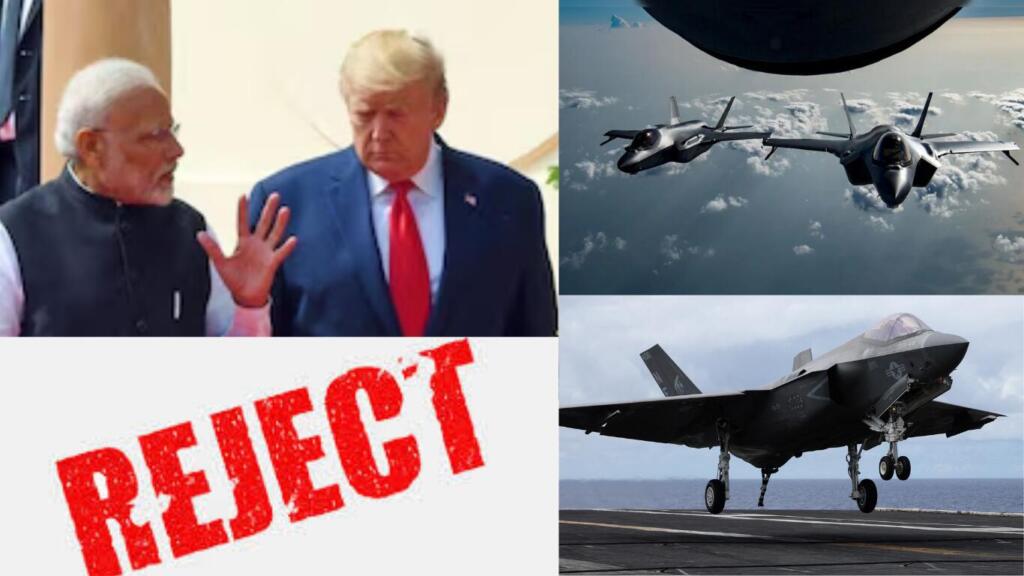
In a significant move that reflects rising trade tensions between India and the United States, New Delhi has reportedly decided not to proceed with the proposed purchase of the American F-35 stealth fighter jets, Bloomberg quoted officials familiar with the matter as saying. This decision comes shortly after US President Donald Trump announced a 25 per cent tariff on Indian exports to the US, citing India’s “high trade barriers” and its continued reliance on Russian defence and energy imports. While India has not announced any retaliatory measures yet, the rejection of the F-35 deal signals a shift in New Delhi’s defence procurement strategy and its broader diplomatic messaging. Officials say India is now focused more on co-developing indigenous defence platforms, aligning with Prime Minister Narendra Modi’s long-standing “Make in India” vision. The Modi government is also weighing alternative ways to narrow the trade gap with the US, including increasing imports of energy and technology products, but not at the cost of compromising strategic autonomy.
India Rejects US F-35 Offer? Amid Tariff Shock
According to the report India has formally communicated to the United States its disinterest in acquiring the Lockheed Martin F-35 stealth fighter jets, which were offered as part of a wider defence cooperation proposal. The offer was made by Donald Trump during PM Modi’s visit to US in February 2025, when he sought to push for deeper military ties as a counter to India’s traditional dependence on Russian defence systems. The F-35, a fifth-generation fighter aircraft valued at over $80 million per unit, was pitched as a high-tech solution to strengthen India’s aerial capabilities.
However, Indian defence planners have highlighted multiple challenges. The aircraft’s operational ecosystem is incompatible with India’s current systems, which include a large inventory of Russian-origin equipment such as IL-78 refueling aircraft and the Integrated Air Command and Control System (IACCS). Moreover, the American unwillingness to meet India’s long-standing demand for technology transfer and co-production sealed the decision.
India’s Multi-Role Fighter Aircraft (MRFA) programme, which aims to procure 114 advanced fighter jets, places top priority on domestic manufacturing under the Strategic Partnership Model. In contrast, Russia’s proposal to co-develop and manufacture the Su-57 stealth fighter jet inside India aligns more closely with this approach.
Trade Tensions Complicate Strategic Ties
The decision to decline the F-35 proposal comes against the backdrop of deteriorating trade relations between New Delhi and Washington. Donald Trump, since returning to the political spotlight, has revived his earlier stance accusing India of running one of the “highest tariff regimes in the world.” In multiple statements throughout July, Trump has targeted India’s $45.8 billion trade surplus with the US, warning of severe retaliatory measures unless India lowers its trade barriers.
On July 30, Trump declared via Truth Social that a 25 per cent tariff on Indian goods would take effect on August 1. He also hinted at additional penalties for India’s continued purchase of Russian oil and defence systems, including the S-400. While he referred to India as a “friend,” Trump accused New Delhi of engaging in restrictive trade practices that hinder US access to Indian markets.
India Eyes Economic Diplomacy, Not Retaliation
Despite the harsh rhetoric and tariff escalation, India has chosen not to respond with retaliatory measures. According to officials quoted in Bloomberg, the Indian government is seeking a measured response to preserve long-term bilateral ties. Instead of immediate countermeasures, New Delhi is exploring ways to placate Washington by increasing imports of American liquefied natural gas, communication hardware, and even gold sectors that could help offset the trade imbalance.
Commerce Minister Piyush Goyal stated that India remains committed to a “fair and balanced” trade relationship with the United States. He acknowledged the need to examine the impact of the tariffs carefully before deciding on the next steps. Indian officials are reportedly working behind the scenes to keep the bilateral trade negotiations on track while managing public optics of strategic independence.
F-35 Rejection? Signals Shift in Indian Defence Thinking
India’s decision to turn down the F-35 offer is not merely a response to Trump’s tariff announcement but reflects a deeper realignment of India’s defence priorities. The Indian Air Force is grappling with a depleted fleet maintaining just 31 squadrons against the required 42. Yet instead of quick-fix purchases from foreign vendors, the focus is now on building indigenous capabilities through joint development programs.
The high maintenance cost of the F-35, its complex logistics, and the lack of interoperability with existing platforms made it a difficult fit. The emphasis on the MRFA programme, along with strengthening India’s Defence Research and Development Organisation (DRDO) and public sector units, underlines a conscious strategic shift. Russia’s offer to co-produce advanced platforms and France’s continuing support via the Rafale deal give India more favourable terms without compromising sovereignty.
A Strategic Reset in Defence and Trade
India’s rejection of the F-35 deal in the wake of US tariff threats marks a watershed moment in Indo-US relations. It signals that New Delhi will not allow economic pressure to dictate its sovereign defence choices. While India remains open to cooperation with the US, it is equally clear that any partnership must respect mutual interests, including domestic manufacturing and strategic autonomy. As Trump’s protectionist policies resurface, India is charting a cautious path—prioritising long-term self-reliance in defence while keeping trade dialogue channels open. The Modi government’s approach underscores a larger strategic recalibration, where economic resilience and indigenous defence capability are paramount to India’s global posture.