
In the contemporary discourse on Indian Dharmashastra literature, one name continues to eclipse all others: the Manusmṛti. Whether in academic circles, political debates, or social activism, Manusmṛti has become the most cited and contested of all ancient legal treatises. For many, it is regarded as the foundational “law book” of Hindu society, while for others it is the epitome of regressive values, social stratification, and patriarchal hierarchies. This dual perception has rendered the Manusmṛti an object of constant controversy—simultaneously revered, reviled, quoted, and discarded. Rarely has any other Dharmashastra occupied such a polarizing place in modern Indian consciousness.
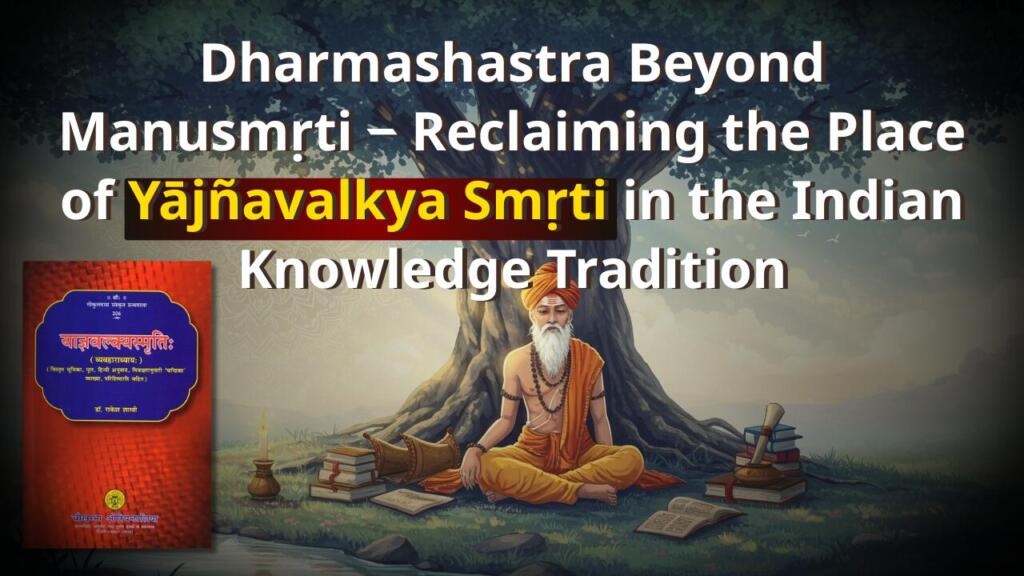
Yet, this overwhelming preoccupation with Manusmṛti has had an unintended and rather unfortunate consequence: the marginalization of the wider Dharmashastra corpus. The Indian intellectual tradition has never been monolithic; it has always thrived on diversity of opinion, multiple schools of thought, and dialogic contestation. Dharmashastra itself is not the voice of a single author or text, but an evolving tradition spanning centuries, enriched by numerous contributions. To confine it exclusively to Manusmṛti is, therefore, to misrepresent the very spirit of India’s legal-philosophical heritage. Among these neglected yet profoundly significant texts stands the Yājñavalkya Smṛti, a treatise that not only systematized the Dharmashastra tradition but also became the foundation of Hindu jurisprudence for over a millennium.
This raises a fundamental question: Why has Yājñavalkya Smṛti, despite its historical authority and intellectual sophistication, remained overshadowed by Manusmṛti in both popular imagination and academic discourse? Addressing this requires a careful comparative reflection between the two texts—not merely to assess their relative importance, but to understand how the reception of one became controversial while the other remained in relative obscurity, even though it arguably had a greater and more enduring influence on the evolution of Hindu law.
Manusmṛti: The Burden of Controversy
Manusmṛti, also known as the Mānava Dharmashāstra, is often introduced as the earliest and most comprehensive articulation of Hindu law. Its structure begins with a cosmogony, linking Dharma to divine origins, and proceeds to elaborate on the duties of individuals across varna (social classes) and āśrama (stages of life). Its prescriptions on marriage, inheritance, penance, governance, and punishment reveal a comprehensive vision of order. However, in its insistence on hierarchical social relations and gender roles, it has become the focal point of criticism in modern India. Thinkers like B.R. Ambedkar subjected it to searing critique, holding it responsible for legitimizing caste oppression. In the postcolonial period, social reform movements and intellectuals repeatedly projected Manusmṛti as a symbol of regressive tradition, turning it into a lightning rod for debates on caste, patriarchy, and modernity.
Thus, Manusmṛti today is rarely studied as a text in its own right. Instead, it is mobilized in polemical contexts, either by traditionalists who defend its authority or by reformists who condemn its relevance. In both cases, its significance has been overblown and distorted, leaving little space for acknowledging the wider Dharmashastra literature. This is where the silence around Yājñavalkya Smṛti becomes most striking.
Yājñavalkya Smṛti: The Silent Pillar of Hindu Jurisprudence
Composed several centuries after Manusmṛti—most scholars place Yājñavalkya Smṛti between the 3rd and 5th centuries CE—the Yājñavalkya Smṛti represents a more mature and refined stage of Dharmashastra literature. Unlike Manusmṛti, it dispenses with Pauraanik prefaces and begins directly with the sources of Dharma, reflecting a more pragmatic and legalistic orientation. Structured into three concise sections—Ācāra (conduct), Vyavahāra (legal procedure), and Prāyaścitta (penance)—the text achieves remarkable clarity and systematization.
Its most enduring influence, however, lies in the field of jurisprudence. Commentaries such as Vijnaneshwara’s Mitākṣarā and Jimutavahana’s Dayabhāga, both based on Yājñavalkya Smṛti, went on to shape Hindu law in medieval India. During the colonial period, when British administrators codified Hindu law, it was primarily these commentaries that were invoked—not Manusmṛti. Even in post-independence India, several aspects of personal law traditions bear traces of Yājñavalkya’s systematic jurisprudence.
Thus, while Manusmṛti has occupied the space of controversy, Yājñavalkya Smṛti has quietly shaped the actual practice of Hindu law for centuries. Its neglect in modern debates is therefore not a reflection of irrelevance but of overshadowing.
Comparative Reflections
When we place Manusmṛti and Yājñavalkya Smṛti side by side, several critical differences emerge that help explain their divergent fates in history and discourse.
The orientation of both these texts is different: Manusmṛti opens with cosmology and presents Dharma as a divinely ordained order. Its prescriptions are embedded in a mythic narrative, whereas Yājñavalkya Smṛti, in contrast, adopts a rational-legal approach. It begins with the sources of Dharma—Śruti, Smṛti, and Ācāra—offering a secular framework of authority without mythological scaffolding. At the same time the structure and clarity are also apart; Manusmṛti is expansive and discursive, often repetitive, and difficult to navigate; and Yājñavalkya Smṛti is concise and systematic, divided neatly into three sections that make it more accessible for legal reference.
In terms of social philosophy, Manusmṛti lays heavy emphasis on varna-dharma and social stratification, which later became its most controversial feature. While Yājñavalkya Smṛti does not reject varna, it places far greater emphasis on legal procedures, rights, and duties, thereby presenting a more balanced picture of social regulation.
Such differences have presented impacts which are poles apart; Manusmṛti became a symbol of authority, cited in political and religious discourses, but less influential in actual jurisprudence, it has been endlessly debated, politicized, and even burnt in protest. But Yājñavalkya Smṛti became the living foundation of Hindu law, shaping legal practice through the medieval and colonial periods. despite its enormous influence, Yājñavalkya Smṛti,has remained relatively absent from modern debates, quietly existing in the background of legal scholarship.
The comparison highlights an irony: the text that has dominated public imagination (Manusmṛti) is not the one that most influenced actual practice, while the text that structured Hindu law for centuries (Yājñavalkya Smṛti) remains largely unknown to the wider public. This inversion is a result of political mobilizations, colonial interpretations, and modern polemics that have foregrounded Manusmṛti while silencing its counterparts.
If Indian knowledge traditions are to be understood in their true spirit, it is essential that we move beyond this narrow focus. The Dharmashastra corpus is not a single book but a living tradition of debate, reinterpretation, and evolution. Acceptance and rejection were always part of its growth; plurality was its essence. By reclaiming texts like Yājñavalkya Smṛti, we can restore balance to our understanding of the tradition and appreciate its legal and ethical sophistication.
For the youth of India in particular, this wider engagement is crucial. To study Yājñavalkya Smṛti alongside Manusmṛti is not to replace one dogma with another, but to recognize the richness and diversity of the intellectual heritage they inherit. In doing so, they will see that India’s knowledge system is not a rigid imposition of rules, but an evolving dialogue where criticism, debate, and reform are central.
This piece is written by Prof. Vivek Misra, Dean of Social Sciences, Rani Durgawati University, Jabalpur, Madhya Pradesh.