
Rahul Gandhi and INDI bloc have been targeting Election Commission with Vote Theft allegations. To which the EC has responded by promptly requesting Congress Leader Jairam Ramesh for a face-to-face interaction at its headquarters. However, despite the clear invitation for the dialogue, Congress continued with their protest, blocked roads and marched a rally consisting of opposition MPs.
This raises certain questions. Does Congress party heed to spectacle over substance? Was the allegation on EC just for optics to create a space for western media to intervene and comment on the integrity of Indian Democracy? If Rahul Gandhi claimed that he has 100% proof of vote theft against the ruling government and EC was involved hands in glove, then why didn’t Congress step in for the confrontational interaction that it was invited for?
The ECI’s letter was unequivocal: a meeting scheduled, names and vehicle details requested due to limited space. It’s been made clear; this is not an institution ignoring opposition concerns, it is an independent constitutional body reaching out to hear grievances. Yet Congress’s response is defiance, not dialogue. Instead of utilizing this opportunity to raise their issues in a formal setting, they chose to mobilize a march that Delhi Police predictably blocked, resulting in detentions and theatrical confrontations.
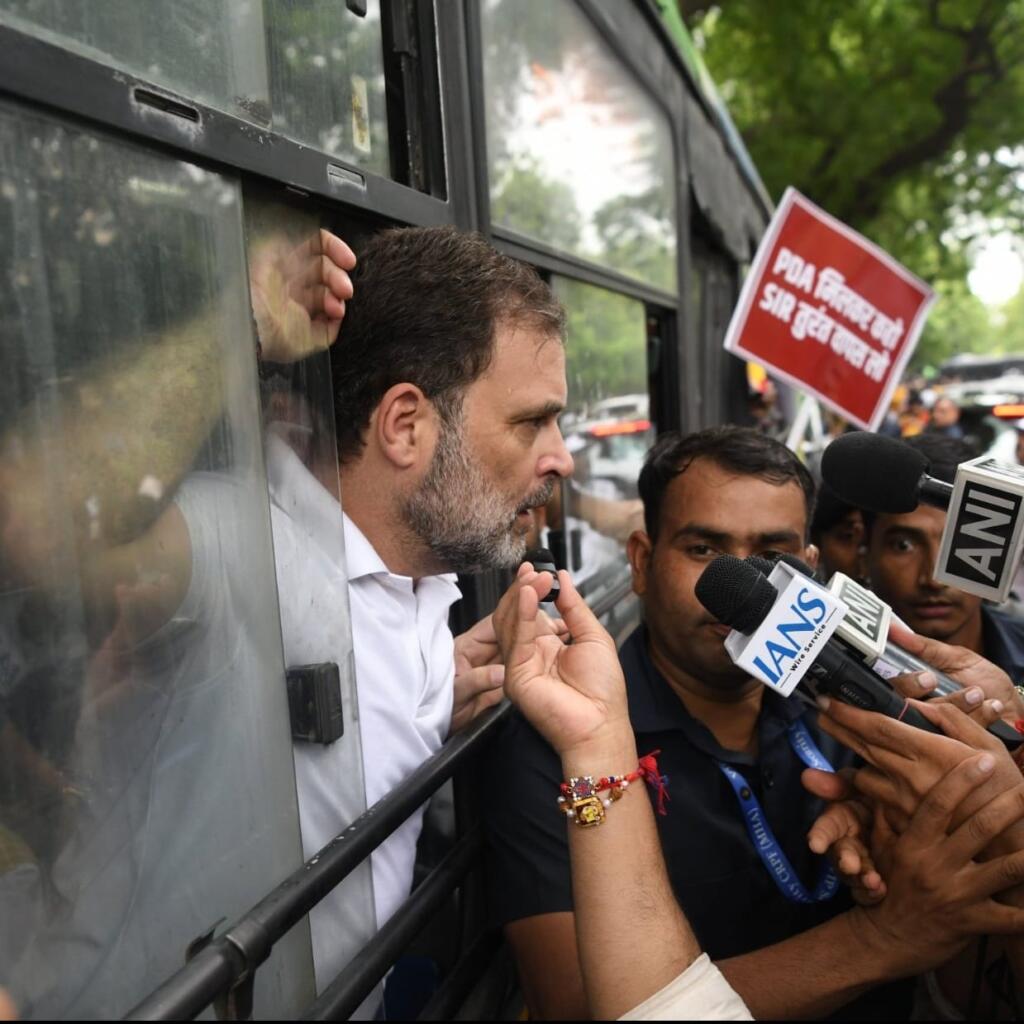
Rahul Detained, Akhilesh Jumps Barricade
Delhi Police detained several INDIA bloc MPs, including Lok Sabha Leader of Opposition Rahul Gandhi and Congress MP Priyanka Gandhi, for staging an unauthorized protest against the Special Intensive Revision (SIR) of electoral rolls in Bihar. The march, which started from Parliament’s Makar Dwar after the national anthem, was stopped outside the PTI building by heavy police barricades, preventing the MPs from reaching the Election Commission headquarters to submit a memorandum.
Despite the police blockade, women MPs like TMC’s Mahua Moitra and Congress’s Sanjana Jatav and Jothimani climbed barricades to raise slogans against the Election Commission, while many others sat on the road chanting slogans before being taken away in buses. Samajwadi Party chief Akhilesh Yadav symbolically defied the police by scaling the barricades, accusing authorities of using force to suppress their peaceful protest and demanding transparency in the voter roll revision ahead of Bihar’s assembly elections.
Protests or Theatrical Politics?
Why does Congress insist on protest when the ECI has invited them to talk? The answer lies in political strategy. Rahul Gandhi’s claims of “vote theft” in the 2024 Lok Sabha elections, especially the alleged manipulation in Karnataka’s Mahadevapura segment, are serious allegations that deserve scrutiny. However, Congress’s handling of the situation reeks of political grandstanding.
The Congress leadership repeatedly frames their protests as a fight to “save the Constitution” and secure “One Man, One Vote.” But if that were the case, wouldn’t they seize the opportunity to hold a substantive dialogue with the ECI instead of turning to the streets? The contradiction between claiming respect for democratic institutions and undermining them through disruptive protests is glaring.
The Election Commission’s role is clear to ensure free, fair, and transparent elections. It has not only invited Congress leaders for discussions but also demanded formal declarations from Rahul Gandhi regarding his allegations. Congress dismisses these reasonable procedural demands, insisting instead on public agitation.
State CEOs Challenge Voter Fraud Claims
The Chief Electoral Officers (CEOs) of Karnataka, Maharashtra, and Haryana have each issued separate notices to Rahul Gandhi, demanding that he substantiate his serious allegations of voter fraud in the 2024 Lok Sabha elections. Karnataka’s CEO specifically questioned Gandhi’s claim that voter Shakun Rani from the Mahadevapura assembly segment voted twice, pointing out that Rani herself has denied the allegation and that the documents Gandhi presented were not official polling officer records.
Meanwhile, the CEOs of Maharashtra and Haryana have also sent fresh letters asking Gandhi to furnish signed declarations along with particulars of electors he alleges were fraudulently added, giving him 10 days to provide the required evidence. These individual notices highlight the Election Commission’s insistence on formal, evidence-based complaints and due process before initiating detailed investigations.
The High Cost of Political Posturing
Congress’s decision to reject dialogue and opt for street protests risks turning a legitimate electoral grievance into a partisan spectacle. It undermines the very democratic process the party claims to defend and risks alienating a public weary of political theatrics. The question is: does Congress want answers or headlines?
The drama unfolding in Delhi is less about electoral reform and more about keeping Congress relevant in a rapidly shifting political landscape. The Election Commission has done its part by opening channels for engagement. It’s time for Congress to move beyond drama and into dialogue or risk being remembered not as defenders of democracy but as masters of political theatrics.