




















The issue of illegal immigration continues to be one of India’s biggest challenges in National Security, Humanitarian concerns and eventual demographic shifts. Millions of undocumented Bangladeshi and Rohingya migrants are living within India’s cities and border states, altering demographics, straining resources, and raising red flags for national security agencies.
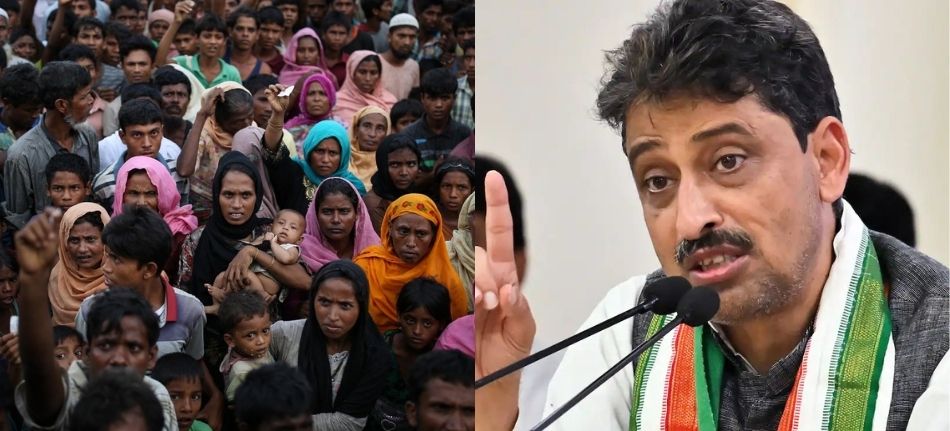
Recent remarks by a Congress MP Imran Masood, an advisor to Priyanka Gandhi Vadra arguing that “Bangladeshi-Rohingyas are poor, they shouldn’t be asked to go back” have reignited accusations of appeasement and “vote bank politics,” with the BJP hitting back, calling such statements dangerous for national security.
Scale of Illegal Immigration
Estimates of illegal Bangladeshi immigrants in India vary widely from 2 million to as high as 20 million. Assam alone is believed to host about 2 million migrants. The 2019 National Register of Citizens (NRC) in Assam identified nearly 1.9 million illegal immigrants, of which roughly 700,000 were Muslims.
Large metropolitan cities like Delhi, Mumbai, Bengaluru, Hyderabad are home to undocumented enclaves where migrants live with forged papers, making detection and deportation increasingly difficult.
The Rohingya refugee population, officially placed at 40,000 but unofficially estimated up to 75,000, has drawn sharp political divides. Security agencies have repeatedly flagged concerns over many holding fraudulent Aadhaar and voter IDs, raising alarms about infiltration into the electoral process.
The Union Home Ministry recently disclosed that 1,880 illegal immigrants were deported in just two months in 2025.
Congress’ Political Appeasement?
Congress leaders have often taken a softer line on the subject, citing humanitarian obligations. The latest remarks by a senior Congress MP underscore this view, drawing immediate fire from the BJP, which sees such statements as an open admission that the party seeks to shield undocumented migrants for electoral gain.
However, critics argue that this is not new. The Illegal Migrants (Determination by Tribunals) Act (IMDT), 1983, passed under Congress, made identification and deportation of illegal immigrants in Assam notoriously complex. In 2005, the Supreme Court struck it down as unconstitutional, observing that it endangered national security. Still, Congress leaders, including Sonia Gandhi at the time, resisted stronger enforcement measures, and even promised amendments to protect suspected illegal immigrants.
Statements from advisors linked to Priyanka Gandhi Vadra, defending illegal immigrants on humanitarian grounds, have only fueled BJP’s charge of “appeasement politics.”
National Security First
The BJP has consistently framed illegal immigration as a national security and demographic threat, not a humanitarian issue. Party leaders argue that undocumented inflows from Bangladesh and Myanmar distort population balances in sensitive border states, put pressure on scarce resources, and risk infiltration by extremist elements.
In Parliament, BJP leaders have accused Congress of maintaining “lenient and unstructured immigration laws” that encouraged unchecked entry. The Immigration and Foreigners Bill, 2025, currently under debate, epitomizes the sharp divide: the BJP pushing for tighter controls, while Congress continues to advocate softer handling, often invoking constitutional values and minority rights.
Illegal immigration has become more than a law-and-order problem; it is now one of the most polarizing issues in Indian politics. For the BJP and its allies, deportation and border enforcement are central to protecting sovereignty. For Congress and its ecosystem, humanitarian concerns and minority rights take precedence, though critics allege this position is rooted in vote bank calculations, not principle.
Illegal immigration in India is not just a border issue; it is a national security challenge with political overtones. While humanitarian concerns are real, critics argue that unchecked migration threatens sovereignty and social cohesion.