



















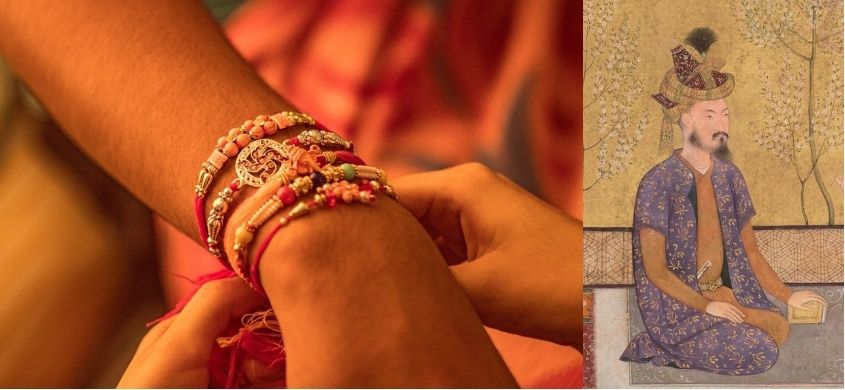
For years, the story that Rani Karnavati of Mewar sent a Rakhi to Mughal Emperor Humayun, pleading for protection against the invasion of Bahadur Shah, has been propagated as the origin of Raksha Bandhan. This tale, often parroted in popular culture is not only historically unaccounted and evidently baseless but also a glaring distortion of India’s proud and ancient cultural heritage.
It is high time this colonial-era myth is exposed for what it truly is: a fabricated narrative that undermines the deep-rooted Hindu traditions and the heroic sacrifices of our ancestors.
A Colonial Hangover
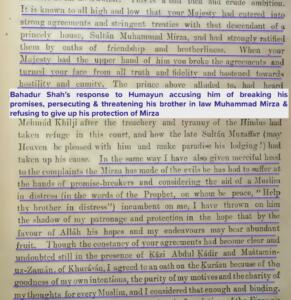
The so-called “Rakhi story” is a creation of 19th-century British colonial historian James Tod, who, while romanticizing Rajput valor, inserted Mughal rulers into a sanitized and chivalrous role that the actual historical records emphatically deny. The Mirat-i-Sikandari (1611 CE), a contemporary Islamic chronicle of Gujarat’s history, provides a brutally clear picture: Humayun was embroiled in a bitter conflict with Bahadur Shah because the latter harbored Humayun’s rebellious brother-in-law, Muhammad Zaman Mirza. Humayun’s priority was not to defend Karnavati or Chittor but to settle his personal and political scores.
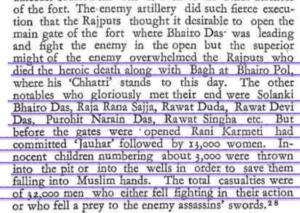
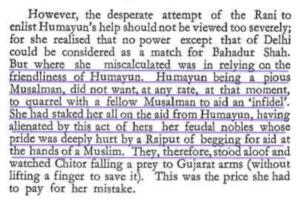
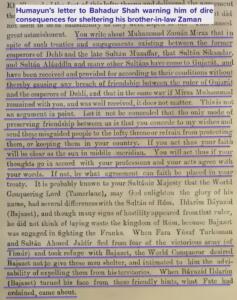
Bahadur Shah’s brutal attack led to the horrific Jauhar, where over 16,000 women and children immolated themselves to escape dishonor- an event commemorated for its valor and sacrifice, not one rescued by Mughal “brotherly concern.”
An Ancient Hindu Festival Hijacked by Myths
Raksha Bandhan is not a 16th-century invention linked to Mughals. It is an ancient Hindu festival with origins stretching back thousands of years, deeply entwined with Vedic rituals and Puranic legends. The Mahabharata tells us of Draupadi and Krishna, whose bond symbolized protection and devotion long before Mughal invasions. The tale goes that Draupadi tore a piece of her saree to bandage Lord Krishna’s injured finger. In return, Krishna promised to protect her, a vow he fulfilled during her disrobing by Kaurvas.
Vedic scriptures speak of the Raksha Sutra- sacred protective threads tied by priests for warriors and kings, echoing the spiritual essence of Raksha Bandhan. The festival’s timing on Shravan Purnima, its rituals of tying protective threads, and offerings to ancestors are clear markers of its pre-Islamic, pre-Mughal Hindu origin.
Reclaiming Our History
The persistence of the Humayun-Karnavati Rakhi myth is not accidental; it is a colonial hangover that continues to distort Indian history and culture. This narrative conveniently glorifies Mughal rulers while trivializing the sacrifices of Hindu warriors who gave their lives defending their land. It also feeds into a politically motivated rewriting of history under the guise of “secularism” or “syncretism,” often dismissing legitimate Hindu traditions as sectarian or regressive.
The Humayun-Rani Karnavati Rakhi story is a myth without foundation in authentic historical records. Humayun’s political struggles had nothing to do with protecting Chittor or its queen. The real story of Raksha Bandhan lies in India’s ancient Vedic and Puranic heritage, celebrating a timeless cultural ethos that has survived millennia.