
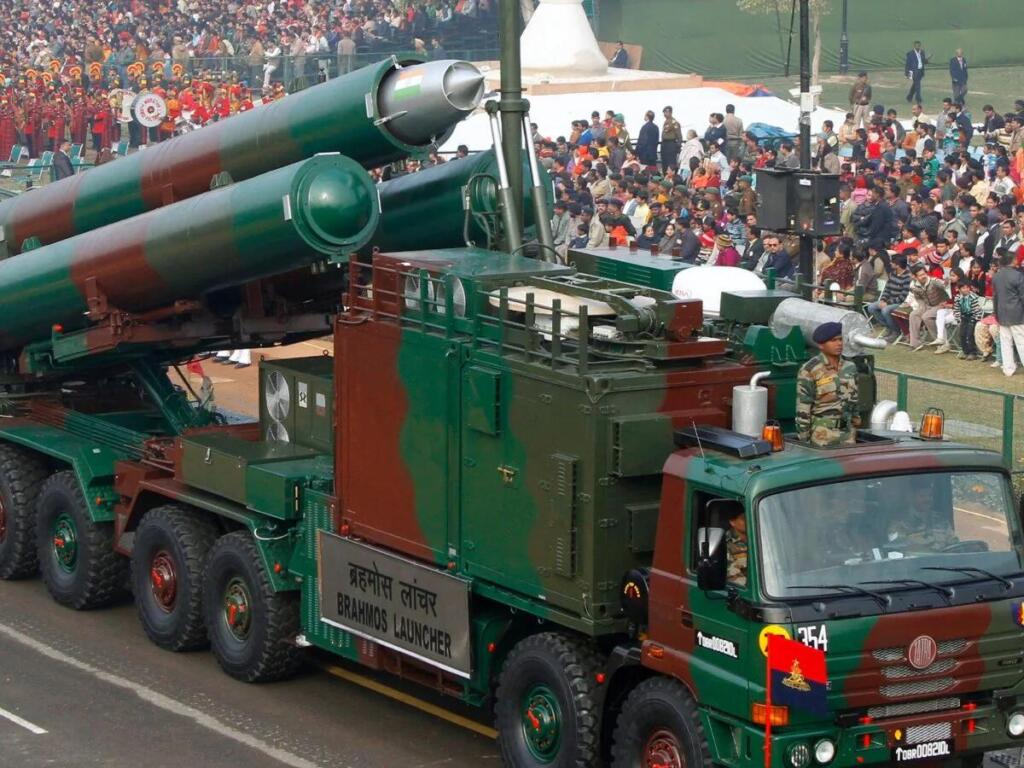
Operation Sindoor changed the game. Within days of precision strikes on terrorist targets in Pakistan and PoK, the Indian armed forces have set in motion a major scale-up of their missile strike capabilities. At the heart of this military upgrade is the BrahMos supersonic cruise missile a proven weapon of strategic value. Now, in a clear signal of readiness and deterrence, the Indian Air Force, and Navy are preparing for massive BrahMos missile procurement.
These aren’t routine acquisitions. They reflect lessons learnt in real-time combat and represent a technological pivot towards faster, smarter, and highly accurate firepower. From stealth capabilities to supersonic speed, BrahMos has emerged as a platform of choice. As the Indian defence ecosystem strengthens its edge across land, sea, and air, this missile is more than just a weapon. It’s a message. A message that India’s response, if provoked, will be sharp, swift, and decisive.
Mass Orders : Post Operation Sindoor
After the success of Operation Sindoor, India is significantly ramping up its missile capabilities with large-scale procurement of BrahMos missiles. Top defence sources indicate that a high-level meeting at the Ministry of Defence is expected to give the go-ahead for procurement of a fresh batch of BrahMos cruise missiles for all three services. The Navy is expected to deploy them across its Veer-class warships, while the Indian Air Force will enhance its Su-30MKI fleet with air-launched versions. This step follows the operational deployment of BrahMos during Operation Sindoor, where the missiles played a critical role in striking key Pakistani military infrastructure.
The decision to expand the BrahMos arsenal signals India’s strategic intent to reinforce deterrence and establish a rapid-response mechanism in future conflicts. The precision and impact demonstrated by BrahMos during the four-day conflict have made it a reliable frontline weapon for the Indian military.
Operation Sindoor: Tactical Success Leads to Strategic Reform
Operation Sindoor, carried out in early May following the Pahalgam terror attack, marked a turning point in India’s recent military history. The Indian armed forces conducted precision strikes targeting key terror training camps and military installations in Pakistan and Pakistan-occupied Kashmir. BrahMos cruise missiles were used extensively in the operation, hitting Pakistani air bases and army cantonments with accuracy and speed.
The operation was seen not just as retaliation but as a clear statement of India’s zero-tolerance policy towards terrorism. It also showcased the effectiveness of India’s indigenous weapon systems and the tactical coordination between the three branches of the armed forces. The success of these operations has driven the urgency for a full-scale induction of BrahMos across all deployment platforms.
A Technological Force Multiplier
Jointly developed by India’s DRDO and Russia’s NPO Mashinostroyenia, BrahMos is one of the fastest supersonic cruise missiles in the world. Capable of speeds up to Mach 3, it significantly reduces enemy reaction time, making it nearly impossible to intercept.
BrahMos is a two-stage missile, with a solid-fuel booster as its first stage and a liquid-fuelled ramjet engine in the second. It can be launched from land, sea, air, and potentially even submarines. With stealth features, GPS/GLONASS navigation, and fire-and-forget capability, BrahMos is ideal for precision strike missions.
Its sea-skimming trajectory enables it to avoid radar detection, and its ability to strike from multiple platforms makes it highly versatile in modern warfare scenarios. The standard version has a range of around 450 km, while extended-range variants under development may reach beyond 800 km.
Variants and Future Development
Several versions of the BrahMos have been developed to suit different operational needs:
- BrahMos-A: Air-launched version, successfully integrated with Su-30MKI fighters.
- BrahMos-ER: Extended-range variant.
- BrahMos-NG: Next-generation mini version for lighter aircraft and smaller launch platforms.
- BrahMos-II: Hypersonic variant under development, aiming for speeds above Mach 7.
These developments point towards a future where BrahMos variants will be standard in Indian defence doctrine. The missile’s evolution from a joint Indo-Russian venture to a symbol of India’s strategic autonomy is a milestone in indigenous capability.
BrahMos as a Strategic Deterrent
India’s mass orders for BrahMos missiles reflect a clear doctrine: deterrence through capability. With operational success in Operation Sindoor as the backdrop, the rapid scale-up in it’s deployment showcases India’s readiness for full-spectrum warfare. Whether on Veer-class warships, Sukhoi jets, or mobile launchers, BrahMos has now become a frontline asset for rapid, precision-based responses.
Beyond its battlefield role, the missile also represents a leap in defence indigenisation and joint military doctrine, proving that India can build, deploy, and dominate with its own systems. As the defence forces gear up for next-generation threats.