

The political storm intensified over allegations of voter list manipulation escalated on Thursday, when BJP leashed a scathing attack on Leader of Opposition Rahul Gandhi. The row stems from Mr. Gandhi’s explosive claims of large-scale irregularities in the voter rolls during the 2024 Lok Sabha elections in Karnataka’s Mahadevpura constituency, as well as his broader accusations against the Election Commission of India (EC).
BJP leaders, led by the party’s IT cell head Amit Malviya, dared Mr. Gandhi to submit the names of “ineligible electors” under a formal declaration, as prescribed in Rule 20(3)(b) of the Registration of Electors Rules, 1960. In a post on X (formerly Twitter), Mr. Malviya warned that Mr. Gandhi’s failure to file such a statement would reveal his allegations as hollow and politically motivated.
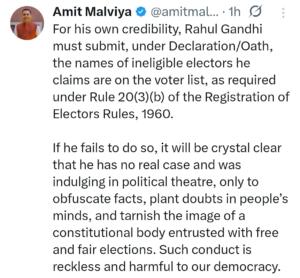

“For his own credibility, Rahul Gandhi must submit, under Declaration/Oath, the names of ineligible electors he claims are on the voter list,” Mr. Malviya asserted. “If he fails to do so, it will be crystal clear that he has no real case and was indulging in political theatre to obfuscate facts, plant doubts, and tarnish the image of a constitutional body entrusted with free and fair elections. Such conduct is reckless and harmful to our democracy.”
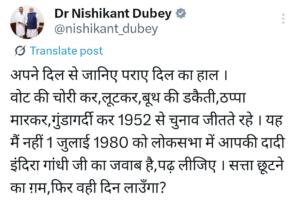
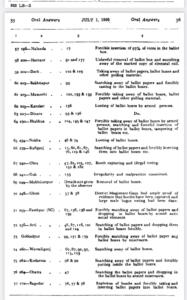
BJP MP Dr. Nishikant Dubey also joined the criticism, posting a sharp Hindi remark that accused the Congress of historically winning elections through manipulation, booth capturing, and intimidation, citing former Prime Minister Indira Gandhi’s remarks in Parliament on July 1, 1980. “This is not my statement; it’s what your grandmother said,” Mr. Dubey wrote, suggesting that the Congress’s frustration stemmed from losing power.


The confrontation between the Opposition and the poll body intensified earlier this week amid political opposition to the Special Intensive Revision (SIR) of electoral rolls in Bihar, a process the EC says is aimed at removing names of inactive and deceased voters. Mr. Gandhi alleged that the Karnataka case was part of a broader pattern of voter fraud that may have influenced electoral outcomes.
According to the Congress leader Rahul Gandhi, a private survey had uncovered six major irregularities in Karnataka’s voter rolls including duplication of names, the same voters listed across multiple states, fake addresses, hundreds of voters registered at a single address, poor-quality voter ID photographs, and misuse of Form 6 for registering first-time voters.
He further claimed that the Opposition’s sharp drop in Maharashtra’s performance between the Lok Sabha elections and the state polls from 30 parliamentary seats to under 50 assembly seats raised suspicion of manipulation.
Mr. Gandhi also accused the EC of preparing a “choreographed” election schedule to benefit the ruling BJP, evading questions from the Opposition, and refusing to provide digital copies of voter rolls. The EC responded with a strong public rebuttal, urging him to file a sworn complaint using a specific format it circulated.
At a dinner meeting on Wednesday evening, attended by around 50 leaders from 25 Opposition parties, Mr. Gandhi presented what he described as photographic evidence of “fake voters” in Mahadevpura. However, BJP leaders dismissed the claims as “baseless.”
Union Minister Pralhad Joshi argued that Mr. Gandhi’s allegations lacked seriousness, noting that the Congress leader had not filed any official petition. He also pointed out that Mr. Gandhi is a member of the three-person committee responsible for appointing Chief Election Commissioners, contrasting it with the Congress era when Prime Ministers directly appointed the EC chief.
“When Rajiv Gandhi was assassinated, they (Congress) could have postponed the election only in his constituency, but instead they postponed the election nationwide to gain sympathy votes,” Mr. Joshi said. “Those who have conducted elections in such a manner are now trying to give us lessons about democracy.”
The political clash shows no sign of abating, with the BJP maintaining that Mr. Gandhi’s credibility hinges on submitting the formal declaration of his findings and the Congress leader continuing to allege systemic voter fraud without, as yet, formally approaching the Election Commission under oath.