
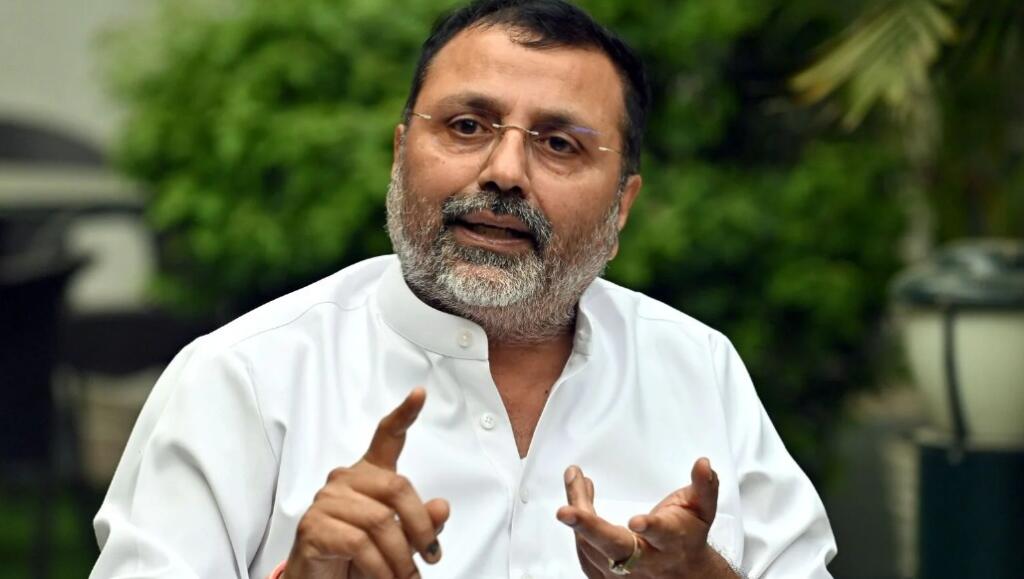
BJP MP Nishikant Dubey on Wednesday launched a sharp attack on the Congress party and accused it of electoral malpractice and collusion with illegal voters.
In a post on X, Dubey raised questions about the conduct of elections following the assassination of former Prime Minister Indira Gandhi in 1984 and made serious allegations about the integrity of the voter rolls during that period.
https://x.com/nishikant_dubey/status/1957972866047086981?t=Re7mfw_0ElVdwoJwx02Ctw&s=08
“Prime Minister Indira Gandhi was assassinated on 31 October 1984. The fire of the funeral pyre had not even cooled down when the Election Commission announced Lok Sabha elections on 13 November 1984. Were these hasty elections?” Dubey asked.
He went further, alleging that Indira Gandhi remained a registered voter even after her death—not only in 1984 but also in 1989.
Taking a swipe at Congress leader Rahul Gandhi, Dubey wrote, “Today Rahul Gandhi is preaching to the public about democracy, while his own party has been complicit in vote robbery and manipulation.”
He also accused the Congress of aligning with “Bangladeshi infiltrator Muslim voters,” a remark likely to spark political outrage and reignite the contentious debate around illegal immigration and voting rights.
The post is part of the BJP’s broader offensive against the Congress as the political climate heats up ahead of upcoming elections.
Earlier on Tuesday, Prime Minister Narendra Modi invoked a News18 report based on parliamentary archives to criticise former Prime Minister Jawaharlal Nehru’s handling of the Indus Waters Treaty (IWT), highlighting Nehru’s reluctance to consult Parliament before signing the landmark agreement with Pakistan in 1960.
According to the archival records, Nehru faced sharp questions in Parliament on November 30, 1960—just weeks after the treaty was signed in Karachi on September 19—without any prior discussion in the House.
The Parliament had been in session until September 9, yet members, including senior Congress leaders, were kept in the dark.
When pressed on the lack of transparency, Nehru offered a dismissive response.
“Should I bring a truckful of papers to the Parliament?” he asked, referring to the extensive documentation and correspondence over the 12 years leading up to the treaty.
“There must have been dozens of approaches, dozens of plans—many discussed, many rejected. Are we to come to Parliament at every stage and ask for approval?” Nehru remarked.
Criticism in the House focused on the lack of parliamentary oversight in what many MPs considered a decision of national significance.