
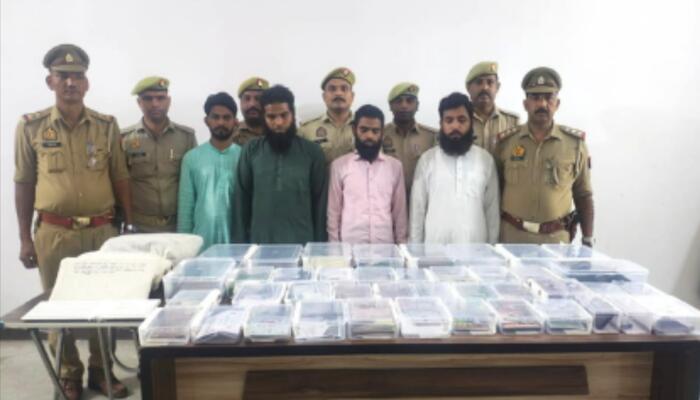
The investigation into the Bareilly religious conversion racket has revealed a far wider and more alarming conspiracy than initially suspected. Police sources now confirm that the gang, allegedly masterminded by Maulana Abdul Majeed, operated across 13 states in India, with more than 200 maulanas actively supporting the network. Foreign funding is strongly suspected, with unusually high-value financial transactions traced to those arrested.
A Multi-State Operation with Powerful Backing
The conversion racket first came under the spotlight when Bareilly police arrested Abdul Majeed (35) and three of his associates Salman Raza (30), Mohammad Arif (29), and Mohammad Faheem (24) on August 25. The arrests were made after a complaint by an Aligarh woman, Akhilesh Kumari, who alleged that her visually impaired son, Prabhat Upadhyay, was being forced to convert to Islam under the guise of marriage.
During a raid at Faiznagar madarsa, police found the four accused preparing for the boy’s circumcision ritual. Though the victim initially identified himself as “Hamid,” he later disclosed his real name and background. He was immediately rescued and reunited with his family.
Investigations have since revealed that the gang systematically targeted vulnerable individuals poor families, unmarried youth, and even disabled people—by offering marriage proposals, jobs, and money. Those lured were taken to madarsas, where they were brainwashed using religious texts, propaganda literature, and CDs of fugitive preacher Zakir Naik.
Suspected Foreign Funding and Financial Irregularities
The financial trail unearthed by the police indicates that the racket was backed by substantial foreign funding.
-
Abdul Majeed and his wife operated five bank accounts, with deposits exceeding ₹13.20 lakh far beyond their known sources of income.
-
Salman, a tailor by profession, shockingly managed 12 bank accounts, six of them in his wife’s name. The accounts saw transactions worth nearly ₹12 lakh, far higher than what his income justified.
-
Arif and Faheem were also found to be operating multiple accounts with suspicious activity.
Authorities believe hawala transactions could be involved, and intelligence agencies are now tracking possible overseas links. Call detail records (CDRs) of the accused show Majeed was in frequent contact with individuals in Telangana, Kerala, Andhra Pradesh, Tamil Nadu, Maharashtra, and Rajasthan, indicating a deeply spread-out network.
SP (South) Anshika Verma stated: “We are thoroughly scrutinising the bank accounts and call records. The hawala angle is being probed, and more arrests are likely.”
Propaganda, Radicalisation Material, and Pakistani Links
Police also seized religious conversion certificates, sharp blades, laptops, mobile phones, and CDs of Pakistani clerics during their raid. Particularly concerning was the discovery of video lectures of Zakir Naik, the controversial Islamist preacher who has been on the run for spreading radical ideology.
Officials suspect the gang was receiving ideological support and material from a larger network that promotes extremist agendas in India. This raises fears of foreign-backed attempts to destabilise Indian society by encouraging illegal religious conversions.
The gang also reportedly sheltered targeted families in their madarsa for several days before forcing conversions. One Hindu family from Subhashnagar, Bareilly, was kept at Abdul Majeed’s institution before being converted. The family is now living in the area under new Islamic names, and police are still trying to trace them.
How the Racket Expanded Across States
The conversion racket is believed to be the sixth such network busted in Uttar Pradesh this year, following similar cases in Balrampur, Agra, Prayagraj, Kushinagar, and Aligarh. Intelligence reports show that Abdul Majeed frequently travelled to different states, recruiting middlemen and creating local sleeper units to identify vulnerable targets.
One such accomplice, Mahboob Beg, considered the second most important figure in the network after Majeed, managed to escape when police raided his house in Izzatnagar. Beg allegedly acted as a coordinator, maintaining regular communication between Majeed and other gang members.
Salman, who worked as a tailor, and Faheem, a barber, played specific roles in identifying victims. Salman would approach Hindu households under the pretext of offering help, while Faheem often identified potential victims among his customers. Once marked, these individuals were pressured, indoctrinated, and then converted.
The racket’s well-structured methods and nationwide spread have alarmed security agencies, who are now tracing Abdul Majeed’s extensive travel history and contacts across the 13 states. While no evidence of foreign travel has surfaced yet, the possibility of overseas connections remains under active investigation.
A Larger Conspiracy Unfolding
The unmasking of Abdul Majeed’s gang has once again exposed the grave threat posed by organised religious conversion rackets operating in India. With a network spanning 13 states, links to more than 200 maulanas, suspicious funding patterns, and foreign propaganda material, this racket is not just a local crime it has the signs of a coordinated ideological campaign.
The targeting of vulnerable communities, especially disabled individuals and poor families, underlines the sinister intent of such operations. As investigators dig deeper into the financial and ideological dimensions, the case could open up a much larger conspiracy aimed at destabilising social harmony.
India has already witnessed a series of such rackets in recent years, and each bust highlights the need for stronger enforcement of the Prohibition of Unlawful Conversion laws, closer scrutiny of foreign funding channels, and proactive vigilance by both state and central agencies.
The Bareilly case is a reminder that illegal conversions are not isolated crimes but part of a larger design. A comprehensive crackdown on such networks is essential to protect vulnerable communities and maintain the country’s secular fabric.