
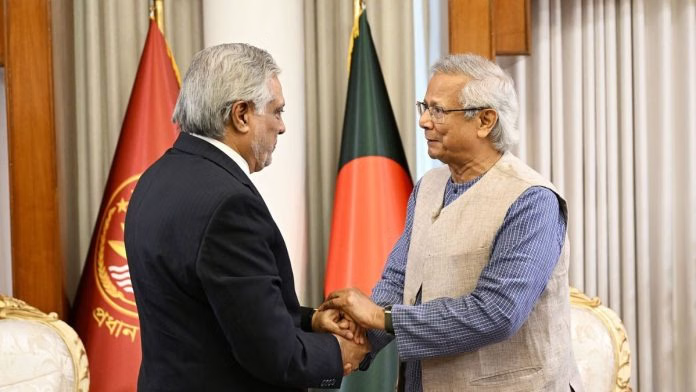
Bangladesh has once again raised its long-standing demand for an official apology from Pakistan over the atrocities committed during the 1971 Liberation War. The latest call came during the visit of Pakistan’s Deputy Prime Minister and Foreign Minister, Ishaq Dar, marking the most senior-level Pakistani visit to Dhaka since 2012. The visit, which initially began on a cordial note, soon ran into controversy as unresolved historical grievances resurfaced, casting a shadow on prospects of improved bilateral relations.
Bangladesh’s Firm Stand on Historical Wrongs
The Ministry of Foreign Affairs in Dhaka issued a strong statement during Dar’s visit, stressing that lingering issues from 1971 cannot be brushed aside. Bangladesh demanded a formal apology from Islamabad for what it termed a “genocide” carried out by the Pakistani military during the Liberation War. Alongside an apology, Bangladesh also pressed for resolution of matters such as the division of pre-1971 assets and the transfer of foreign aid meant for cyclone victims that allegedly never reached Dhaka.
Bangladesh emphasized that unless these historical issues are resolved, any attempt at building a forward-looking relationship will remain incomplete. Chief Adviser Muhammad Yunus further reinforced this demand publicly, pointing out that Pakistan’s unwillingness to acknowledge its past crimes continues to hinder true reconciliation.
Pakistan’s Silence and Political Undercurrents
However, Pakistan’s official response was notable for what it left unsaid. The statement released by Pakistan’s Foreign Office after Dar’s visit avoided any reference to the apology demand, shocking many in Dhaka. According to diplomatic sources, while initial meetings between Dar and Bangladeshi officials were warm, tensions escalated after Dar visited the residence of former prime minister Khaleda Zia, leader of the opposition Bangladesh Nationalist Party (BNP).
Dar’s subsequent interactions with leaders of the Jamaat-e-Islami a party that opposed Bangladesh’s independence in 1971 and sided with the Pakistani military deepened the controversy. For many in Bangladesh, Pakistan’s engagement with these political actors is seen as a reminder of the scars of 1971. Observers believe Yunus’ vocal demand for an apology is also linked to domestic political pressures, with the ruling dispensation keen on projecting itself as the guardian of Bangladesh’s national pride.
Mukti Bahini, Razakars, and Atrocities Against Hindus
The demand for an apology cannot be understood without recalling the horrors of 1971. When East Pakistan rose in rebellion demanding independence, the Pakistani military unleashed a brutal campaign of suppression. The Mukti Bahini, Bangladesh’s liberation forces, fought courageously against overwhelming odds, with support from India, ultimately leading to victory in December 1971.
During this conflict, the Razakars a local militia aligned with the Pakistani army committed some of the worst atrocities. Hindus, in particular, were targeted in systematic massacres, forced conversions, and widespread persecution. Villages were torched, women were subjected to mass rapes, and millions of refugees poured into India, seeking shelter from the carnage. International observers and historians have repeatedly described the campaign as genocidal in scale, with estimates of deaths ranging from 300,000 to 3 million. Pakistan’s apology will be a moral justice for the victims especially for the Hindu minority that bore the brunt of the atrocities.
Trials and the Strain on Bilateral Relations
The relationship between Bangladesh and Pakistan has remained strained for decades, largely because of the unresolved legacy of 1971. In 2010, under former Prime Minister Sheikh Hasina, Bangladesh initiated trials against collaborators who sided with the Pakistani military. Many Jamaat-e-Islami leaders were convicted and executed, a move that drew sharp criticism from Islamabad but was welcomed by large sections of Bangladeshi society as long-overdue justice.
These trials further strained ties, with Pakistan refusing to acknowledge the legitimacy of the judicial process. While occasional attempts at diplomatic thaw have taken place, including rare high-level meetings such as Dar’s recent visit, the core issues have remained unaddressed. The latest episode once again underscores how the past continues to dominate the present in Bangladesh-Pakistan relations.
The Shadow of 1971 Still Looms
More than five decades after the Liberation War, the wounds of 1971 continue to shape Bangladesh’s relations with Pakistan. Dhaka’s renewed demand for a formal apology reflects not only a desire for historical closure but also the political compulsions of its leadership. Pakistan’s refusal to address the issue, combined with its outreach to opposition forces linked with 1971 collaborators, has only deepened mistrust. Unless Pakistan confronts its past and issues a clear apology, the shadow of that bloody year will continue to loom over bilateral ties, preventing the two nations from moving forward on a path of genuine reconciliation.