
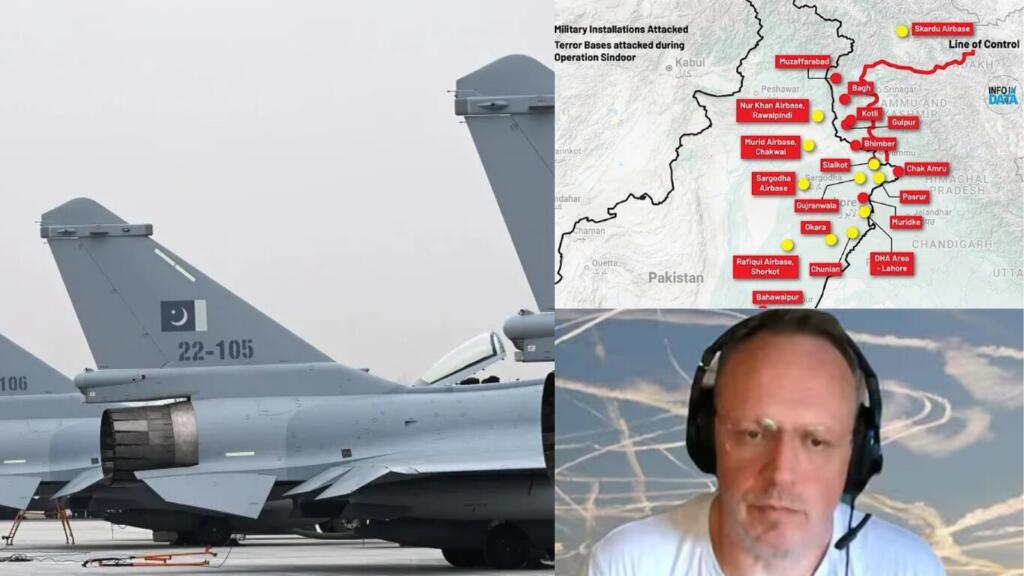
Austrian military aviation analyst Tom Cooper has backed the Indian Air Force’s (IAF) latest disclosure on the scale of Pakistani losses during Operation Sindoor, calling it a “nice confirmation” of what was already known to defence observers in May. Speaking to News Agency ANI, Cooper stated: “We have seen evidence of not only five, but even more Pakistan aircraft being shot down. We have seen evidence for even more Pakistani aircraft being destroyed on the ground. But there was no official confirmation from the Indian Air Force, not even from the Government of India. Therefore, this is a nice confirmation for something that was assessed as a matter of fact already back in May.”
Cooper, who has tracked South Asian military aviation for decades, said that the Indian strike set a record for range, calling it “a major tactical, operational, and strategic achievement.” He noted that the 300-km Airborne Early Warning and Control (AEW&C) kill by India’s S-400 system is the longest-range confirmed surface-to-air missile (SAM) strike of its kind.
Operation Sindoor: Official IAF Confirmation
The confirmation first came from Air Chief Marshal Amar Preet Singh during the 16th Air Chief Marshal LM Katre Memorial Lecture in Bengaluru. He revealed that between May 7 and 10, 2025, India’s S-400 Triumf air defence system destroyed five Pakistani fighter jets and one large AEW&C aircraft in the aftermath of the April 22 Pahalgam terror attack, which killed 26 civilians.
“This was the largest ever recorded surface-to-air kill,” Singh said, adding that the S-400’s 40N6 missile, with a 380-km reach, kept Pakistani aircraft outside their weapons’ release range.
The AEW&C likely a Saab 2000 Erieye was struck inside its hangar at Bholari Airbase. Singh also confirmed that F-16s were damaged at Shahbaz Airbase in Jacobabad. The targeting demonstrated the IAF’s ability to hit both in the air and on the ground with precision.
Targets and Damage Inside Pakistan
Along with the six confirmed aerial kills, the IAF’s strikes damaged and destroyed:
-
Two command and control centres at Murid and Chaklala.
-
Six radar installations across Pakistani territory.
-
Critical infrastructure at Sargodha, Rahim Yar Khan, Sukkur, and Bholari airbases.
Recovered debris from Pakistani drones and munitions is currently being analysed by the Defence Research and Development Organisation (DRDO) and the IAF to map Pakistan’s missile and drone capabilities.
According to Singh, the S-400’s long-range deterrence prevented Pakistan from deploying its long-range glide bombs, since the aircraft carrying them could not penetrate Indian air defences without being at risk of destruction.
Why the AEW&C Kill Matters
The AEW&C aircraft plays a critical role in Pakistan’s air combat operations coordinating fighter movements, detecting incoming threats, and managing airspace. Neutralising it effectively blinded Pakistan’s networked air defence, forcing them into a reactive posture.
Cooper described this as a “range-wise historic achievement,” noting that such kills are extremely rare in modern warfare. The strike was executed from so close to the Pakistan border that the S-400 battery itself was within range of Pakistani artillery a deliberate but calculated risk by the IAF to ensure full target coverage.
This elimination of Pakistan’s airborne battle management capabilities early in the operation shaped the rest of the engagement, with Pakistani fighter sorties decreasing significantly once the AEW&C was out of action.
Operation Sindoor: Timeline and Context
Operation Sindoor was initiated after the Pahalgam terror attack, which India traced to Pakistan-based terror outfits. The mission was conducted between May 7 and 10, 2025, and was the first major operational use of the S-400 system by India.
Key elements of the operation:
-
Engagements began with long-range missile strikes on airborne targets.
-
Follow-up strikes targeted ground-based radars and C2 nodes to degrade Pakistani response capacity.
-
High-value assets were struck on the ground, including hangars and fuel storage at key airbases.
The scale of the operation, combined with its precision and lack of own-force losses, has already made it a case study in modern integrated air defence operations.
Cooper’s Assessment on Washington’s Stance
In his comments, Cooper also criticised the United States for what he called a “short memory” regarding Pakistan’s history with terrorism and nuclear proliferation.
“The USA, just like all the rest, remembers like a fish in regards to Pakistan’s involvement in terrorism and Pakistan’s involvement in distributing nuclear-related technology to many rogue nations. Pakistan is running a jihad import-export business,” Cooper said.
He linked recent U.S. diplomatic moves to superficial gestures from Pakistan aimed at currying favour with Washington, rather than any real policy change.
Strategic Message Sent
The confirmation of Pakistani losses during Operation Sindoor is more than just a tally of destroyed assets it sends a message about India’s evolving air defence capabilities and its willingness to use them decisively.
By integrating long-range SAM systems like the S-400 into a broader operational plan, the IAF demonstrated it can shape the air battle well beyond its borders, deny the enemy critical airborne assets, and neutralise command and control networks in the opening phase of combat.
The operation also underscored the vulnerability of high-value air assets, even when stationed deep inside enemy territory, to modern precision strike systems. For Pakistan, the loss of multiple fighters and an AEW&C in such a short time represents a significant degradation in both capability and morale.
From Cooper’s perspective, the events of May 2025 have already been analysed and understood by defence experts the IAF’s official confirmation simply closes the loop.