
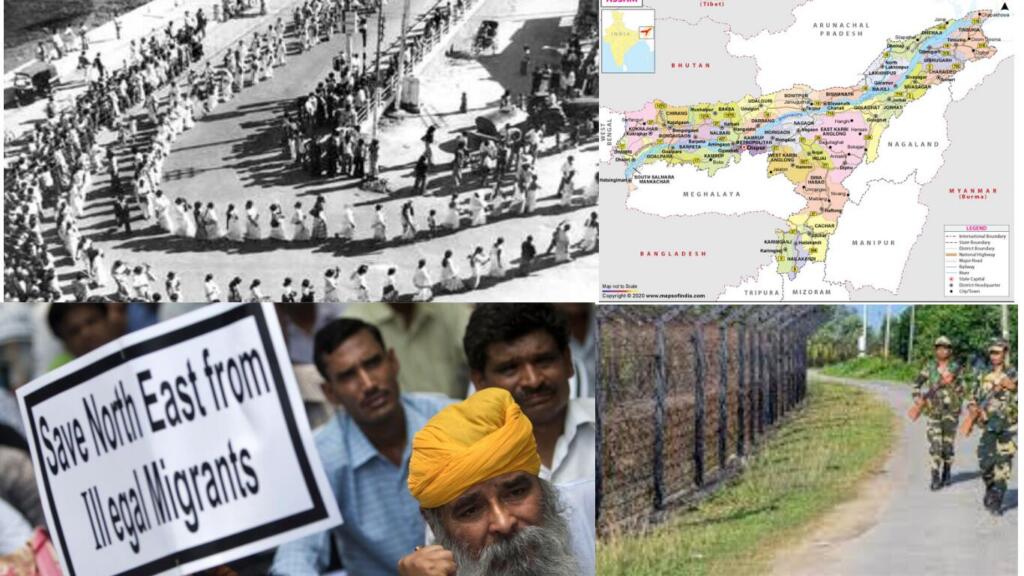
The roots of infiltration into Assam go back not to 1971, not even to Partition, but to the British colonial period. After the Treaty of Yandabo in 1826, Assam came under British control. At that time, the Brahmaputra Valley was thinly populated, with vast tracts of fertile land lying fallow. The British, hungry for revenue, saw Assam as a potential rice bowl. To exploit this, they actively encouraged Bengali Hindus and Muslims from what is today Bangladesh to migrate into Assam.
The British also imported tea plantation labourers from central India, as well as agricultural workers from Bengal. This initial influx sowed the seeds of a demographic transformation. What began as colonial policy later grew into a full-blown political crisis.
By the early 20th century, the problem of “outsiders” was already visible. The Line System was introduced in 1920 to restrict immigrants from encroaching on tribal lands. Yet, migration continued. The first alarms were sounded by Assamese as early as the 1930s, warning that unchecked settlement could one day reduce indigenous Assamese to a minority.
Indira Gandhi’s Acknowledgement: Infiltrators Are a Problem
Fast forward to post-Independence India. Partition in 1947 triggered mass migration, with many Hindus entering Assam as refugees, but the movement of Muslims also continued, especially from East Pakistan (now Bangladesh).
By the late 1960s, even the Congress leadership under Prime Minister Indira Gandhi was forced to acknowledge the seriousness of the issue. In 1971, during the Bangladesh Liberation War, nearly 10 million refugees fled to India, many entering Assam and Tripura. While some returned after Bangladesh’s independence, a huge number stayed back permanently.
In a letter to the Chief Ministers in 1983, Indira Gandhi herself admitted that infiltration from Bangladesh was a “serious problem”. She recognized that Assam’s demography was under strain, and her government even passed the Illegal Migrants (Determination by Tribunals) Act, 1983 (IMDT Act). But far from solving the problem, the Act made it nearly impossible to deport illegal migrants, since the burden of proof was placed on the complainant rather than the accused infiltrator. This disastrous law protected infiltrators rather than Assamese citizens.
Rajiv Gandhi, the Assam Accord, and the NRC
By the late 1970s, the people of Assam had risen in revolt. The Assam Agitation (1979–1985), led by the All Assam Students’ Union (AASU), became one of the largest mass movements in post-Independence India. The demand was clear: detect, delete, and deport illegal immigrants.
The agitation ended with the Assam Accord of 1985, signed by Prime Minister Rajiv Gandhi. One of its key provisions was updating the National Register of Citizens (NRC) to identify illegal migrants. The cut-off date for citizenship was fixed as March 24, 1971. Anyone who entered Assam after that date was to be considered an illegal immigrant.
However, successive Congress governments dragged their feet. For decades, the NRC remained on paper. Only after the Supreme Court, in 2014, directed the exercise under monitoring, did the process actually begin. In 2018, the final NRC draft was published, excluding 1.9 million people, many of whom remain in legal limbo today.
Appeasement Politics: Why No Action Was Taken
Why did successive governments fail to act on a problem acknowledged by both Indira and Rajiv Gandhi? The answer lies in vote-bank politics.
The Congress, Left parties, and later the Trinamool Congress treated infiltrators as a vote bank. The IMDT Act of 1983 was one such appeasement tool. Despite the Supreme Court striking it down in 2005 as unconstitutional, the damage had already been done.
Even leaders like Mamata Banerjee once admitted in 2005 that infiltration in Bengal was a “disaster” and threatened to resign over it. Yet, once in power, she opposed the NRC, preferring to retain infiltrators as potential voters.
The BJP, under Prime Minister Narendra Modi, has been the only party to push for a nationwide NRC and Citizenship Amendment Act (CAA). Yet, opposition parties consistently resist such moves, branding them “anti-minority.” This selective politics has left Assam to fend for itself.
The Changing Demography of Assam
The fears of Assamese nationalists have now materialized. Assam’s demography has undergone a dramatic shift.
- According to the 2011 Census, Muslims comprised 34% of Assam’s population. By 2024, Chief Minister Himanta Biswa Sarma warned that the figure had risen to 41%, while Hindus had fallen to 57%.
- Sarma said Hindus were already a minority in 12–13 districts.
- In districts like Dhubri, Goalpara, and Barpeta, Muslims already form the overwhelming majority.
This is not natural demographic change but the result of decades of unchecked infiltration. The cultural, linguistic, and political balance of Assam has been disrupted, pushing Assamese identity to the brink.
National Security at Stake: The Wider Impact of Infiltration
The issue of infiltration is not just cultural it is strategic. Assam and Tripura share over 1,100 km of border with Bangladesh, much of it still porous. Former CBI Director Joginder Singh once estimated that five crore Bangladeshis were living in India.
This demographic shift has multiple consequences:
- Economic Impact: Infiltrators compete with locals for land, jobs, and resources.
- Cultural Erosion: Assamese language and traditions face marginalization in migrant-dominated areas.
- Religious Shift: Assam’s changing religious demography is leading to fears of communal imbalance.
- Political Power: Illegal migrants, once naturalized or included in voter rolls, tilt electoral outcomes.
This is why Sarma warns that Assam’s identity is “on the brink of extinction.”
Why NRC and CAA Are Essential
The NRC in Assam, was a step toward identifying illegal immigrants. Prime Minister Narendra Modi in 2019 rightly pointed out that the NRC was the result of Congress’s own Assam Accord. Yet today, the same Congress opposes the exercise.
The Citizenship Amendment Act (CAA) further attempts to protect persecuted Hindus, Sikhs, Christians, Buddhists, Jains, and Parsis from Bangladesh, Pakistan, and Afghanistan. But it is opposed by parties that continue to blur the line between refugees and infiltrators.
As Chief Minister Sarma said, Assam’s future is at stake. Without firm measures like NRC, CAA, border fencing, and deportation policies, the Assamese identity risks being drowned out forever.
The Fight for Assam’s Future
The story of Assam is not just about migration it is about the survival of a civilization. From British colonial policies to Partition, from Indira Gandhi’s warnings to Rajiv Gandhi’s Assam Accord, the problem of infiltration has been acknowledged but never solved. Political appeasement, Congress hypocrisy, and the silence of so-called secular intellectuals like Syeda Hameed have allowed Assam’s demography to tilt dangerously.
Today, Hindus are reduced to a minority in several districts, and Assamese culture itself faces extinction. This is not alarmism it is a reality borne out by census data and political developments.
But as Sarma reminds us, Assam is also the land of Lachit Barphukan, the legendary Ahom general who resisted Mughal domination. The Assamese people will not surrender their land, their identity, or their culture.
India must stand with Assam in this battle not just for the state, but for the unity and integrity of the nation. Infiltration is not just Assam’s problem; it is India’s problem. And if ignored, it will one day become India’s tragedy.