
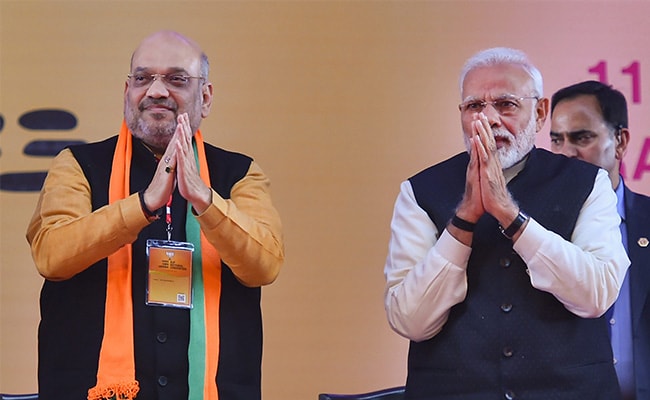
Union Home Minister Amit Shah has officially become the longest-serving Home Minister in India’s history, completing 2,258 days in office and surpassing the record previously held by BJP stalwart Lal Krishna Advani. This milestone, today on August 5, holds added historical resonance for exactly six years ago Shah spearheaded the abrogation of Article 370, a move that transformed the constitutional landscape of Jammu and Kashmir and etched his name into the records of Indian political history.
The occasion was acknowledged at the National Democratic Alliance (NDA) Parliamentary Party meeting held on Tuesday at the Parliament Library Building, amid a continuing deadlock in the Monsoon Session. Prime Minister Narendra Modi praised Shah for his leadership, commitment to national integration, and bold policymaking, noting the symbolism and significance of this date; both in Shah’s personal political journey and the broader ideological narrative of the BJP.
Six Years of Transformational Leadership
Appointed as Union Home Minister in May 2019, Shah’s tenure has been marked by some of the most consequential decisions in modern Indian governance. His very first year in the role saw the historic revocation of Article 370 on August 5, 2019, scrapping Jammu and Kashmir’s special constitutional status and bifurcating the state into two Union Territories: Jammu & Kashmir and Ladakh.
The move fulfilled a long-standing ideological goal of the BJP and its forerunner, the Jana Sangh; a vision held dearly by figures like Syama Prasad Mookerjee, L.K. Advani, and now implemented under Shah’s stewardship. On that day in 2019, Advani, Shah’s political mentor, had hailed the move as a ‘bold step towards strengthening national integration.’
Now, six years later to the day, Shah has surpassed Advani’s own record, a symbolic passing of the baton, as he not only upheld but fulfilled the ideological legacy of the party.
From Gandhinagar to North Block
Amit Shah took over the Gandhinagar Lok Sabha seat in 2019, a constituency held by Advani for over two decades. Since then, he has emerged not just as the BJP’s chief political strategist, but also as a formidable force in internal security, policy-making, and legislative overhaul.
Under Shah’s leadership, the Ministry of Home Affairs has seen sweeping changes. From combating left-wing extremism to tackling terrorism in Jammu and Kashmir, Shah’s policies have had measurable impact:
Terror-related deaths in J&K declined by over 70%.
Naxal-related incidents dropped significantly, with deaths falling from 5,225 (2009–2014) to under 600 (2019–2024).
Casualties among security forces due to left-wing extremism declined by 56%.
Shah has also been a key force behind India’s push for internal legal reforms. In 2023, he piloted a complete overhaul of India’s criminal justice system, replacing colonial-era laws with:
Bharatiya Nyaya Sanhita (BNS) – replacing the Indian Penal Code.
Bharatiya Nagarik Suraksha Sanhita (BNSS) – replacing the Code of Criminal Procedure.
Bharatiya Sakshya Adhiniyam (BSA) – replacing the Indian Evidence Act.
These laws reflect Shah’s emphasis on modernization, efficiency, and a break from colonial legacy; part of a broader vision to align the justice system with a modern democratic India.
Nationalist Vision of Shah
Shah’s imprint on India’s legislative landscape also includes the Citizenship Amendment Act (CAA) 2019, which fast-tracked Indian citizenship for persecuted minorities from Pakistan, Afghanistan, and Bangladesh. His backing of the abolition of Triple Talaq, initiation of a Uniform Civil Code, and firm stance on internal security have cemented his role as not just a political heavyweight but a principal architect of BJP’s nationalistic and reformist agenda.
During his tenure, the Home Ministry also invested over ₹8,200 crore in modernising policing and internal security infrastructure, particularly in technology, surveillance, and digital forensics.
A Political Journey Etched in History
Before his current role, Shah served as the BJP’s national president, overseeing the party’s unprecedented electoral expansion across India, especially in the Northeast, with victories in Assam and Tripura, and the historic return to power in Uttar Pradesh after 15 years in 2017.
His transformation from party strategist to Union Home Minister has been seamless, with each step solidifying his place as one of the most influential leaders in the BJP’s modern era.
On August 5, 2025, as Amit Shah becomes the longest-serving Home Minister, overtaking Advani’s 2,256-day record and leaving behind historical figures like Govind Ballabh Pant (over six years) and Sardar Vallabhbhai Patel (1,218 days), it is not just a personal triumph but a testament to a political career defined by ideological clarity and institutional change.
As India looks ahead, Shah’s tenure is certain to be remembered as one of the most transformative in the history of the Ministry of Home Affairs, one that has shaped the nation’s internal security, legal framework, and political direction for years to come.